AI Ecommerce PDP Imagery: The Operator's Playbook for 2026
Mango and ASOS now ship AI-generated visuals as primary product page imagery, and mid-market retailers are following fast. The question isn't whether to adopt, but which SKUs, which workflow, and which guardrails keep return rates from creeping up. Absolutely AI works with ecommerce teams navigating exactly this shift, and this piece is the triage and governance framework we hand operators.

The debate about AI on the product detail page ended quietly in 2025. Mango launched full campaigns with AI models. ASOS reported a 65% reduction in production costs after moving portions of its catalogue to AI-generated imagery, with less than a 3% quality-parity gap flagged by internal review. For ecommerce leads reading this in 2026, the strategic question has shifted from 'should we' to 'which SKUs go first, what does the QA gate look like, and how do we prove it in the return-rate data?' That is a very different conversation, and it needs a different kind of guide than the tool roundups currently dominating search results. This is the framework we use with retail clients at Absolutely AI.
What counts as PDP imagery in 2026
Before triaging anything, it helps to be precise about the shot set a modern PDP actually needs. Shopper expectations have hardened around a consistent grammar: a hero front shot, a back view, at least one side angle, a 360 spin or interactive rotation, one or two macro details showing texture or trim, a flat lay or ghost shot, an on-model lifestyle image in a plausible use context, and a scale reference. Miss any of these and you leak conversions to competitors who don't.
AI-generated imagery now meets or beats studio output on several of these shot types, particularly flat lays, ghost shots, lifestyle backgrounds, and colourway variants where the reference garment already exists. It still trails traditional capture on macro detail, complex fabric drape, and hand-held close-ups. Understanding which cells of the shot-set grid AI can safely fill is the foundation of any sensible rollout, and it is the reason our AI product photography workflow is organised around shot type rather than SKU count.
Where AI actually wins on the PDP
Four wins are now well-documented enough to plan against. First, cost: ASOS's cited 65% reduction and Stylitics's frequently referenced 90% shoot-cost saving on styled looks are directional, not universal, but the economics are real for any catalogue over roughly 500 active SKUs. Second, speed: long-tail variants that previously waited weeks for a studio slot can launch on the same day the tech pack lands. Third, on-model diversity: a single garment can be rendered across body types, ethnicities, and age ranges without additional shoot days, which matters both commercially and for representation commitments. Fourth, early conversion-lift signals: virtual-studio vendors cite ~19% uplift on PDPs that added AI-generated lifestyle context, though these numbers should be treated as vendor-reported until you replicate them in your own A/B environment.
The compounding win, which rarely gets discussed, is catalogue completeness. Retailers historically shipped SKUs with only a hero and a back shot because studio budget didn't stretch to the full grammar. AI closes that gap cheaply, and shoppers reward completeness with lower bounce rates. Our breakdown of AI product imagery at scale covers the throughput mechanics in more depth.

Where AI still loses
The honest counter-list matters more than the wins, because this is where return rates get made. Fabric drape on silk, chiffon, and heavy knits still trips diffusion models: the fall looks plausible in a thumbnail and wrong at zoom. Jewellery caustics and gemstone refraction remain unreliable and often produce sparkle patterns that don't correspond to any real physics. Hand and finger anatomy has improved dramatically but still fails at roughly 5 to 8% of generations, which is fine for a moodboard and unacceptable for a live PDP.
The commercial risk sits in proportions. If an AI-rendered garment sits 4% longer on a virtual model than the real product does on a real shopper, return rates climb, and the cost saving evaporates inside a quarter. This is why the triage framework in the next section refuses to send any garment with complex drape or fitted tailoring into an AI-first workflow without a real reference shot anchoring it, a principle we also apply on our AI branding engagements.
A four-tier SKU triage
Rather than debate philosophy, put every SKU in one of four buckets before generation touches your pipeline. This is the single most important decision in the rollout.
| Tier | SKU type | Workflow | AI role |
|---|---|---|---|
| 1. Flagship / hero | Campaign heroes, launch pieces, high-consideration items over roughly $200 | Full studio capture | None on primary imagery; AI only for social crops and secondary contexts |
| 2. Seasonal drop | New-season core range, mid-tier price points | Hybrid: real hero + AI-extended shot set | Generate flat lays, alt colourways, lifestyle backgrounds from real reference |
| 3. Long-tail variants | Deep catalogue, low-volume SKUs, replenishment lines | AI-first with human QA gate | Generate full shot set from tech pack + one reference; human sign-off before sync |
| 4. Colourway / size swaps | Same silhouette, different colour or fit | AI generative fill only | Recolour or resize existing hero; no net-new generation |
The discipline this table imposes is that no SKU escapes classification. A merchandiser who wants to escalate a Tier 3 item to Tier 2 needs to justify the studio spend against forecast volume. A finance lead who wants to demote a Tier 1 hero needs to accept the return-rate risk. The framework is boring on purpose: it converts a subjective quality debate into an inventory decision. Teams running this triage on large ecommerce catalogues tend to land at roughly 15% Tier 1, 30% Tier 2, 45% Tier 3, and 10% Tier 4 within two seasons.
The generation stack
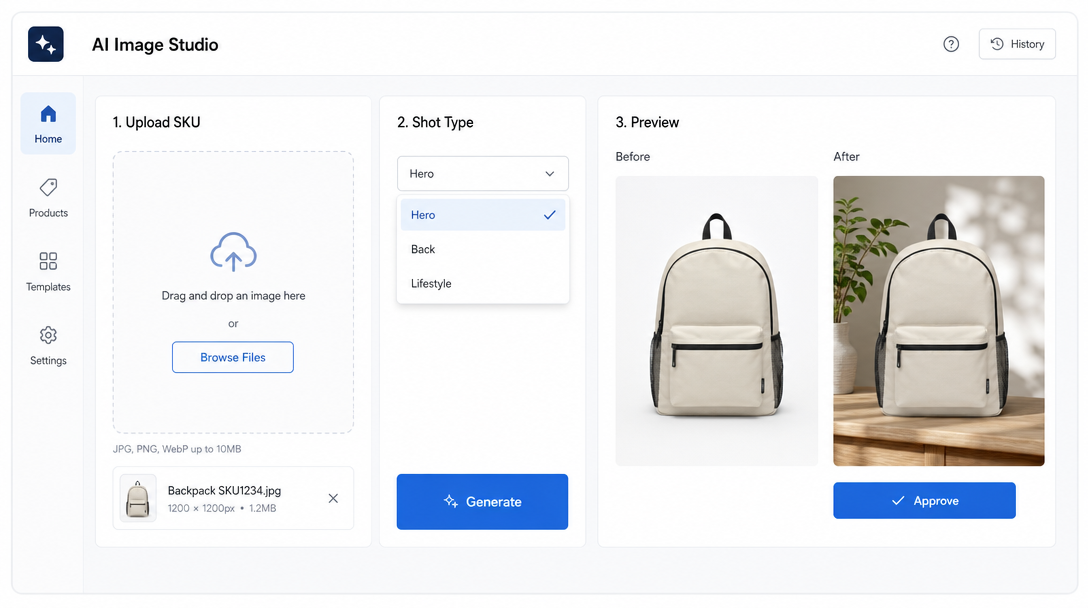
The tooling market is crowded and consolidating. For reference-anchored diffusion, the practical shortlist as of early 2026 is Claid.ai, Pixofix, Ecomtent, Piccopilot, Bandy, and Shopix, alongside custom internal pipelines for teams that want workflow control rather than a SaaS product. For background removal and relight passes, most of the above ship native tooling, and the standalone options remain viable. For on-model and pose generation, Stylitics and Metamodels dominate the fashion vertical.
The choice matters less than the integration. What kills adoption isn't tool selection: it is the manual handoff between generation, QA, DAM, and PIM. A stack that generates ten thousand images a week is worthless if the merchandising team has to hand-approve each one through a folder-based workflow. Bake the approval gate into the generation tool or the DAM, not a spreadsheet, and consider whether an automation layer should sit between generation and Shopify or CommerceTools sync.
Brand consistency guardrails
The guardrails are what separate a catalogue that looks coherent from one that looks like a stock-image dump. Four controls do the heavy lifting.
- Locked prompt frames. Every generation for a given brand pulls from a fixed prompt scaffold covering lighting direction, backdrop, camera angle, and model styling. Only the garment variables change.
- HEX-pinned palette. Backgrounds and props reference specific brand HEX values, not descriptive colour names. 'Warm neutral' produces drift; #F4EDE4 does not.
- Tech-pack cross-check. Automated comparison of the generated garment against the tech pack for colour, trim placement, button count, seam lines, and stitching. This is where most in-market tools are weakest and where custom pipelines earn their keep.
- Human-in-the-loop approval gate. A merchandiser signs off before anything syncs to Shopify, Salesforce Commerce Cloud, or CommerceTools. The gate should take under 30 seconds per image; if it takes longer, your generation quality isn't ready for the tier you've put the SKU in.
Measuring it honestly
Vendors sell conversion lift. Operators measure four things. PDP-level conversion rate is the headline metric, ideally split-tested against the previous studio-shot version. Add-to-cart rate catches shoppers who reach the page but bounce, which is often where subtle image issues show up first. Return-rate delta, measured against a matched cohort of studio-shot SKUs, is the metric that will kill your programme if you ignore it. Image-quality parity, the score ASOS keeps under 3%, is best measured through blind reviewer panels rather than internal team assessment.
Publish these numbers internally every fortnight. Retailers who run a public dashboard get honest conversations about where the programme is working and where a Tier 3 SKU needs to be pulled back to Tier 2. Retailers who don't measure end up with quiet return-rate creep and a CFO who cancels the programme in month nine. Our team covers measurement discipline more fully in the Shopify-specific breakdown.
Legal and disclosure
The compliance layer is where most operator guides go silent, and it is the fastest-moving part of the picture. Under the EU AI Act, AI-generated content depicting people carries labelling obligations from August 2026, and most large retailers are moving to a visible 'AI-generated' badge on affected imagery ahead of the deadline. Model-release equivalence for synthetic humans is unsettled: the safest posture is to treat AI-generated models as if they were real for the purposes of usage rights and to document generation provenance in the DAM.
Platform policies are the other watch-item. Amazon's imagery guidelines were updated in late 2025 to require disclosure of AI-generated main product images in several categories. Meta Shops has moved similarly. Whatever your primary sales channel, read the current terms before you commit to an AI-first tier, and re-read them quarterly.
Frequently Asked Questions
How much of a mid-market catalogue can safely go AI-first?
In most fashion and homewares catalogues, Tiers 3 and 4 combined represent 50 to 65% of active SKUs. That is the realistic ceiling for AI-first work in year one. Pushing beyond it usually means degrading Tier 2 quality standards, which shows up in return rates within two quarters.
Do AI-generated PDP images hurt SEO or Google Shopping rankings?
Not in themselves. Google Shopping evaluates image quality, background compliance, and product accuracy, not generation method. AI images that meet the platform's technical standards rank identically to studio shots. The risk is inconsistency across a catalogue, which can trigger quality-signal drops.
What is the realistic cost saving in year one?
For a catalogue with 2,000 to 10,000 active SKUs, expect 25 to 40% total production cost reduction in year one, climbing toward 50 to 60% in year two once the triage matures and the automation layer removes manual handoffs. The ASOS 65% figure is achievable at enterprise scale with a mature stack.
Should we use AI models or stick to real models for on-model imagery?
Hybrid works best. Real models for Tier 1 heroes and campaign imagery, AI models for Tier 3 diversity extensions and long-tail lifestyle. Going fully AI on-model too early is where most brand-consistency complaints originate.
How do we handle returns that trace back to AI-generated imagery?
Tag every SKU in your PIM with its imagery tier and track returns by tier monthly. If Tier 3 return rates exceed Tier 2 by more than 1.5 percentage points on comparable products, pause new Tier 3 generation and audit the guardrails before resuming.
What does the QA team look like?
For a 5,000-SKU catalogue running the triage properly, you need roughly one full-time merchandiser dedicated to the approval gate, plus part-time input from a brand or creative lead for weekly quality audits. This is materially less than the studio coordination role it replaces.
How long before we see conversion-lift data we can trust?
Six to eight weeks of split testing on a stable SKU set, minimum. Anything shorter is noise. Retailers who publish two-week conversion claims are usually cherry-picking a launch spike.
Where do we start on Monday?
Pull your top 200 SKUs by revenue and your bottom 500 by view count. Classify all 700 using the four-tier matrix. Pick 50 from Tier 3 for a pilot, agree the guardrails and measurement plan, and run for eight weeks before expanding. That is the entire 30-day plan.
A 30-60-90 rollout plan
Days 1 to 30: classify the catalogue against the four-tier matrix, select a 50-SKU Tier 3 pilot, lock the prompt frames and HEX palette, set up the approval gate and measurement dashboard, and generate the pilot shot sets. Days 31 to 60: run the pilot on the live PDPs with A/B testing against retained studio versions, review return-rate and conversion data weekly, refine the guardrails based on failure modes, and prepare the Tier 4 colourway workflow. Days 61 to 90: scale to the full Tier 3 and Tier 4 populations, integrate the automation layer into your PIM and DAM, publish the internal quality dashboard, and begin the hybrid Tier 2 workflow on the next seasonal drop.
The teams that succeed at this treat it as a merchandising and operations programme, not a technology project. The generation is the easy part; the triage, the guardrails, and the measurement discipline are what turn an experiment into a durable cost and speed advantage. If you'd like a walkthrough of how Absolutely AI builds this stack for retail clients, we're happy to share the working templates and a redacted case study or two.