AI Lifestyle Imagery Cost: A 2026 Pricing Breakdown
Lifestyle imagery is the line item most marketing directors underestimate. Talent, location, wardrobe, stylist and usage licences stack fast, and AI has rewired the maths in ways most cost guides gloss over. This is the buyer's view from Absolutely AI: what a real lifestyle shoot costs in 2026, what AI-driven lifestyle imagery costs per image, and where the two workflows meet in the middle.
Lifestyle imagery is where content budgets get out of hand fastest. A single hero campaign with talent, location, stylist and photographer can absorb an entire quarter's spend and produce one story, when the brand actually needs fifty pieces of derivative content across ratios and channels. That gap is why AI lifestyle imagery has moved from experiment to line item on almost every marketing plan we see at Absolutely AI, and why costing it correctly matters more than the headline per-image number.
What AI lifestyle imagery actually means
Before pricing anything, define the product. AI product photography is the tidy, tabletop discipline: PDP shots, floating hero angles, white or textured backgrounds, one SKU per frame. AI lifestyle imagery is the opposite. It puts synthetic people in real-feeling environments wearing, using or holding the product, with the mood, casting and lighting a campaign shot would carry. Our primer on what AI lifestyle photography is covers the creative territory in more detail.
The distinction matters because lifestyle work carries cost drivers that product photography simply does not. Traditional lifestyle shoots pay for talent day rates, wardrobe stylists, location fees, permits, glam, catering and usage licences that expire. AI lifestyle imagery pays for compute, prompt iteration, retouching and, where a studio is involved, senior creative direction. Same output category, entirely different cost model.
What a traditional lifestyle shoot costs in 2026
The all-in day rate for a mid-tier lifestyle shoot in Australia sits between $18,000 and $45,000 depending on scope. That covers a photographer at $3,000 to $8,000, a first assistant at $600 to $1,200, a stylist at $1,200 to $2,500, hair and makeup at $900 to $1,800, two on-camera talent at $1,500 to $6,000 each with a usage licence layered on top, a location fee of $2,000 to $6,000 for a serviceable interior, and a retoucher at $150 to $400 per finished image. Our comparison of an AI lifestyle shoot versus a traditional shoot walks through the day itself.
The number that actually matters is the effective cost per finished image. A one-day shoot typically ships 25 to 40 hero-quality frames after edit and retouch. That puts the working range at $450 to $1,800 per usable hero, with campaign key visuals commonly landing above $1,200 once buyout and residuals are counted. Add revision rounds, a second shoot day for anything missed, or a talent extension for a longer usage window, and the effective per-image figure climbs fast.
What AI lifestyle imagery costs per image today
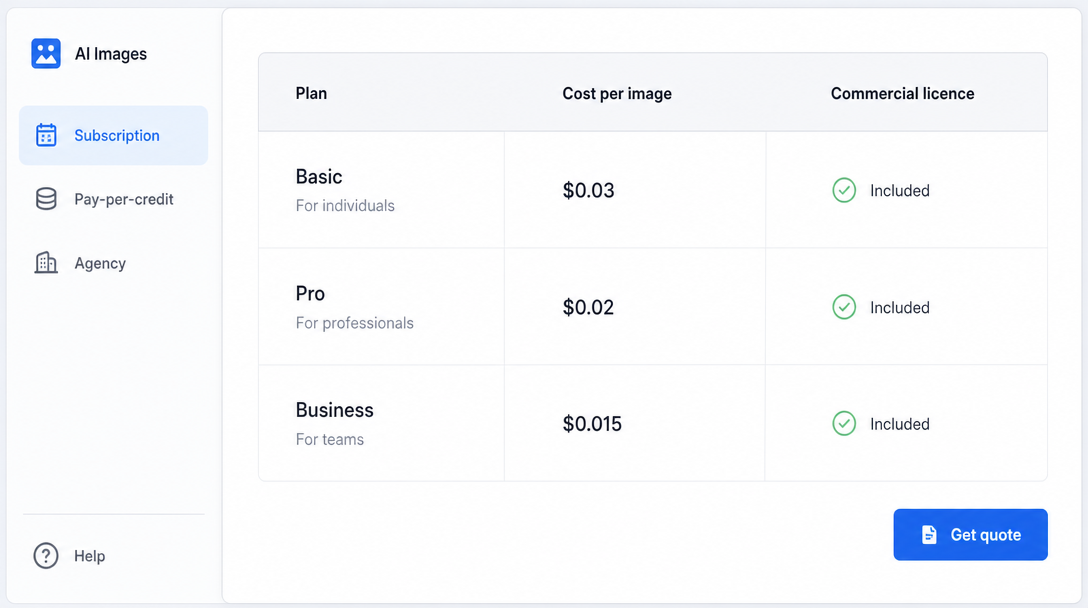
Raw generation is startlingly cheap. Consumer-tier plans on Midjourney, Google's Nano Banana, Flux and Stable Diffusion sit between $0.02 and $0.20 per image before any refinement. Enterprise credit tiers on Runway, Ideogram and the Gemini image API move that band up to $0.10 to $0.80 per image at commercially useful resolution. If you are only counting the moment the button is pressed, an AI lifestyle image looks like it costs less than a coffee. Our note on AI product photography costs in Australia shows the same pattern inside the tabletop category.
The number that reflects reality is cost per usable frame. Most brand teams generate between eight and thirty candidates to land one on-brief hero, then run one to three retouching passes to fix hands, garment fidelity and product truth. Real per-image economics for a usable, on-brand lifestyle frame land between $6 and $40 when the pipeline is DIY. A managed pipeline costs more per frame, because a specialist team is carrying art direction, model consistency and legal cover, and it is quoted against the scope rather than sold per image.
Pricing models compared
Four buying patterns dominate the market right now, and they price very differently once revisions, licensing and quality control are folded in. The table below is calibrated to a brand producing on-model lifestyle content at campaign standard, not casual social filler.
| Model | Headline cost | Effective per usable image | Hidden costs | Best for |
|---|---|---|---|---|
| DIY SaaS subscription | $30 to $250 per month | $6 to $40 | HD upscale, commercial tier, model retraining | Test-and-learn, social filler |
| Pay-per-credit | $0.05 to $5 per image | $10 to $60 | Revisions burn credits fast, no art direction | Programmatic ad variants |
| Agency-managed AI | Retainer, quoted per scope | Highest of the four, and the most consistent | Rush fees, extra review rounds | Brand hero, campaign, PDP lifestyle |
| In-house prompt team | Salary plus tools | $25 to $90 | Ramp time, staff turnover, licence audit | High-volume own-label ecommerce |
The subscription and credit tiers look cheapest on paper and often are, if there is an internal creative lead willing to own prompting, revisions and rights. The managed and in-house tiers cost more per image but bake in the parts that DIY buyers routinely forget: consistent characters across a campaign, licensed reference material, commercial-use documentation and a human reviewer who kills bad frames before they ship. Our guide to AI lifestyle imagery for ecommerce brands breaks the buyer profiles down further.
Cost by use case
Not every lifestyle frame carries the same price floor. The variables that drive cost up are aspect ratio complexity, casting consistency, product fidelity and the size of the usage window. A programmatic square social variant is cheap to iterate; a 16:9 hero banner or a full campaign key visual with recurring on-model characters is not.
- Social ad variants (1:1, 9:16): $8 to $30 per usable image via DIY, more once managed.
- PDP lifestyle (in-context product on model): $25 to $80 DIY, and materially more once managed, driven by product-fidelity retouching.
- Hero banner (16:9, 4:5): $40 to $150 DIY, and several times that once managed.
- Campaign key visual with recurring cast: the most expensive frame on any brief, because character consistency requires reference-training and additional review.
- UGC-style content: $10 to $40 per image, but volume and authenticity checks matter more than per-image cost.
Fashion is the extreme case because garment fidelity has to be defensible. Our breakdown of AI lifestyle photography for fashion walks through where the retouch tax lands and how to price it in.
Where AI is cheapest but risks look expensive
The cost-per-image headline hides four failure modes that quietly wreck brand equity when they ship. Hand and limb anatomy is the most visible, garment drape and fabric physics is the second, on-model product truth is the third, and brand-consistent casting across a campaign is the fourth. Any of them, unfixed, force an emergency reshoot or a retraction, and the money spent on generation becomes a sunk cost. Our AI branding workflow treats each of these as a mandatory review gate rather than a stretch goal.
The retouch tax is the honest name for it. Fixing hands, cleaning up warped garment seams, straightening logos and rebuilding product silhouettes typically adds $8 to $30 per image on top of raw generation cost. Skip it and the brand pays in returns, complaints or a quiet loss of premium positioning. Fold it in and the AI workflow still lands well below a traditional shoot, but the honest per-image figure sits closer to the managed-tier band above, not the pure SaaS number.
Agency-managed AI lifestyle imagery
The managed tier is the option most brand teams actually buy once they have run a DIY pilot for a quarter. A monthly retainer covers art direction, prompt engineering, licensed reference material, model consistency across a campaign, three to five review rounds, commercial-use documentation and delivery in every ratio the brand's channels need, and it is quoted against that scope rather than off a rate card. For most brands running four campaigns a year it lands meaningfully below a single day of traditional production while shipping ten to twenty times the volume of on-brief frames.
The value of the managed tier is not the raw output. It is the review layer that stops off-brief, off-brand or legally awkward frames from ever entering the delivery queue. Our AI content creation pipeline is built around that review gate, and the pricing conversation for lifestyle work sits inside a wider content-programme decision most brands make once and then optimise.
Budget worksheet at 20, 100 and 500 images per month
Volume is the variable that decides which tier wins on cost. The numbers below assume campaign-standard lifestyle output with revisions and licensing folded in, not raw generation.
- 20 images per month: DIY SaaS at $150 to $800 total; a managed program at a modest monthly retainer; traditional shoot equivalent at $18,000 plus every quarter.
- 100 images per month: DIY SaaS at $600 to $4,000 assuming an internal owner; a managed program at a mid-band retainer; traditional shoot equivalent effectively unreachable without three shoot days.
- 500 images per month: DIY hits a quality ceiling without headcount; in-house prompt team at $12,500 to $45,000 loaded cost; a managed program on a volume tier still lands well under that.
The compounding advantage sits in refresh cadence. AI lifestyle libraries can be re-shot seasonally at 10 to 20 percent of the traditional cost, which is where the annual budget conversation with finance actually gets interesting. Our AI consulting engagements usually start with this worksheet on the table.
Frequently Asked Questions
Do I own commercial rights to AI lifestyle imagery?
Rights vary by tool. Enterprise tiers on the major generators grant broad commercial use; consumer tiers often do not, and some restrict paid media or exclude specific categories. Managed engagements should provide an assignment letter and licensed reference documentation for every deliverable so audit and legal review are clean. Our AI commercial workflow builds that documentation into every handoff.
What resolution do I get for the money?
Native output from most generators sits between 1024 and 2048 pixels on the long edge. Managed pipelines run a dedicated upscaling and detail-preservation pass to reach print-ready 4K, and the cost sits inside the retainer rather than as a per-image add-on.
Do I need a model release for a synthetic person?
A synthetic likeness does not require a model release from a real person, but you do need documentation that the reference material used to generate that likeness was licensed or of synthetic origin. That documentation is what protects the brand under Australian consumer law and the EU AI Act.
Does the EU AI Act change the cost?
For lifestyle imagery it adds a labelling and provenance requirement rather than a licence fee. Managed studios typically build C2PA-style provenance metadata and disclosure copy into delivery. DIY pipelines need to add this step themselves, and the internal workflow cost is usually the hidden number.
How often should we refresh AI lifestyle libraries?
Seasonal refreshes every quarter are the common cadence for fashion and beauty; twice a year is enough for homewares and lifestyle categories. This is where the AI cost model compounds, because refreshing a library at 10 to 20 percent of the original cost is realistic once prompts, references and character models are already built.
Can AI lifestyle imagery match a hero campaign shoot?
For most category work, yes. For a headline campaign anchored on a named person, a location that must be recognisable, or a specific product interaction that has to be provably real, a traditional shoot still wins. Our note on AI lifestyle photography for wellness brands walks through where the line sits in practice.
What is the true minimum monthly budget?
For a brand producing lifestyle content at a professional standard, a managed tier is scoped and quoted against the brief, while a well-run DIY pipeline runs from roughly $500 per month plus an internal owner spending eight to ten hours a week on it.
AI lifestyle imagery is cheaper than a traditional shoot by an order of magnitude at raw-generation level, and by three to five times once retouch, licensing and revisions are honestly costed in. The decision is not really about cost per image; it is about which tier matches the brand's quality bar, refresh cadence and legal appetite. For most brand teams the managed-agency tier is the option that pays back inside a quarter. If you want a costed pipeline built to your calendar, Absolutely AI runs the full managed workflow end to end.