AI Lifestyle Shoot vs Traditional Shoot: What Fits Your Brand
Every brand marketing director in 2026 is being asked the same question by their CFO: can we just do the lifestyle shoot with AI now? The honest answer, from a studio like Absolutely AI that runs both workflows every week, is more interesting than the yes/no you'll find on most tool blogs. Here's the real trade-off, line by line.
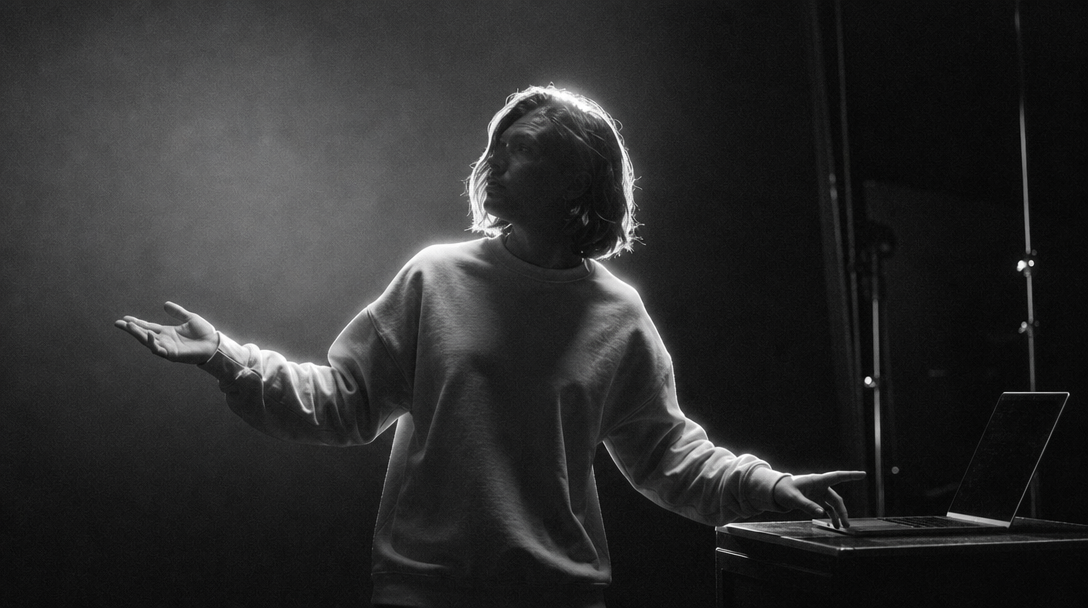
Every brand marketing director in 2026 is being asked the same question by their CFO: can we just do the lifestyle shoot with AI now? The honest answer, from a studio like Absolutely AI that runs both workflows every week, is more interesting than the yes/no you'll read on most tool blogs. It depends on the product, the placement, the brand tier, and whether you actually need one hero image or two hundred variants.
TL;DR: The 30-Second Answer
If your budget is under $8k, your timeline is under a week, your SKU count is over 20, and the imagery is destined for paid social or PDPs rather than a national OOH campaign, an AI lifestyle shoot will almost always be the smarter choice. If you're shooting a hero campaign for a luxury tier product, a talent-led narrative, food, jewellery, or anything on-body where fit and drape matter, traditional still wins. Most sophisticated brands aren't picking a side, they're running a hybrid workflow that uses both.
| Scenario | Recommended path |
|---|---|
| Under $8k, under 1 week, 20+ SKUs | AI lifestyle |
| Hero campaign, luxury tier, national OOH | Traditional |
| Paid social variants, A/B testing, geo splits | AI lifestyle |
| Food, jewellery, on-body fit, talent narrative | Traditional |
| Seasonal refresh across 100+ assets | Hybrid (traditional hero + AI extensions) |
What Counts as a 'Lifestyle Shoot' (And Why the Comparison Is Trickier Than Product-on-White)
Lifestyle imagery means people in environments, using the product in context, with an emotional cue. It's the hardest category for AI to nail because it stacks three failure modes at once: human anatomy (hands, teeth, eyes), product fidelity (your specific bottle, not a generic one), and brand-consistent models across multiple scenes. The gap between AI and traditional is much smaller for product-only imagery than it is for lifestyle, which is why the vs/traditional question actually needs a proper answer here.
The Traditional Lifestyle Shoot, Line by Line
A mid-market lifestyle shoot in Australia in 2026 breaks down roughly like this. Photographer day rate: $3.5k to $6k. Stylist: $1.2k. Hair and makeup: $800 to $1.5k. Two models via a Sydney agency: $2.5k to $5k plus 20% usage buyout. Location: $1k to $4k. Props, wardrobe, catering, permits: $1.5k. Post production and retouching across 30 selects: $2k to $4k. You're looking at $12k to $25k for a single shoot day producing 20 to 40 finished images.
The timeline is the other cost people forget. Brief to casting takes a week. Casting to shoot day another two. Shoot day itself, plus selects and retouch, another two to four weeks. From brief to delivered assets you're looking at six to eight weeks in the real world, longer if you're waiting on a location or a talent hold. That's the true baseline you're comparing against.
What you get for that money is genuine: hero-quality assets, on-set flexibility (a client can call for a wardrobe change at 11am and see it by lunch), guaranteed usage rights, and a set of images with the tactile authenticity that human eyes still register subconsciously. For the right brief, all of that is worth every dollar.
The AI Lifestyle Shoot, Line by Line
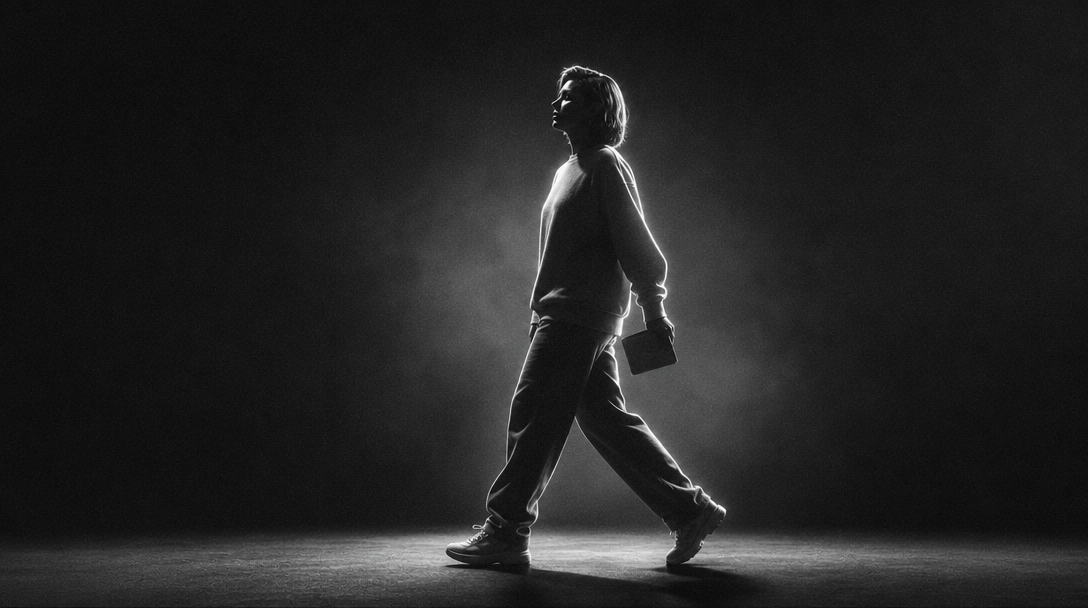
An AI lifestyle shoot in a proper studio setup looks like this. A reference pack goes in: brand guidelines, product hero photography, mood references, model likeness locks. A creative director and prompt operator brief the model set (Flux, Midjourney v7, Google's Nano Banana for photorealistic humans, Seedream for scene composition). Concept selects come back within hours. Inpainting cleans up hands and product labels. An upscale and grade pass matches the brand's colour science. Licensing checks confirm the model likeness isn't too close to a real person.
The real cost is not $50 in tool subs. It's the creative direction time. A properly briefed AI lifestyle set for one product across ten scenes is mostly agency time, plus $200 to $500 in compute and licenses. That's still 60 to 80 percent less than the traditional equivalent, but it's not the 99% savings you'll see quoted by SaaS tools that ignore the humans in the loop. The real cost breakdown we've published on the journal walks through why.
Timeline is where AI genuinely destroys traditional: 24 to 72 hours for a full concept round, another day or two for refinement. A brief on Monday morning delivers finished lifestyle assets by Thursday, sometimes Wednesday. For a marketing team running a weekly promo cycle, that speed is the whole game, not a rounding error.
Head-to-Head Comparison
| Criteria | Traditional | AI Lifestyle |
|---|---|---|
| Cost per finished image | $400 to $800 | A small fraction of that |
| Turnaround | 4 to 8 weeks | 2 to 5 days |
| Revisions | Reshoot cost or heavy retouch | Minor: reprompt in hours |
| Scalability to 100+ variants | Punishing | Native strength |
| Commercial licensing | Clean if paperwork is right | Emerging risk, needs checks |
| Brand consistency across a set | Locked in by direction | Locked in by reference pack + operator |
| Edge cases (food, jewellery, on-body fit) | Reliable | Still unreliable |
Where Traditional Still Wins
There is a specific list of briefs where I will still send a client to a traditional shoot without hesitation. Hero campaign imagery destined for OOH, print, or a brand film. Luxury tier products where tactile authenticity is the entire proposition. Food photography, because AI still can't render steam, sauce viscosity, and freshness cues without tells. Jewellery, because the light interaction with real metal and stone is unforgivably hard to fake. Talent-led narrative content where a real person's likeness and performance is the point. And anything on-body where fit, drape and how a garment actually sits matters commercially.
Where AI Lifestyle Wins Right Now
The categories where AI is not just competitive but genuinely better in 2026: paid social variants (five backgrounds, three moods, two aspect ratios, delivered same-day). Seasonal refreshes (dropping a Christmas or Ramadan version of an existing set without a reshoot). Marketplace and PDP volume for brands with 50+ SKUs. A/B creative testing where you need 20 versions of the same idea. Geo variants where a US-facing image needs an AU-facing equivalent by tomorrow. Any brief where speed and volume are the win condition, AI lifestyle is the answer. Our commercial AI imagery service is built around exactly those use cases.
The Hybrid Playbook Smart Brands Are Actually Running
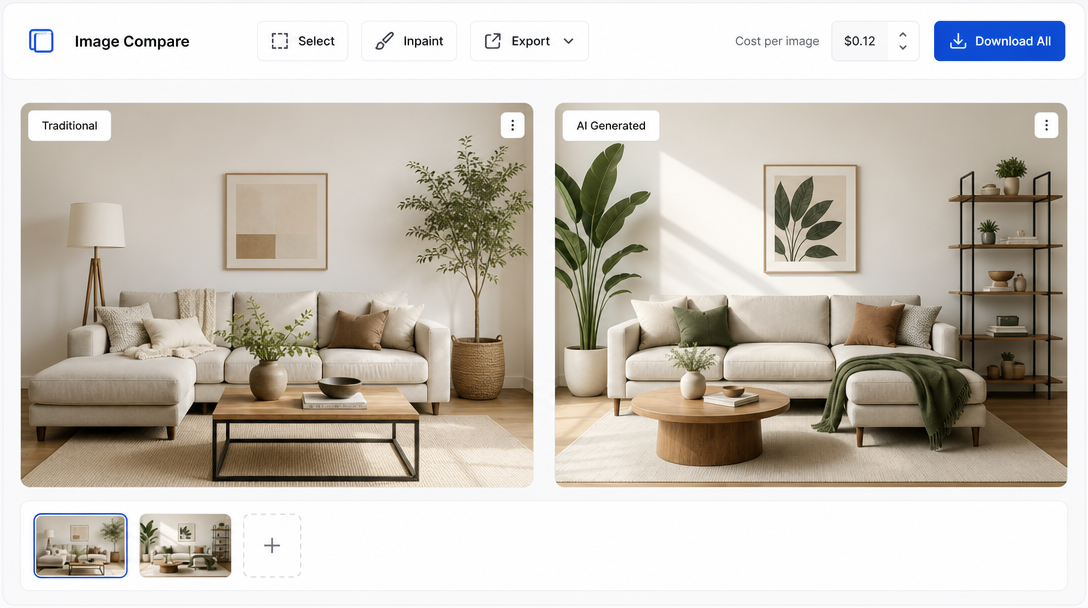
The most operationally sophisticated brands we work with aren't picking a side. They're running the Calvin Klein / Sephora playbook: one traditional hero shoot per season captures the anchor assets (hero campaign image, the two or three cover shots, any talent-led content). Then an AI extension pipeline generates the 80 to 200 variants that the hero can't cover: seasonal skins, geo splits, paid social sizes, PDP context shots, retargeting creative. The hero locks the brand look, the AI pipeline scales it. See this comparison for how the same logic plays out on product-only shoots.
Decision Framework: Six Questions Before You Brief Either Team
- Is this a hero asset or a variant asset? Heroes lean traditional, variants lean AI.
- Will this appear on OOH, print or broadcast, or only on digital? Digital-only briefs handle AI better.
- Does the image need a real, named talent? If yes, traditional.
- How many finished assets do you need? Under 15, either works. Over 40, AI or hybrid wins on unit economics.
- What's your timeline? Under 5 days is AI-only territory in practice.
- What's your brand legal team's tolerance for AI-generated humans in paid media? Ask before you brief.
The Two Things Nobody Talks About Honestly
First, commercial licensing for AI-generated humans is still a live question in Australia. If your AI model output resembles a real person too closely, you have a likeness claim risk. A proper agency runs a similarity check on every human-featuring output before it goes to paid media. Cheap tools skip this step and hand the risk to the brand. Ask any provider what their process is; if they don't have one, that's your answer.
Second, brand consistency across a 100-asset campaign is genuinely hard in AI, and it's the single thing most tool comparisons ignore. Maintaining the same model face, the same lighting logic, the same product colour across 100 scenes takes a proper reference pack, a locked prompt scaffold, and a human doing quality control. It doesn't happen by accident. If you brief this into an untrained operator, you'll get 100 images that don't look like the same campaign. See our take on the tooling landscape for how the platforms actually stack up on consistency.
Frequently Asked Questions
Is AI lifestyle imagery legal to use commercially in Australia?
Generally yes, provided the output doesn't resemble a specific real person too closely and your tool's licensing terms permit commercial use. The grey zone is human likeness. A responsible provider runs similarity checks and documents its process; a $20 SaaS tool doesn't.
Will customers notice the images are AI-generated?
In 2026, well-directed AI lifestyle imagery for product context, background scenes and PDP variants is genuinely indistinguishable to a scrolling consumer. Where they'll notice is close-up hands, jewellery detail, food texture, and hero campaign imagery viewed at scale. The failure modes are predictable, which means an experienced director avoids them.
What about using real human models with AI?
Increasingly common. Traditional shoot captures a real model in a small number of scenes, then AI extends that model's likeness across dozens more contexts with a signed usage agreement. This is the compliant version of what Calvin Klein and Sephora are quietly doing.
How do I keep brand consistency across 200 AI-generated assets?
Three things: a locked reference pack (brand book, product hero shots, model likeness reference), a fixed prompt scaffold that a single operator maintains, and a human quality control pass on every batch. Skip any of the three and consistency collapses inside 20 images.
What's the honest cost savings versus traditional?
For lifestyle specifically, 60 to 80 percent on total campaign spend when you account for creative direction time properly. The 99 percent number quoted by tool vendors ignores the humans still in the loop. That's the real benchmark to hold suppliers to.
Can an agency do both under one roof?
Yes, and increasingly that's the model brand teams want. One creative director, one brief, and the studio decides which parts get shot traditionally and which parts get generated. That's the workflow we run at Absolutely AI, and it's the one most enterprise clients settle into within a quarter.
The Bottom Line
AI lifestyle shoots haven't replaced traditional in 2026, and anyone selling you that story is selling you a tool licence. What they have done is made the hybrid workflow the new normal: traditional captures the hero, AI extends it across every channel and variant your brand needs. If you want a partner that runs both sides properly and can tell you honestly which parts of your brief belong on each side, Absolutely AI's lifestyle imagery team works with brands like yours every week. Start with the brief; we'll tell you which format wins it.