AI Lifestyle Imagery for Ecommerce Brands: 2026 Playbook
Ecommerce brands adopting AI lifestyle imagery are cutting shoot costs, testing more creative, and lifting conversion. The teams winning at it are not the ones prompting fastest, but the ones treating AI like an in-house studio with a brand system. Absolutely AI has been building that system for direct-to-consumer brands across skincare, food, and homewares. Here is the 2026 playbook.

The gap between ecommerce brands winning with AI lifestyle imagery and the ones producing forgettable output is not budget or model choice. It is systems thinking. The winners treat generative tools like an in-house studio with locked brand tokens, clear shot lists, and QA gates. The rest ship whatever the model returned on the first pass, and their product pages look like every other direct-to-consumer storefront running the same three prompts.
Why Lifestyle Beats Packshot in 2026 Ecommerce
The packshot on a white background is not dead, but it is no longer earning its keep on the product detail page. Justuno reported a 65% lift in conversion when brands paired product photography with lifestyle context, and Shopify's creative team has cited around a 73% reduction in production time when generative tools handle first-pass scene work. Meta, Google Shopping and Pinterest all reward creative variety in their auction, so brands that can produce ten scenes for the price of one traditional shoot compound their reach.
Zero-click SERP behaviour is the other pressure. Google Shopping tiles, image packs and AI Overviews now surface product imagery before the click, which means the lifestyle context has to do work before a shopper ever hits your site. Static packshots blend into the grid. Scenes with human context, ambient light and a clear story tell shoppers what the product is for, and they earn the click. Brands running AI commercial content at ecommerce scale are converting this pressure into weekly release cadence, not quarterly campaigns.
What AI Lifestyle Imagery Actually Means Today
The category has fragmented into three distinct approaches. At one end is background swap, where a photographed product is composited into a generated scene. Fast, cheap, and the ceiling is wherever your original packshot ends. In the middle is on-model generation, where the product is placed on a synthetic person in a synthetic environment. At the top is full scene synthesis, where the product itself is rendered from a reference sheet, and every pixel is generated. Each has different failure modes, different QA burden, and different suitability for product pages versus paid social.
The diffusion ceiling has moved fast in the last twelve months. Nano Banana, Flux, Seedream and Sora Image now support reference-conditioning that keeps a product's silhouette, label geometry and colour accurate across dozens of scenes. IP-Adapter and character-lock workflows in ComfyUI let brands hold a synthetic model consistent across a hundred SKUs. The tooling is no longer the bottleneck. Art direction is, which is why tool choice ranks lower than most brands assume.
The Four Shots Every Ecommerce SKU Needs
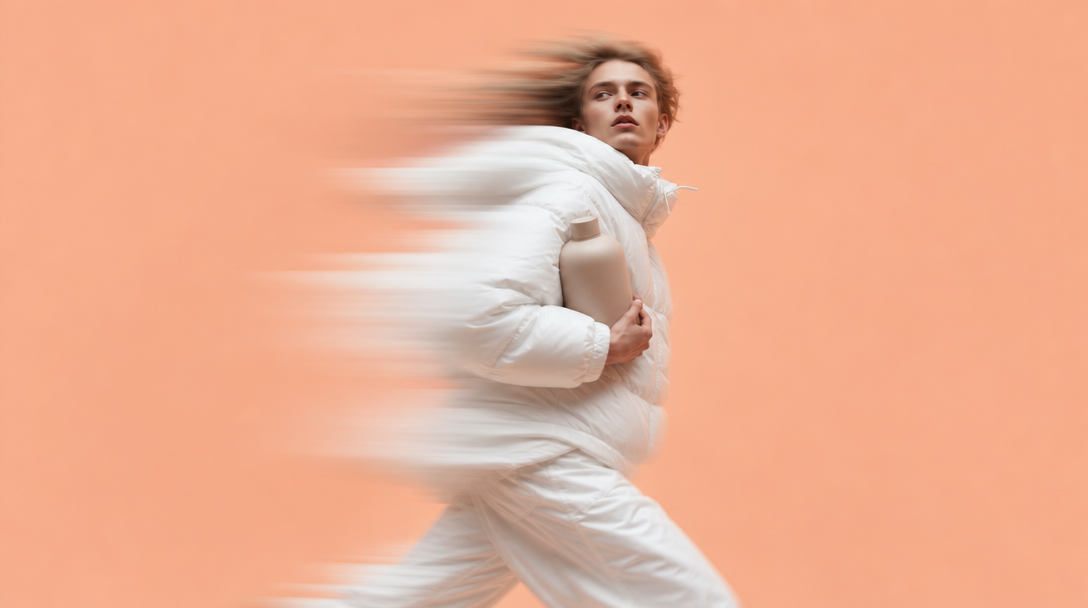
Every SKU should ship with four shot types, each mapped to a placement. The hero context shot goes on the product page above the fold, showing the product in a signature branded environment at 4:5 or 1:1. The in-use shot shows a hand, a face or a body interacting with the product, and it earns its keep in email hero panels and Meta feed ads. The detail crop shows texture, ingredient, weave or mechanism at close range, and it lifts trust on the product page scroll. The aspirational scene is the widest, most editorial frame, and it drives brand feel on Pinterest, TikTok covers and Google Shopping tiles.
The aspect-ratio matrix matters more than most brands admit. A single generation run should output 1:1 for feed, 4:5 for product pages, 9:16 for Reels and Stories, and 16:9 for site banners and YouTube. If your prompt system is not producing all four ratios from a single scene brief, you are paying a studio tax on every deliverable. The teams doing this well have the whole aspect matrix baked into their generation pipeline.
Building a Brand-Consistent AI Lifestyle System
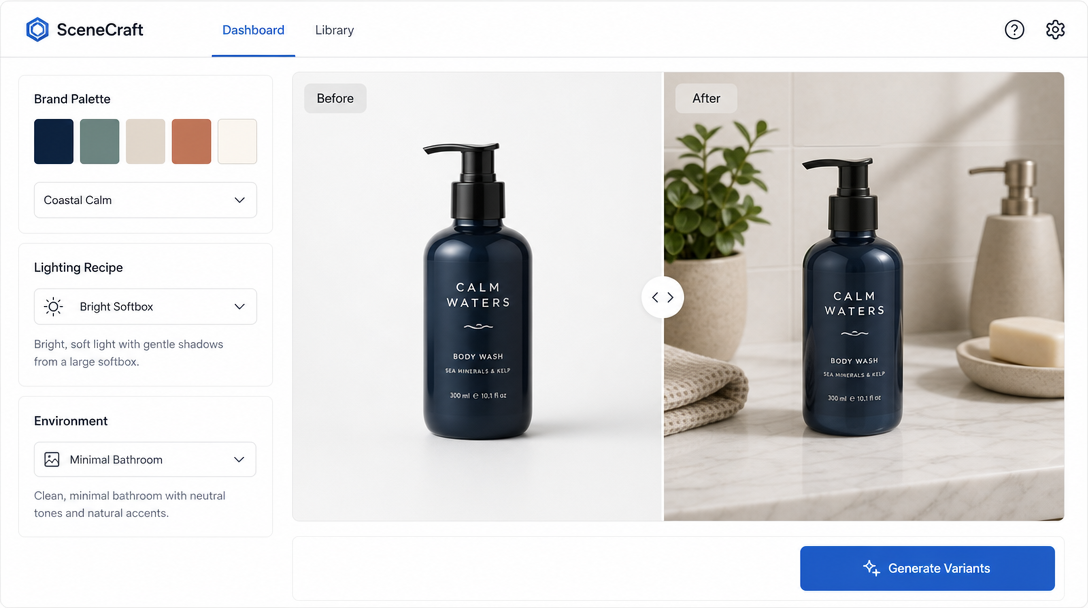
This is where most ecommerce brands break. A prompt-first workflow produces five hundred SKUs that look like five hundred different tools. A system-first workflow produces the same five hundred SKUs that read as one brand. The difference is locking your brand tokens before you write a single prompt: palette, lighting recipe, model demographic, environment library, wardrobe range, prop kit, and aspect-ratio matrix.
Palette is the easiest to lock and the most commonly ignored. Extract the six to eight hex codes from your brand guidelines and pin them into the positive and negative prompt for every generation. Lighting recipes are the next layer: define whether your brand is soft north-facing daylight, warm tungsten interior, or hard midday sun, and hold it. Rotate through three environments at most per campaign so your grid reads as considered art direction. This is the level of rigour teams building AI brand systems for ecommerce apply from day one.
Model consistency is the hardest lock and the highest leverage. Using IP-Adapter, reference-image conditioning or character-lock LoRAs, brands can hold a synthetic model consistent across shoot after shoot. Combined with a locked wardrobe kit and a small environment library, this gives you a talent roster without contracts, day rates or agency fees. When shoppers see the same face across your product pages, email, and Meta ads, brand recall compounds.
The Production Workflow, End to End
A repeatable AI lifestyle system runs in eight steps: brief, deliverable list, prompt pack, generation, QA gate, retouch, DAM upload, variant test. Skipping any step means you are back to prompting on vibes. The brief is where you translate the merchandising calendar into shot lists tied to each SKU's product page, ad set, and email placement. The deliverable list is the ratio matrix multiplied by the shot types, which is where you discover most catalogues are shipping half the assets they need.
Generation is the least interesting step, despite being what most tool listicles obsess over. Whether you use Midjourney, Flux, Nano Banana or a ComfyUI stack is a question of throughput and control, not quality. The QA gate is where the brand stands or falls. Every image needs a manual pass for hand anatomy, logo integrity, fabric drape, glass reflection accuracy, and shadow direction. Then a retouch pass on the top ten percent, DAM upload with structured metadata, and finally the creative test in Meta Advantage+ or Google Performance Max.
Avoiding the AI Slop Tells That Kill Trust
Consumers now spot AI imagery in about a second. The tells are consistent: plastic skin, warped or six-fingered hands, floating shadows that do not match the light source, impossible reflections on glass and metal, wrong fabric drape, and logo warp. Any one of these on your product page and the shopper's trust drops before they read your product description.
Bake a QA checklist into your workflow. Every image gets a pass on hand count and anatomy, logo geometry against the reference, shadow direction consistent across the frame, reflection physics on glass and metal, fabric weight and drape, and skin texture. Reject anything that fails any of these before it hits the DAM. Teams comparing AI against traditional product photography consistently name the QA gate as the difference between usable and shippable.
Legal, Disclosure and Platform Rules in 2026
The regulatory landscape has hardened. The EU AI Act now requires clear disclosure of synthetic media in marketing contexts, and platforms have followed. Meta requires disclosure for AI-generated content in ads, Amazon has tightened its policy on synthetic product imagery in listings, and Google Merchant Center will demote listings with materially misleading generated imagery. In Australia the ACCC and in the UK the ASA have both issued guidance treating undisclosed synthetic imagery as potentially misleading conduct.
The practical implication for ecommerce is straightforward. Keep an audit log of every generation, tag AI-created assets in your DAM, and disclose on placements where policy requires it. For synthetic humans, keep a release-equivalent record: the reference sheet, the prompt pack, and the licensing status of any inputs. This is table stakes for any brand running paid media at scale.
Measuring ROI and When to Still Hire a Photographer
Creative testing is where the ROI story either lands or falls apart. Run five to ten lifestyle variants per SKU, watch CTR, CVR, and CPA deltas over a two-week window, and compare against a photographed control cell. Incrementality testing is the only credible way to answer whether AI variants are outperforming, not just outnumbering, your photographed baseline. Most brands find AI wins on volume and iteration, while photography wins on the hero campaign.
There are shots you should still hire a photographer for. Hero campaign imagery that carries a season. The tactile hero SKU where texture is the story. Founder and team portraits where authenticity matters. Editorial PR imagery that trade press will scrutinise. Everywhere else, an AI-native pipeline like the ones running AI content creation for ecommerce will out-produce a traditional studio at a fraction of the timeline.
Frequently Asked Questions
How many AI lifestyle images does an ecommerce brand need per SKU?
At minimum, four: hero context, in-use, detail crop, and aspirational scene. Multiply that by the four core aspect ratios (1:1, 4:5, 9:16, 16:9) and you have sixteen assets per SKU. Brands running paid media at scale often double this for creative testing.
Can I use AI lifestyle imagery on Amazon and Meta ads?
Yes, with disclosure. Amazon and Meta both allow AI-generated product imagery provided it accurately represents the product and any AI-generated content is disclosed per their current policies. Materially misleading generation, like altering the product itself, is the line.
Do synthetic models need model releases?
Synthetic humans do not need a traditional release, but keep a documented reference sheet, prompt pack, and confirmation that any real-person references used for training or conditioning are properly licensed. Many brands use character-lock LoRAs trained on their own commissioned reference sessions to avoid ambiguity.
How do I keep my brand consistent across hundreds of AI-generated images?
Lock your brand tokens before you prompt: palette hex codes, lighting recipe, model likeness, environment library, wardrobe kit, and aspect-ratio matrix. Use reference-image conditioning such as IP-Adapter or character-lock LoRAs to hold model and palette consistent across every generation.
What is the fastest way to start?
Pick one product category, define your four shots and four aspect ratios, write a locked prompt pack for one SKU, generate, QA, and ship to a Meta Advantage+ test with a photographed control. Iterate from a proven single-SKU workflow before scaling to your full catalogue.
Which tool is best in 2026?
Tool choice matters less than pipeline. Midjourney and Flux lead on aesthetic control. Nano Banana and Seedream lead on reference-conditioning fidelity. ComfyUI stacks give the most control for brands with in-house technical capacity. Any of them will outperform a bad prompt on a great model.
The 30-Day Rollout
Week one is systems. Extract brand tokens, define the shot list, and build the aspect matrix. Week two is one-SKU prototype: lock the prompt pack, generate, QA, and get to sixteen shippable assets from a single SKU brief. Week three is scale-out: apply the same pack to ten SKUs and measure the drop-off in consistency. Week four is creative testing: ship the variants against a photographed control on Meta Advantage+ and read the results.
The brands that treat AI lifestyle imagery as a creative direction problem rather than a tools problem end this thirty-day sprint with a working system. Absolutely AI runs this exact rollout with ecommerce clients as a starting engagement, and it is the fastest way to move from prompting on vibes to producing brand-consistent output at ecommerce scale.