What AI Ecommerce Photography Actually Costs in 2026
AI ecommerce photography has quietly rewritten the cost model for online catalogs, but the pricing landscape is messier than most guides admit. This piece walks through how AI product imagery is priced, where hidden costs hide, when traditional studios still win, and how the team at Absolutely AI sees operators building hybrid stacks that hold up at 50, 500, and 5,000 SKUs.
Every ecommerce operator we speak to wants the same answer: what does AI ecommerce photography actually cost once you factor in the messy real-world work around it. The honest answer is that AI product imagery is dramatically less expensive than traditional studio work for most catalog scenarios, but the sticker price on a tool page rarely reflects the true operating cost. This guide, written from the vantage point of Absolutely AI, walks through pricing models, hidden costs, the crossover point where traditional still wins, and a break-even formula you can apply to your own catalog.
The short answer on AI versus traditional pricing
At a glance, AI-generated product imagery sits in an entirely different order of magnitude to traditional studio work. Where a traditional shoot is priced per image, per day, or per campaign, AI generation is typically priced per credit, per subscription tier, or per SKU. For most mid-market DTC brands, moving background generation, lifestyle staging, and ad variations to AI produces a substantial cost reduction versus a rolling studio contract, though the exact figure depends heavily on catalog volume and quality bar. For a broader view of how this plays out across a catalog, our guide to ecommerce imagery at scale covers the volume side in detail.
How AI product photography is priced
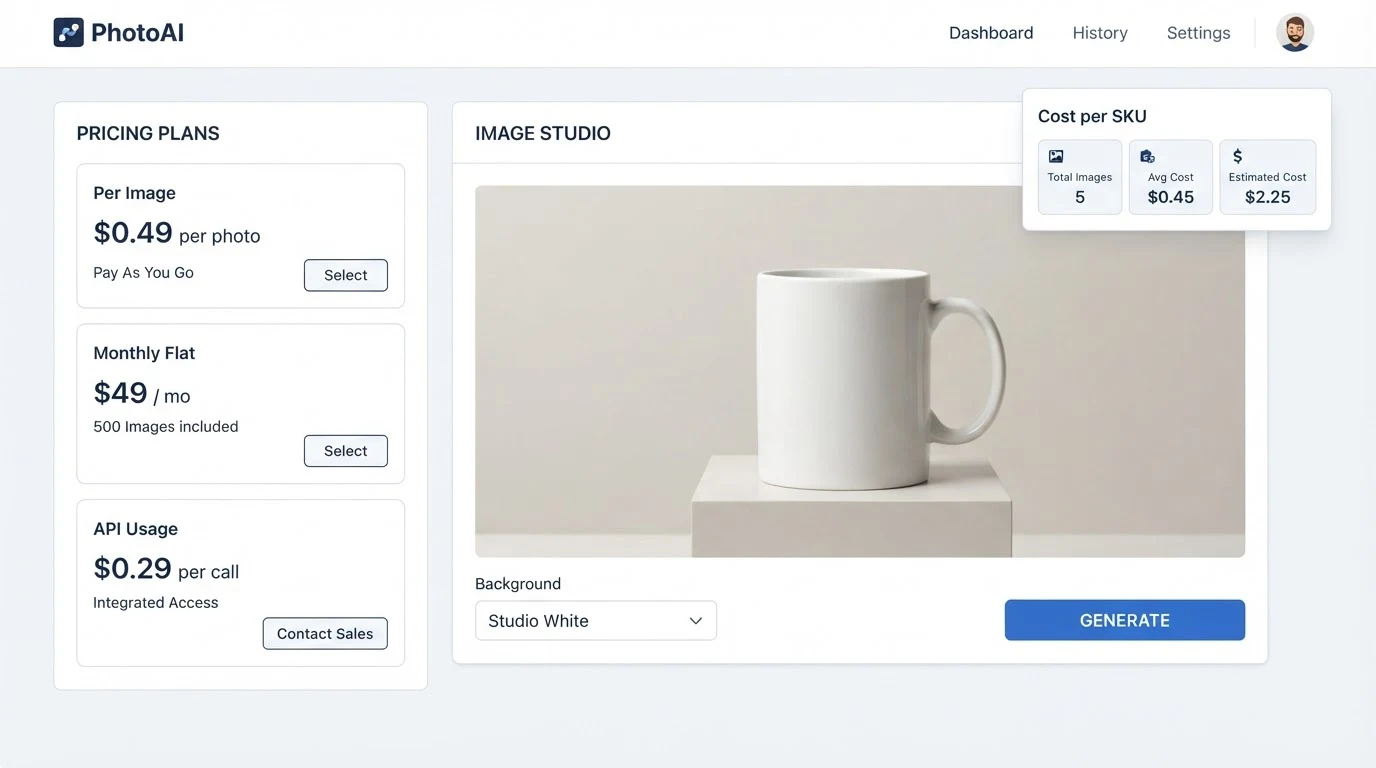
There are four dominant pricing models in the AI ecommerce imagery market, and understanding which one you are actually buying matters more than the headline number.
- Per-image credits. Tools like Pebblely and PhotoRoom sell credits that convert to generations. A single credit rarely maps to a single finished image, since upscales, background swaps, and model shots typically cost different credit amounts.
- Flat monthly subscriptions. Products like Assembo and PixelPanda charge a flat monthly fee for unlimited or high-cap generation, which suits high-volume catalogs but often hides throughput caps in the fine print.
- Per-SKU packages. Vendors such as Rewarx and Fibbl price by SKU, delivering a full set of angles and lifestyle scenes per product.
- API and usage pricing. Platforms like Bria and custom Wireflow-style workflows charge per generation via API, which is the model that scales best for enterprise catalogs and internal tooling.
Bespoke agency work, including brand-calibrated ecommerce sets, sits outside these tool categories entirely and is quoted per scope after a brief review. If your catalog needs consistent brand voice across every SKU, tool-tier pricing is usually the wrong lens; you are buying a creative outcome, not a generation.

True cost per SKU: worked scenarios
Rather than quoting dollar figures that vary wildly by vendor and geography, it is more useful to look at the shape of cost across three catalog sizes. In every case, the AI stack costs a small fraction of the traditional path, but the relative overhead of prompt work and QA shifts as you scale.
| Scenario | AI stack cost shape | Traditional cost shape | Turnaround |
|---|---|---|---|
| 50-SKU DTC brand | Low base subscription plus modest prompt and QA labour | Multiple studio days with post-production | AI: days. Traditional: weeks. |
| 500-SKU marketplace seller | Mid-tier subscription or API usage plus dedicated operator time | Extended studio engagement or ongoing retainer | AI: two to three weeks. Traditional: months. |
| 5,000-SKU catalog migration | API pricing at volume plus a brand fine-tune and structured QA | Rarely quoted; generally out of reach at this scale | AI: weeks to a couple of months. Traditional: often not feasible. |
The pattern is consistent: AI turns catalog-scale imagery from a capital project into an operational line item. Our piece on catalog imagery for ecommerce unpacks the operational side in more detail.
Hidden costs nobody quotes you
The tool pricing is only the visible tip. Every operator running AI product imagery in production ends up paying for several other line items that vendors do not mention on their marketing pages.
- Prompt engineering hours. Someone has to write, test, and version prompts. This is a real labour cost, and it scales with catalog complexity. A junior operator and a senior creative produce very different outputs at very different hourly rates.
- Brand-consistency fine-tuning. Getting a model to reliably reproduce your brand's colour, lighting, and styling usually requires a one-off fine-tune or LoRA training pass. This is a project cost, not a subscription cost, and it recurs whenever the brand identity shifts.
- Reshoot rate for AI misses. First-pass generations fail QA at a real rate. Fifteen to thirty percent of outputs typically need a rerun, an edit, or a manual retouch, depending on the complexity of the scene.
- Platform compliance rejections. Amazon's white-background rules, Google Shopping feed requirements, and marketplace-specific policies mean some AI outputs get rejected on upload. Rework is a hidden cost.
- Legal review for AI humans. If your imagery includes AI-generated people, legal counsel on likeness, disclosure, and platform policy is a genuine overhead most brands underestimate.
When traditional photography still wins
AI is not the right answer for every image. There are still scenarios where a physical shoot is the more sensible choice, either because the quality bar demands it or because the alternative simply does not exist yet.
- Hero shots and campaign imagery where a specific art direction, model performance, or environment matters.
- Jewellery, watches, and reflective surfaces where physical light behaviour is difficult to replicate convincingly.
- Apparel on real models where fit, drape, and body language are the entire point.
- Video content, though this is closing rapidly as AI motion tools mature. Our AI films practice is where hybrid video work lives.
The crossover point is usually a mix of quality bar and shot type. For high-consideration hero imagery on a small number of SKUs, traditional often wins. For long-tail catalog work, background variations, ad testing, and seasonal refreshes, AI is almost always the cheaper and faster path.
The hybrid stack most brands actually run
The pattern we see repeatedly at brand-led ecommerce shops is a hybrid stack. AI handles the volume work: backgrounds, lifestyle staging, ad variations, seasonal refreshes, PDP secondary angles. Traditional studio work is reserved for hero and campaign moments where the quality bar is highest. Our seasonal campaigns piece shows how this split works across a year.
A realistic monthly budget for a mid-market DTC brand doing this well allocates the majority of spend to the AI subscription or API usage, a meaningful chunk to prompt and QA labour, a smaller amount to occasional studio work for hero moments, and a contingency line for reshoots and fine-tune updates. The exact split depends on catalog size, launch cadence, and how much the brand is built around imagery.
How to calculate your own break-even
The simplest way to know whether AI ecommerce photography will pay for itself in your business is a one-line formula: your current cost per image multiplied by your monthly image volume, minus the total cost of the AI stack including prompt labour. If the result is meaningfully positive and the quality bar holds, switching pays off. If your monthly image volume is very small, the switching cost of setting up prompts, fine-tuning, and QA rarely clears against the incumbent studio arrangement. Volume is the dominant variable.
The second variable is quality bar. If your PDPs live and die by hero imagery, the calculation shifts. Our PDP imagery guide covers the specific quality considerations for product detail pages.
Frequently Asked Questions
Is AI product photography Amazon-compliant?
Yes, provided the final image meets Amazon's technical rules: pure white background on the main image, product filling the frame, no additional graphics or text. AI generation is agnostic to Amazon policy; the compliance layer sits in your QA process, and marketplace-specific rules should be baked into your prompt templates.
Do I still need a photographer at all?
For most catalog work, no, but most brands keep a photographer for hero campaigns, brand films, and any imagery where fit or physical performance matters. The photographer role often shifts from shooting every SKU to art-directing the AI stack and shooting selectively for premium moments.
What about apparel photography?
Apparel is the hardest category for AI right now. On-body fit imagery still benefits from real models, though AI is increasingly used for colourway variations, background swaps, and lifestyle staging around a base shot. A hybrid approach dominates in fashion ecommerce.
Who owns the copyright on AI-generated product imagery?
Copyright treatment varies by jurisdiction and by tool. In most cases the operator owns the commercial usage rights to generated imagery of their own products, but the underlying model rights and any AI-generated human likenesses require careful review. This is worth a proper legal check before you scale.
How long does it take to switch a catalog to AI imagery?
For a 500-SKU catalog, expect a few weeks for prompt development, brand fine-tuning, and initial generation, plus ongoing QA time. Larger catalogs take longer proportionally, though the marginal cost per additional SKU drops sharply once the pipeline is set up.
Can AI handle reflective products like jewellery?
Reflections and complex material behaviour remain a weak point for current models. It is getting better quickly, but for premium jewellery, watches, and glass, most brands still shoot traditionally for hero imagery and use AI for background variations and lifestyle contexts.
What is a realistic reshoot rate for AI product imagery?
Fifteen to thirty percent of first-pass generations typically need a rerun or a manual retouch. This drops as prompts mature and brand fine-tunes stabilise, but it never goes to zero. Build it into your budget and your timeline from day one.
Does AI work for beauty and homewares?
Yes, and these categories tend to see the highest ROI from switching. Our beauty imagery guide and homewares imagery guide cover both in detail.
Where to go from here
The honest answer on AI ecommerce photography cost is that it is dramatically cheaper than traditional studio work for the volume portion of most catalogs, but the true operating cost includes prompt labour, QA, fine-tuning, and occasional traditional shoots for hero moments. Brands that treat AI as a tool inside a hybrid stack, rather than a wholesale replacement, tend to end up with the strongest cost-to-quality ratio. If you want a scoped view of how this could work for your catalog, the team at Absolutely AI quotes ecommerce imagery engagements per scope after a short brief review.