AI Ecommerce Seasonal Campaigns: The Operator's Playbook
Seasonal peaks now decide the year for most ecommerce brands, and the teams winning them are not the ones with the biggest ad budgets. They are the ones with a repeatable AI workflow that spans forecasting, creative production, personalisation, and post-peak analysis. At Absolutely AI we build these workflows for retailers who want cinematic seasonal creative delivered at the speed a modern peak actually demands.

Most articles on AI seasonal campaigns stop at a shallow list of tools or a generic BFCM checklist. The real unlock sits deeper: a five-stage workflow that connects demand signals to creative production to personalised delivery to post-peak learning. Done well, it turns each seasonal moment into training data for the next one. This playbook walks through that workflow with an Australian retail lens, a worked example, and the failure modes nobody talks about. For teams weighing whether to build in-house or bring in a creative partner, our AI consulting practice maps the same territory in workshop form.
What Counts as an AI Seasonal Campaign in 2026
A seasonal campaign is any commerce push tied to a calendar moment where demand spikes and attention windows compress. The obvious ones still dominate revenue: Black Friday Cyber Monday, back-to-school, Mother's Day, Ramadan, Christmas. Australian retailers add EOFY, Click Frenzy, Melbourne Cup, and the ANZ back-to-school wave in late January. What makes a campaign an AI seasonal campaign is not the presence of a chatbot; it is that forecasting, creative variants, personalisation, and post-peak analysis are all model-driven rather than manually assembled.
The newer category is the micro-season. AI models watching weather feeds, TikTok trend signals, and category search velocity now surface windows that do not exist on any retail calendar: a three-day heatwave that spikes swimwear demand, a viral recipe that empties baking-aisle inventory, a sports result that moves apparel. Brands geared for this see the signal on day one and have creative live by day two, which is only possible when the creative production step is not the bottleneck. That is where our AI content creation pipelines earn their keep.
The Five-Stage AI Seasonal Workflow
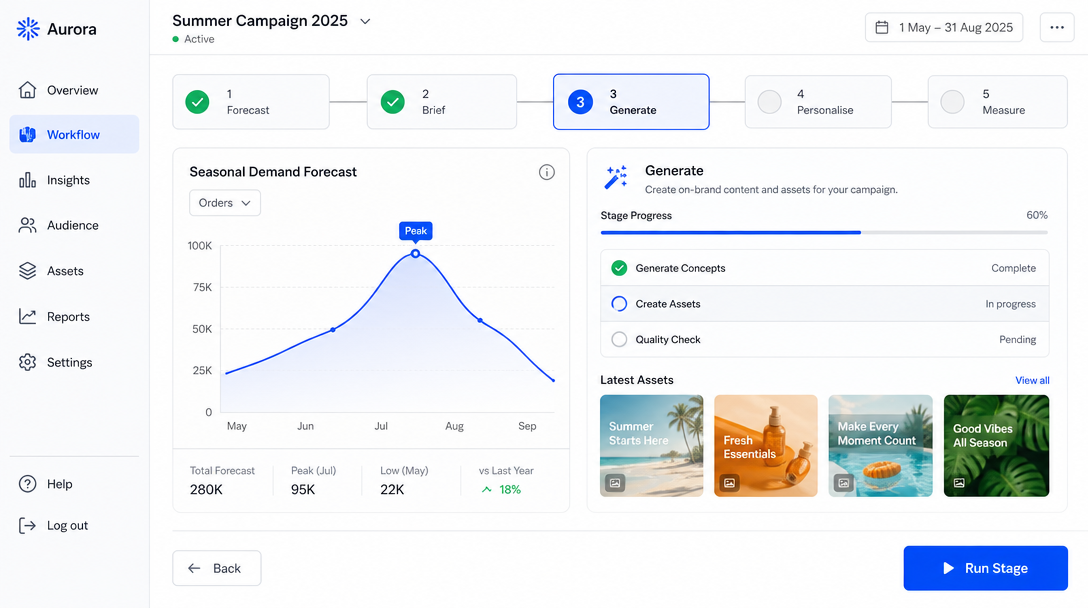
Every seasonal campaign we run for ecommerce clients follows the same five stages: Forecast, Brief, Generate, Personalise, Measure. Each stage produces an artefact the next stage consumes, and each stage is model-assisted rather than model-owned, meaning humans still make the calls that matter. The value of writing it down as a workflow is that it becomes repeatable, auditable, and improvable season on season. Teams new to this rhythm often start with our breakdown of how AI product photography works before layering the other stages on top.
- Forecast: predict demand by SKU, region, and channel using historical plus real-time signals.
- Brief: translate the forecast into a creative brief with concrete deliverables and variants.
- Generate: produce hero, PDP, and ad creative at the volume the forecast demands.
- Personalise: route the right creative to the right segment via email, on-site, and paid.
- Measure: capture what worked, feed it back into next season's forecast and creative library.
Stage 1: Demand Forecasting With AI
Forecasting is the stage most brands still handle in a spreadsheet, which is why they run out of the wrong stock in week three. Modern models blend three data layers: historical GA4 and Shopify performance for baseline seasonality, real-time signals like search trends and social velocity for short-window shifts, and inventory constraints so the forecast is actionable rather than aspirational. Tools like Prophet, ARIMA-based models, Bloomreach, and Triple Whale each cover different slices; the choice depends on data maturity rather than brand size.
For Australian retailers, the forecasting model has to understand that EOFY and Click Frenzy have their own demand curves that look nothing like US Black Friday. A generic North American model will underweight late-June discount sensitivity and completely miss the Melbourne Cup lift for hospitality-adjacent categories. Building or tuning a local model is not optional, and the payoff shows up in inventory turns rather than campaign metrics. Brands running high-SKU catalogues often pair this with our catalog imagery workflow so creative capacity matches forecast volume.

Stage 2: Turning the Brief Into Creative at Scale
Once the forecast is set, the brief writes itself: which SKUs need hero shots, which need lifestyle context, how many ad variants per audience, which aspect ratios per channel. The bottleneck historically was production. A traditional photoshoot for a seasonal push might produce forty finished assets over three weeks. A generative workflow, run against a locked brand profile, produces the same forty concepts in a day, then iterates the winners across every aspect ratio the media plan needs. Our AI product photography service is built for exactly this shape of brief.
Volume alone is not the point. The point is that when creative production stops being the constraint, the media team can request variants they never would have asked for under the old model: a version of the hero for the rainy-Sydney weather segment, a version for the last-minute-gifter Meta audience, a version for the TikTok Shop feed. Each variant is cheap to produce and expensive to skip, because the compounding CTR gains across a peak add up to meaningful revenue. Beauty and homewares brands in particular see outsized returns; see our notes on AI ecommerce imagery for beauty and homewares for category-specific patterns.
Stage 3: Personalisation and Dynamic Product Recommendations
Personalisation is where most seasonal campaigns quietly lose money, because the default is to blast the same hero to the whole list. Segment-level personalisation, driven by Klaviyo predictive analytics or an equivalent CDP layer, routes different creative to different behavioural cohorts: high-AOV historical buyers get the gift-with-purchase angle, lapsed customers get the win-back offer, first-time visitors get the trust-building lifestyle asset. Combined with sub-50ms on-site product recommendations, this shifts conversion rate without touching the media budget. The lifestyle side of the asset library is worth studying separately in our lifestyle photography breakdown.
Subject lines and body copy are the other cheap personalisation win. An LLM producing five subject-line variants per segment, tested live during the peak, will out-CTR a single human-written line most of the time, provided the brand voice is properly encoded upfront. The trap here is over-personalisation creep, where every segment gets its own micro-treatment and the brand starts to feel schizophrenic across channels. A brand system that governs both creative and copy prevents this, which is what our AI branding practice exists to build.
Stage 4: Ad Budget and Bid Automation Across the Peak
During the peak itself, the workflow has to run faster than any human can watch a dashboard. Meta Advantage+ shopping campaigns and Google Performance Max both handle bid and audience automation natively; the layer worth adding is creative rotation logic that detects saturation on a winning asset within hours rather than days. When a hero starts to fatigue, the system pulls the next variant from the pre-built library rather than waiting for a designer to spin one up. Ad platforms handle the media math; the AI content stack handles the creative supply.
Budget reallocation across Meta, Google, and TikTok is the other decision that benefits from automation during a peak. A rules-based layer sitting above the platforms, informed by real-time ROAS and inventory data, can shift spend at a cadence no human team would try. The important guardrail is inventory-aware pacing: nothing burns goodwill faster than aggressively advertising a SKU that sold out on Friday morning. Brands running full-funnel video also benefit from having a flexible AI video pipeline that can produce fresh cutdowns mid-peak.
Stage 5: The Post-Peak Learning Loop
The stage almost every playbook skips is the one that makes the next campaign easier. Post-peak, the workflow captures three data layers: creative performance by variant and segment, forecast accuracy versus actuals, and any anomalies that need human interpretation. All three feed back into the model stack. The creative library gets tagged with performance metadata, so next season's brief starts from winners rather than a blank page. The forecast model retrains with the new season's actuals. The anomaly log becomes the input to the strategy review.
This is the compounding advantage. A brand running its second AI-driven Mother's Day starts from a tagged library of last year's winners, a forecast model that already understands its category's Australian curve, and a personalisation layer with a year of behavioural data. A competitor starting from scratch is running the same race with none of that context. Two or three seasons in, the gap becomes structural.
A Worked Example: Mother's Day for a DTC Skincare Brand
Consider a mid-size Australian DTC skincare brand running Mother's Day end-to-end with this workflow. Six weeks out, the forecast model, blending three years of GA4 and Shopify data with real-time search signals, projects a 3.2x lift on gift sets versus baseline, weighted toward NSW and VIC. The brief translates this into four hero concepts, twelve PDP variants, and around forty ad cutdowns across Meta, Google, and TikTok. Generation runs over two days against a locked brand profile.
Personalisation splits the audience into six segments: existing high-AOV buyers, existing regulars, lapsed six-month, lapsed twelve-month, cold prospecting, and gift-guide traffic. Each segment sees different creative and different copy. During the two-week peak, budget shifts automatically between platforms based on ROAS, with inventory-aware pacing preventing overspend on the two SKUs that sell through by day eight. Post-peak, forty-seven creative variants get tagged with performance data and folded into the library for next year. The workflow itself sits inside a broader automation architecture that clients own outright.
Common Failure Modes
Four failure modes show up repeatedly and are worth naming. Hallucinated product claims are the most dangerous, where a generative copy pass invents ingredients, warranties, or specifications that do not exist. Off-brand generative imagery is the second, usually caused by an under-specified brand profile rather than a model limitation. Over-personalisation creep is the third, where the brand voice fractures across too many segment-specific treatments. Model drift after a viral moment is the fourth, where a single-day traffic spike distorts the forecast for weeks unless the model is explicitly told to treat it as an outlier.
All four are workflow problems rather than tool problems, and all four are preventable with the right review gates. A human editorial pass on any customer-facing copy, a locked brand profile that generative image tools reference on every call, a governance layer for personalisation, and an anomaly-detection step in the forecast retrain: these are the four seatbelts. For teams evaluating AI versus traditional production trade-offs, brand-safety controls are usually the deciding factor rather than raw output quality.
Starter Stack and 30-Day Rollout
| Stage | Starter tool | Owner |
|---|---|---|
| Forecast | Triple Whale or Prophet on GA4 exports | Analytics |
| Brief | Locked brand profile in Notion or Figma | Creative director |
| Generate | Managed workflow producing hero, PDP, and ad variants | Creative partner |
| Personalise | Klaviyo plus Shopify Magic recommendations | CRM lead |
| Measure | Tagged asset library plus post-peak review doc | Marketing lead |
A realistic 30-day rollout runs the forecast build in week one, the brand-profile lock and brief templating in week two, a small generative test batch in week three, and a live micro-season campaign in week four to pressure-test the whole loop before a major peak. Teams often start with a single seasonal moment rather than trying to transform the full calendar at once. Consulting engagements can start with this exact 30-day scope.
Frequently Asked Questions
Do we need a data science team to build the forecasting layer?
No. Off-the-shelf tools like Triple Whale, Bloomreach, and Klaviyo predictive analytics cover most brands under $50M ARR without a dedicated data hire. Custom modelling only pays off once the SKU count and channel mix outgrow what those platforms can express, which is usually a good problem to have.
How many creative variants is enough for a peak?
The honest answer is: more than you think, but not infinite. A useful benchmark for a two-week peak is four hero concepts, three variants each across the aspect ratios your channels need, and enough segment-specific cutdowns to cover your top five audiences. That lands around forty finished assets, which used to be a shoot and is now a two-day generative run.
How do we handle brand safety with generative creative?
Lock a brand profile that every generative call references, run a human editorial pass on any customer-facing copy, and never let a model invent product claims. Brand safety at scale is a governance problem, not a model problem, and the governance layer costs almost nothing to implement compared to the reputational cost of a bad launch.
What about the Australian retail calendar specifically?
EOFY, Click Frenzy, Melbourne Cup, and the January back-to-school wave all need dedicated forecast tuning because the demand curves look nothing like US equivalents. If your forecasting model was trained on US data, it will underweight late-June sensitivity and miss the hospitality lift around Melbourne Cup. Local retuning is a two-week project, not a six-month one.
Can we start with just one stage of the workflow?
Yes, and most brands should. Starting with the Generate stage produces the fastest visible ROI because creative production is usually the tightest bottleneck. Once that stage is running smoothly, the forecast and personalisation stages become easier to justify because they are no longer constrained by creative supply.
How does the post-peak learning loop work in practice?
Tag every creative variant with performance data before archiving it, retrain the forecast model with the new season's actuals within two weeks of peak-end, and hold a structured post-mortem that captures anomalies the model should treat as outliers. Written down, it takes half a day. Skipped, it costs you next year's advantage.
What is a micro-season and should we bother chasing them?
A micro-season is a short-window demand spike surfaced by real-time signals: a heatwave, a viral trend, a sports result. They are worth chasing only if your creative production can turn a concept into live ads within 48 hours. If it cannot, the window closes before you arrive. This is the strongest single argument for owning a generative creative workflow.
How do we know if our brand is ready for this workflow?
Three readiness signals: you have at least two years of clean GA4 and Shopify data, you can articulate your brand voice in a document rather than in someone's head, and your marketing team can commit half a day a week to workflow ownership. If all three are true, you are ready. If any are missing, fix that first.
Where to Start
The teams pulling ahead in seasonal ecommerce are not necessarily the ones with the biggest budgets; they are the ones running a workflow instead of a fire drill. Absolutely AI builds these workflows end-to-end, from forecast tuning to creative production to post-peak review, with an Australian retail lens most global playbooks miss. If your next peak is already on the calendar, the right time to build the workflow was last season and the second-best time is now: start with the creative supply layer and let the rest of the workflow build outward from there.