AI Commercial Photography: Rights, Licensing, and Risk
AI commercial photography introduces two questions brand teams still confuse. Are you legally allowed to publish an AI-generated hero shot in a paid campaign, and can you stop a competitor from copying it next quarter? Absolutely AI treats those as separate problems because the law does, and this is the working brief we give clients before a single prompt is written.
Rights and licensing are where most AI photography programmes stall inside a brand's legal review, not at generation. A short TL;DR before we go deeper: a platform licence tells you whether you are allowed to publish an image in a paid campaign, copyright tells you whether anyone else can copy it back, and indemnity tells you who pays if a third party disagrees. Those are three separate conversations, and treating them as one is why briefs get rejected six weeks after the shoot. This is the working framework we use with brand and agency clients across product, lifestyle, and campaign work, and it maps onto the current 2025 and 2026 case law without pretending the ground has stopped shifting.
Licence Versus Copyright: The Split That Trips Every Brief
Contractual licence and copyright authorship are separate machines. A licence is a promise from the AI platform that you may use the output for commercial purposes, subject to the terms you signed at checkout. Authorship is a question of whether a human made enough creative choices for the output to be a copyrightable work at all. The split between these two ideas is where most legal risk actually sits, because a licensed image is not automatically a protected image.
The United States Copyright Office reinforced this position in its 2025 guidance and the earlier Thaler v. Perlmutter ruling. Without meaningful human authorship, a work generated by an AI system is not eligible for copyright registration in the US. The UK is the outlier, with Section 9(3) of the Copyright, Designs and Patents Act naming the person who arranged the computer-generated work as the author. Australia, the EU, and most APAC jurisdictions sit closer to the US position than the UK one.
The practical implication for a brand is uncomfortable but simple. A hero product shot generated by prompt alone may be perfectly legal for you to publish, and simultaneously impossible for you to enforce against a competitor that lifts it. That gap is what post-generation retouching, layout, and human-authored input assets are for, and we return to those levers later in this piece.
What a Commercial Licence from an AI Tool Actually Covers
Every major platform has a different answer to who owns what and who carries the risk. The differences matter when a shot is going on billboards, not a moodboard. Below is the working shape of the terms as they stand in 2026. Your legal team should still pull the current ToS the week you sign.
| Platform | Commercial use | Output ownership | IP indemnity |
|---|---|---|---|
| Midjourney (Pro/Mega) | Yes, paid tiers only | User owns, subject to licence-back | No |
| OpenAI DALL-E / gpt-image | Yes, on paid API and ChatGPT | User owns | Enterprise only |
| Adobe Firefly | Yes, all paid tiers | User owns | Yes, full for enterprise |
| Google Imagen (Vertex) | Yes | Customer owns | Yes, generated-output indemnity |
| Microsoft Copilot / Designer | Yes, commercial tiers | Customer owns | Yes, Copyright Commitment |
| Stable Diffusion (self-host) | Yes, per model licence | User owns | No |
| Leonardo, Ideogram, Runway | Yes on paid tiers | User owns | Rare or none |
Free tiers are a trap. Midjourney's free credits, for example, sit under a public-domain-style licence with no commercial protection, and most free tiers reserve broader training and reuse rights over your outputs. If a brand is going to paid media, the paid tier is not optional, and the receipt should be filed against the campaign along with the tool you actually used.
Output ownership is not the same as exclusivity. Almost every platform reserves the right to reuse similar images to train future models, and none of them promise your prompt cannot generate a near-identical image for a competitor tomorrow. That is why creative direction, reference control, and unique input assets matter more than the platform brand on the invoice.
Three Risk Vectors Specific to Commercial Photography
Generic art discussions of AI IP do not cover the risks that actually live inside a product or campaign shoot. There are three that come up on every brand brief, and each one has a practical control.
Trademark and Trade Dress in Product Shots
A hero shot rendered on a supermarket shelf will accidentally produce competitor packaging, a Coca-Cola red, a Tiffany blue, or a bottle silhouette close enough to invite a cease-and-desist. Trade dress covers distinctive product configurations even when no logo is visible. The safe practice is to describe negative space in every prompt, review each output for accidental brand hits, and keep category-appropriate references instead of scraping shelf photography.
Likeness and Right of Publicity
AI models generate faces that resemble real people, sometimes uncannily. The right of publicity is state-level in the US and increasingly enforced in Australia through passing off and misleading conduct claims. If a face is going in a paid ad, either commission a real model release for the reference talent, use fully synthetic characters with a documented generation trail, or use a face-swap workflow where the licensed model has signed for that specific use. Do not ship a stock-style AI portrait without a release just because it looks generic.
Training-Data Infringement Claims
Getty Images v. Stability AI in the UK and the New York Times v. OpenAI matter in the US are the two live proceedings brand teams should track. Neither has settled the question of whether models trained on copyrighted works produce infringing outputs, but both put pressure on platforms without an indemnity. Choosing a tool with a documented training-data policy is now a legal choice, not just a taste choice, and it is one of the ways agency-owned workflows reduce a client's exposure.
Indemnification: The Clause Your Legal Team Should Read First
Indemnity is what actually shifts the risk. Adobe Firefly leads here with a full IP indemnity for enterprise customers on generated outputs, provided you have not disabled safety features. Microsoft's Copyright Commitment extends similar protection across Copilot commercial customers. Google's generated-output indemnity on Vertex covers Imagen. OpenAI's Copyright Shield sits inside the enterprise agreement and covers ChatGPT Enterprise and API customers who follow the safety guidance.
Midjourney, Stable Diffusion self-hosts, Leonardo, and most of the smaller platforms carry no indemnity at all. That does not make them unusable for commercial work, but it does mean the brand is carrying the risk itself, and the insurance rider on the campaign should reflect that. This is where the workflow decision meets the finance decision, and legal, procurement, and creative need to be in the same room for it.
How to Make an AI Commercial Shot Defensibly Yours
Because prompt-only outputs cannot be registered for copyright in the US and most of Australia, the practical route to a defensible asset is a stack of human contributions the courts already recognise. None of them require you to abandon AI generation. They add layers around it.
- Human-authored input assets. A real product photograph, a hand-drawn concept sketch, a shot of a real reference model. Feeding these into the generation process anchors human authorship at the start of the chain.
- Documented prompt authorship. Version-controlled prompt history, notes on why choices were made, evidence of iteration. Not a silver bullet, but a growing body of registration decisions credits creative judgement expressed through prompts.
- Post-generation retouching. Meaningful human editing after the model output. This is the strongest lever in current US practice.
- Selection and arrangement. A campaign layout composed of multiple AI images edited by a human attracts a compilation copyright, even if individual images are not registrable.
- Model releases. For any reference talent, and for any output where a real person is recognisable.
None of this is exotic. It is the discipline a traditional shoot already runs on, applied to the new production stack. If the generation workflow treats a brief as a creative document instead of a text-to-image query, most of these levers are already in place before generation starts.
Region-by-Region Cheat Sheet
| Region | Position on AI output | Practical note for brands |
|---|---|---|
| United States | No copyright without meaningful human authorship (Copyright Office 2025, Thaler v. Perlmutter). | Layer human input, retouching, and arrangement to secure registrable rights. |
| United Kingdom | Computer-generated works protected under CDPA s.9(3); author is the person who arranged the generation. | The most brand-friendly jurisdiction, though the position is under active review. |
| European Union | No dedicated AI-output regime; the AI Act adds transparency and content-labelling obligations from 2026. | Plan for disclosure of AI-generated content in ads. |
| Australia | Follows the US position in practice; no human author, no copyright. Passing off and ACL apply to likeness. | Model releases and human authorship layers are essential. |
| China | Beijing Internet Court 2023 recognised copyright in a specific AI image where the user made substantial creative choices. | Case-by-case; document creative decision-making thoroughly. |
Australia is the interesting one for local brands. There is no bespoke AI copyright regime, but the Australian Consumer Law bites hard on misleading conduct, and the courts already handle synthetic likeness through passing off. If a campaign is running in market here, the local production cost picture is not the only factor to weigh, the rights picture matters just as much.
A Pre-Flight Checklist Before an AI Shot Ships
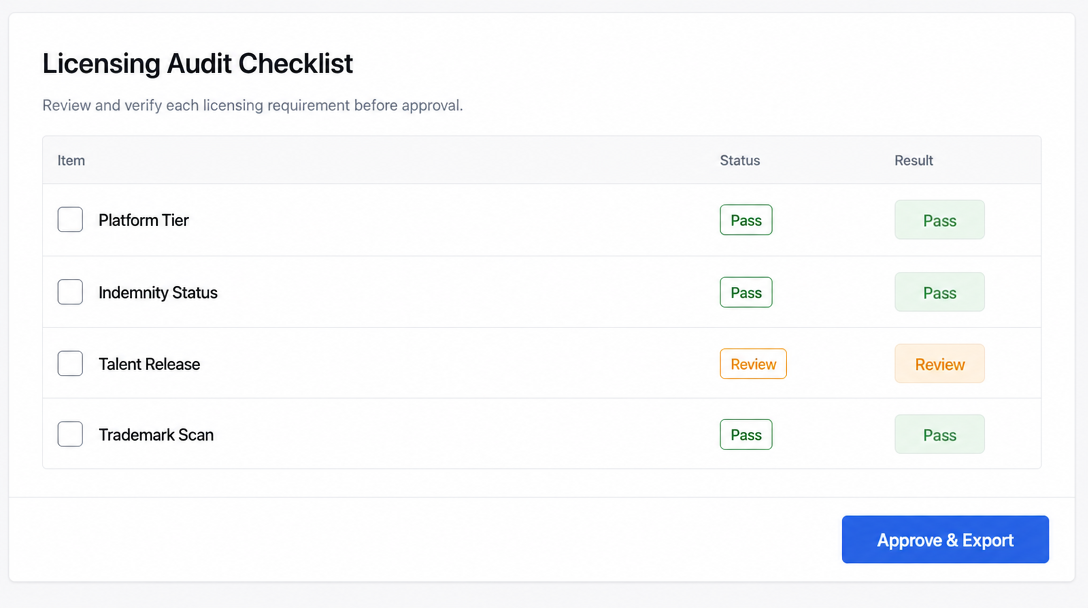
- Rights of every input reference confirmed in writing.
- Platform tier verified as paid and commercial, with the relevant licence terms archived.
- Indemnity clause read, understood, and either accepted or backstopped by the campaign insurance.
- Model releases secured for any recognisable human likeness in the output.
- Trademark and trade-dress scan of the final frame, including background elements.
- Disclosure labels applied where the channel requires them, including Meta, TikTok, and YouTube social-issue and political categories.
- Prompt, seed, model version, and reference set archived alongside the final asset.
- Client contract language covering AI use, indemnity flow-down, and takedown obligations.
- Insurance rider reviewed against the platform indemnity position.
- Documented takedown plan if a third party asserts an IP claim.
Ten items sound heavy on paper. In a well-run commercial workflow, seven of them are handled at brief stage and the remaining three at the final review before a shot goes live. The point is not more paperwork, it is putting the paperwork where it protects the campaign instead of chasing it.
Frequently Asked Questions
Can I use Midjourney images in a paid ad campaign?
Yes, on the paid Pro or Mega tiers. Free credits do not grant commercial rights, and Midjourney provides no IP indemnity, so the brand carries the training-data risk itself. Document the tier, keep the receipts, and consider a platform with indemnity for higher-risk categories.
Does Adobe Firefly's IP indemnity really cover me?
For enterprise customers, yes, provided you have not disabled safety features and you have used the tool as documented. The indemnity is one of the strongest in the market and is a common reason regulated categories choose Firefly for base assets before further creative work.
Do I own an AI-generated hero shot?
You own the licence granted by the platform to use the image commercially. Whether you own copyright in it depends on human authorship, which the US and Australia require and the UK does not. Post-generation retouching and human-composed layouts are the reliable path to a copyright you can enforce.
Do I need to disclose that an ad is AI-generated?
Increasingly, yes. Meta and TikTok require AI-generated content disclosure in specific categories, the EU AI Act adds broader transparency obligations from 2026, and the ACCC in Australia has signalled misleading conduct enforcement where synthetic imagery is passed off as real. Bake disclosure into the channel plan, not the crisis plan.
What happens if a competitor lifts my AI image?
In the US and Australia, if there is no human authorship layer, you may have no copyright to enforce. You may still have trademark, passing off, or unfair competition claims depending on the context. The defensive move is to build authorship layers into every asset, not to rely on the platform licence.
Should we self-host Stable Diffusion to avoid ToS risk?
Self-hosting removes the platform licence question but adds the training-data and infrastructure questions. It suits brands with mature technical teams and a specific reason to control the pipeline. For most, an indemnified platform is safer and cheaper once legal review is priced in.
The Agency View
Rights and licensing are not a legal afterthought on an AI campaign, they are part of the creative brief. At Absolutely AI we build the licensing audit, the indemnity check, and the archival trail into the same document that carries the concept, so the paperwork ships with the shot instead of chasing it. That is the difference between selling a tool and selling a workflow, and it is why brand teams increasingly want an agency partner on the file rather than another subscription.