AI Product Photography Rights and IP: What Brands Own
AI product photography has raced ahead of the legal frameworks that govern it, and most ecommerce brands are running exposed on four fronts they have never audited: input rights, output ownership, likeness, and disclosure. This is the guide Absolutely AI wrote for the brand managers and general counsel we work with, covering the Australian, US, and EU angles you actually need before your next campaign ships.
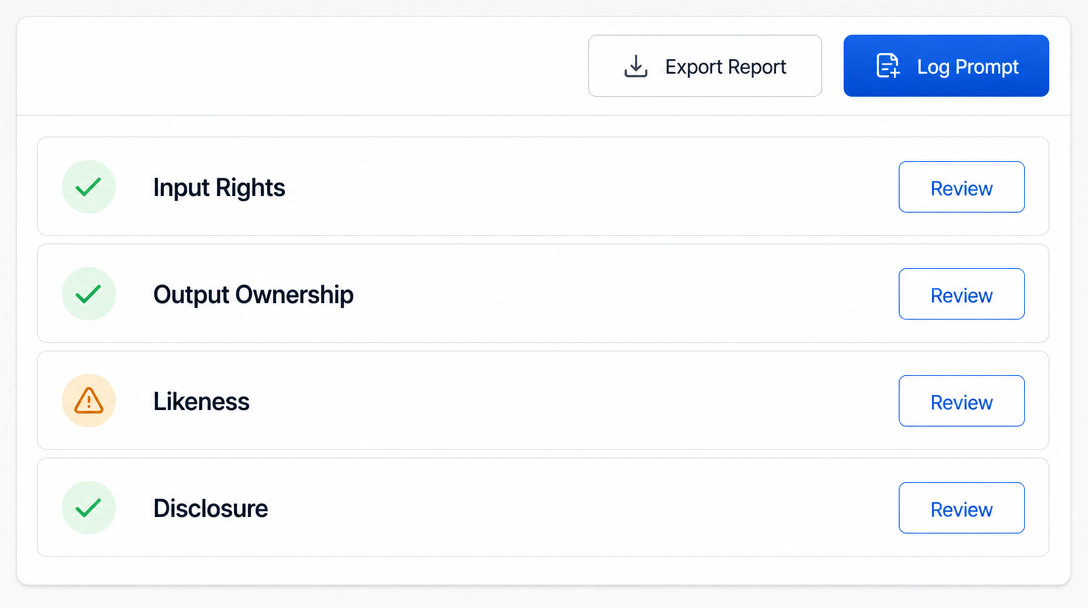
Every brand director we speak to asks the same opening question about AI product photography rights and IP: do we own the image? It is the wrong question. The right question is a four-part audit: who owns the inputs, what does the platform actually assign you, whose likeness or trade dress is in the frame, and what does the deployment channel require you to disclose. Get any one of those wrong and you can lose the copyright, lose a listing, or lose a lawsuit. This guide, written by the team at Absolutely AI, walks through each layer with the Australian, US, and EU rules that apply in 2026.
The four-layer rights stack
Think of any AI image as a stack. At the bottom sit your inputs: the product photograph, the moodboard, the reference silhouette, the model shot you fed to img2img. Above that sits the model, trained on data you did not license and cannot inspect. Above that sits the output, a specific rendered image with its own copyright status. At the top sits deployment: the listing, the ad, the packaging where that image lives. Each layer has its own rights owner and its own regulator, and brands routinely conflate them. Our internal breakdown of how AI product photography works maps the technical pipeline; this article maps the legal one on top of it.
Do you actually own the AI-generated image?
In the United States, the answer is mostly no. The US Copyright Office has held since 2023 that copyright protects works of human authorship. In Thaler v. Perlmutter (D.D.C. 2023, affirmed 2025) the DC Circuit confirmed a fully autonomous AI output cannot be registered. In the Zarya of the Dawn decision the Office cancelled the image registrations for Kris Kashtanova's Midjourney panels while allowing the human-authored text and arrangement to stand.
The UK is the outlier: section 9(3) of the Copyright, Designs and Patents Act 1988 grants authorship of computer-generated works to the person who made the arrangements necessary for their creation. The EU treats AI outputs under its own originality test, which requires the author's own intellectual creation. Australia sits closest to the US: the Copyright Act 1968 has no computer-generated works provision, and the Acohs v. Ucorp and IceTV v. Nine lines of authority require identifiable human authorship. If you want a registrable copyright asset out of an AI render, you almost always need meaningful human editing, compositing, or selection on top, which is the working assumption behind our comparison of AI and traditional product photography.
What the platform Terms of Service actually assign you
Platform terms vary sharply, and most brands never read them. The table below reflects the material commercial terms as of mid-2026. Always re-read the live ToS before signing a campaign off, because these change quarterly.
| Platform | Output assigned to user | Commercial use tier | Indemnity | Training opt-out |
|---|---|---|---|---|
| Midjourney | Yes, on paid plans | Any paid tier; Pro+ for stealth | None | Stealth mode on Pro+ |
| OpenAI (DALL-E / GPT Image) | Yes, user owns output | All tiers | Enterprise only | API opt-out on request |
| Adobe Firefly | Yes | All paid tiers | Yes, commercial indemnity on generative credits | N/A (trained on Adobe Stock) |
| Google Imagen (Vertex) | Yes | Enterprise | Limited generative AI indemnity | Enterprise data not used |
| Stability AI | Yes | Membership required over revenue threshold | None standard | Available via HaveIBeenTrained |
| Runway | Yes on paid | Standard and above | None standard | Enterprise only |
Two lines matter more than the rest: the indemnity column and the commercial tier column. Firefly is the only major consumer-facing tool offering a genuine commercial indemnity on standard plans, which is why it dominates in-house brand teams that cannot absorb third-party IP risk. Everywhere else, the risk sits with you, which is a factor we walk clients through when they price out a program against our Australian AI product photography cost benchmarks.
The input problem: reference images, moodboards and product shots
This is the layer brands miss most often. When your agency feeds a photographer's hero shot into an img2img or a reference-conditioned model, the photographer still owns copyright in the seed image. Owning the physical product does not give you the copyright in every photograph of it. If your original SOW with the photographer was a licence for ecommerce use and social, feeding that image to an AI model to derive new imagery is almost certainly outside the licence scope.
The fix is contractual, not technical. Every photographer SOW from this point forward should either be a work-for-hire assignment of copyright in all deliverables and derivatives, or an express written licence to use the outputs as training or conditioning inputs for AI systems, with attribution and moral-rights waivers where lawful. For agency SOWs, the equivalent clause assigns all IP in AI-generated outputs to the client on payment, with a warranty that inputs were cleared. The comparison of Pebblely, Photoroom, and agency workflows explains why self-serve tools rarely carry these warranties and full-service partners typically do.
Training-data lawsuits and downstream brand risk
The headline cases, Getty Images v. Stability AI, Andersen v. Stability AI, and New York Times v. OpenAI, are fought between rights-holders and model builders. Brands almost never end up as defendants in these suits. The risk that reaches you is downstream: a training-data injunction that pulls a model version, a marketplace policy that delists imagery generated on a challenged platform, or a supplier that loses its commercial licence overnight. This is why sophisticated buyers ask which model version produced each asset, keep archived provenance, and prefer indemnified platforms for anything that will run at scale on paid media, a discipline we build into every project across our AI commercial production workflow.
Trademark, trade dress and packaging
A clean AI render can still infringe. The Lanham Act in the US, the Trade Marks Act 1995 in Australia, and the EU Trade Mark Regulation all protect distinctive product configurations, colours, and packaging. If your generator drifts and produces a bottle silhouette that reads as a competitor's trade dress, or a Pantone-matched colourway associated with another brand, you carry the exposure. Prompt hygiene helps: name your own SKU, describe your own configuration, avoid competitor names in negative prompts, and human-review every hero for accidental trade-dress collisions before it goes live on Amazon or Shopify.
Likeness and right of publicity
Synthetic models are the fastest-growing risk surface in AI product photography, and the regulatory response has moved quickly. New York's SAG-AFTRA-backed likeness bill S.8420-A, the Tennessee ELVIS Act, and California's AB 2602 and AB 1836 all restrict the use of digital replicas of real people without consent. GDPR Article 4 treats facial data as biometric data, and the EU AI Act's transparency provisions require disclosure of deepfakes. Australia has no dedicated right of publicity, but the tort of passing off and section 18 of the Australian Consumer Law both bite where a synthetic face reads as a real endorser.
The safe posture is a written synthetic-model release: an internal document that records the reference set used to build a synthetic character, confirms no living person's likeness was used without consent, and assigns any derivative likeness rights to the brand. For campaigns that use real talent whose likeness is then AI-augmented, negotiate an explicit AI clause into the talent agreement covering the scope, the term, and the models permitted. Our AI branding practice ships these releases as standard on any project involving a face.
Disclosure rules that already apply to your listings
Disclosure is where enforcement is currently loudest. In the US, FTC Section 5 and the 16 CFR Part 255 Endorsement Guides require that material characteristics of an image be disclosed where a reasonable consumer would be misled. In practice, that means a fully synthetic hero, presented as a photograph of the actual product in use, can be a deceptive act.
The EU AI Act's Article 50, applying from August 2026, requires providers and deployers to mark AI-generated content and disclose deepfakes. Marketplace policies have moved ahead of the law: Amazon requires accurate representation of the actual product; Etsy restricts AI listings without disclosure; Meta and TikTok require AI-labelling for realistic synthetic content in ads. In Australia, section 18 of the Australian Consumer Law prohibits misleading or deceptive conduct, and the ACCC has signalled AI-generated imagery as a priority. A short disclosure line in your listing copy and a Content Credentials (C2PA) tag in the asset itself is now the defensible minimum, and it is a standard part of how we ship work through our AI content creation program.
A defensible workflow
The brands we work with land on the same working stack once they have run this audit end-to-end. Adopt it as a template.
- Photographer SOW clause: work-for-hire assignment of all copyright in deliverables and derivatives, or an express licence permitting use as AI inputs, with warranties on third-party clearances.
- Agency SOW clause: assignment of all IP in AI-generated outputs to the client on payment, a warranty that inputs were cleared, and a written record of the models and versions used.
- Prompt and seed log: archive prompt, seed, reference URLs, model version, and platform for every published asset. This is your evidence base if a listing is challenged.
- Synthetic-model release: internal release for every recurring synthetic character, confirming no unlicensed likeness and assigning derivative rights to the brand.
- Disclosure copy template: a short listing line ("Product visuals include AI-assisted imagery. Product specifications are accurate.") plus C2PA Content Credentials embedded in the file.
- Human editing step: a documented human authorship layer on every hero asset to preserve the strongest available copyright position.
Frequently Asked Questions
Can I register the copyright in an AI product photograph?
In the US and Australia, only the human-authored elements are protectable. A pure text-to-image output is generally not registrable, but a composited, edited, or human-arranged work built on AI outputs can be, and the registration should disclaim the AI-generated portions.
Can competitors legally copy my AI-generated image?
If the image has no protectable copyright, the underlying image is not covered by copyright law. However, your trade dress, trademarks, and any registered designs in the depicted product still apply, and passing off or misleading conduct claims are available where a competitor uses your imagery to trade on your brand.
Do I need to disclose AI use on Shopify, Amazon, or Etsy?
Shopify has no platform-level requirement but you are still bound by consumer law in each market. Amazon requires accurate product representation. Etsy explicitly requires disclosure of AI involvement. Meta and TikTok require labelling for realistic synthetic content in paid placements. Adopt a single disclosure standard across channels and you avoid the exceptions problem.
What is the Australian position specifically?
Australia has no computer-generated works provision, so purely autonomous AI outputs are unlikely to attract copyright. Section 18 of the Australian Consumer Law prohibits misleading or deceptive conduct in trade, which covers AI imagery that misrepresents a product. The ACCC has flagged AI-generated content as an enforcement priority, and trade mark and passing-off rules apply as normal.
Does Adobe Firefly's indemnity really cover me?
Firefly's commercial indemnity applies to eligible outputs generated on paid plans, subject to Adobe's terms. It is the strongest indemnity in the mainstream market, but it does not cover downstream uses that infringe trademarks, trade dress, or right of publicity, which remain your obligation.
What about Content Credentials and C2PA?
C2PA Content Credentials attach a signed, tamper-evident record of an image's origin and edit history. Adopting them for AI product photography is not yet a legal requirement in most markets, but it satisfies emerging EU AI Act obligations, supports marketplace disclosure policies, and gives you an evidentiary trail if a listing is challenged.
Do I need a written release for a synthetic model who does not exist?
Yes, as an internal document. It records the reference set used, confirms no unlicensed real-person likeness was used, and assigns derivative likeness rights to the brand. It is cheap to produce and expensive to be without.
The takeaway
AI product photography rights and IP is not a single question with a single answer. It is a four-layer audit that touches your photographer contracts, your platform choices, your talent releases, and your listing copy. Brands that treat it as an afterthought lose listings and lose leverage; brands that build the workflow above get faster, defensible, and calmer. If you want a partner that has already run this audit and ships imagery with the contracts, releases, prompt logs, and disclosure copy in place from day one, that is exactly what Absolutely AI's product photography service is built to do.