AI Commercial Shoot Turnaround Time: What to Actually Expect
A single hero image and a full multi-format campaign sit at opposite ends of the same pipeline, and the gap between them is not the shutter, it is the coordination around it. Absolutely AI scopes timing against the brief rather than against a vendor-marketing slogan. Here is what actually drives it.
Every brand manager evaluating AI production asks the same first question: how fast, really. The vendor answer is usually a headline number stripped of context, and the traditional-agency answer is a three-to-six week block that assumes a shoot day, a studio booking, and a courier of physical product. The truthful answer lives between them, and it varies sharply by deliverable. This piece maps what is realistic per deliverable, the hidden time sinks that vendor blogs skip, and an hour-by-hour view of what a campaign timeline actually looks like. Commercial work is scoped against the brief rather than sold on a headline number.
The short answer: typical AI commercial shoot turnaround times
Before the caveats, the numbers. These are realistic ranges assuming a locked brand profile, hosted reference assets, and a single decision-maker on the client side. Rush is possible on the top of the range, but it eats revision rounds, so we usually recommend against it for anything that will run as paid media. Our product photography workflow is built around these bands.
| Deliverable | Realistic turnaround | Revision rounds included |
|---|---|---|
| Single hero product shot | 1-4 hours | 1 |
| Product plus lifestyle set (8-12 images) | 24-48 hours | 2 |
| 15 second AI video ad | 2-3 days | 2 |
| Multi-format campaign (stills plus video, all aspect ratios) | 5-10 days | 2-3 |
| In-flight revisions or reshoots | Same day | Included |
Two things sit behind those numbers. First, most of the time is not generation, it is decisions: brief clarity, reference approval, brand-safety review. Second, the ranges assume the categories are unrestricted. Beauty, alcohol, finance, and anything touching talent likeness add legal review time we cover further down.
AI vs traditional shoot timelines, stage by stage
The honest comparison is not shutter-versus-render, it is coordination-versus-iteration. A traditional shoot compresses most of the artistic decisions into one physical day, then spends weeks around it on logistics. An AI shoot spreads decisions across a shorter arc, with revision loops that used to require a reshoot now happening in hours. Our full breakdown of the two approaches lives in the AI vs traditional product photography comparison.
| Stage | Traditional shoot | AI shoot |
|---|---|---|
| Pre-production | 1-2 weeks (casting, location scouting, prop sourcing) | 1-2 days (brand profile, references, storyboard) |
| Shoot day | 1-3 days on location or in studio | 2-6 hours of directed generation |
| Post and retouch | 1-2 weeks | 4-24 hours |
| Revisions | Reshoot required, add 1-2 weeks | Same session, minutes to hours |
| Total | 3-6 weeks | 1-10 days |
The bottleneck in the traditional column is almost never talent or gear, it is the calendar Tetris of getting product, studio, crew, and client sign-off aligned on the same date. AI removes the shipping and studio-booking constraints entirely, which is where most of the compression comes from.
What actually eats the days in an AI shoot
If generation itself takes minutes, why does a campaign take a week. Because the work around the generation is where the real hours go. On a typical commercial engagement, our internal time-tracking breaks down roughly as follows:
- Brief clarity and brand profile extraction (15-20%). Turning a written brief into a structured brand profile, aesthetic direction, and shot list. If this is skipped, revisions balloon.
- Reference asset preparation (10-15%). Hosting product photos, packaging renders, and moodboard references at stable HTTPS URLs the generator can read.
- Model and prompt iteration (25-30%). The first grid is rarely the final answer. Directed iteration on composition, lighting, and mood is where the aesthetic quality is won.
- Brand-safety and legal review (10-20%). Especially for regulated categories or anything resembling a real person.
- Upscaling, retouch, and delivery (15-20%). Fixing hands, cleaning edges, upscaling to print resolution, packaging aspect-ratio variants.
Turnaround by deliverable type
Blended averages are misleading because a hero still and a 15 second video have almost nothing in common operationally. Here is what each deliverable actually costs in time when we walk through the process end to end.
Hero product shot
A short job from brief to delivery, assuming references are already hosted. Most of the time is one round of directed iteration to nail the composition and lighting.
Lifestyle grid (8-12 images)
24-48 hours. The multiplier is not generation, it is maintaining a consistent aesthetic across scenes, models, and props. Batched prompts and a locked style reference cut this significantly.
Vertical social ad (still)
4-8 hours if adapted from a hero, 24 hours if built fresh. Reformatting to 9:16 without cropping key elements requires re-generation, not a crop.
Hero video (15-30 seconds)
2-3 days for a single spot. Storyboard approval is usually a full day on its own, then shot-level generation, then edit, colour, and sound. Our AI video workflow compresses this by pre-approving the storyboard before any shot is generated.
Storyboard-to-video campaign
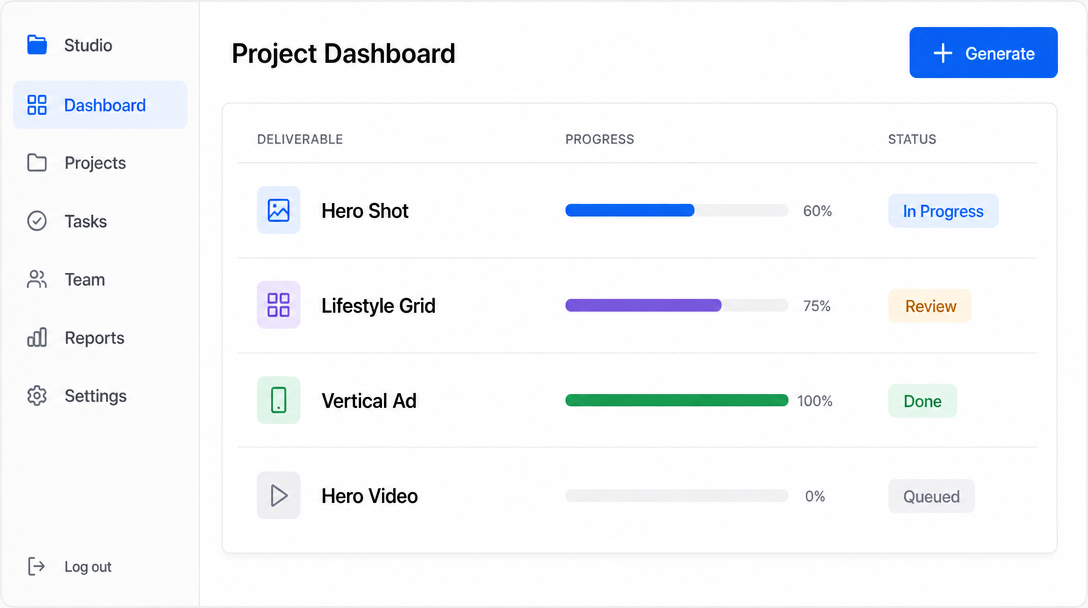
5-10 days end to end. Multiple video spots, still assets, and every aspect-ratio variant for paid media. This is where structured project management earns its keep.
How to compress it further
Most clients who hit the top of the range do so for reasons that are entirely fixable next time. The compression levers we recommend to every ongoing account are structural, not technical.
- Lock the brand profile once. A written brand profile with aesthetic direction, palette, tone, and shot preferences means every future project skips a day of upfront work.
- Host references at stable URLs. Packaging, hero product photos, and moodboards need to live at HTTPS URLs the generator can read directly. Local files add a courier step.
- Batch prompts and generate in parallel. Ten prompts fired concurrently return in the time of one. Serial iteration is the slow path.
- Single reviewer, single revision window. Committee reviews multiply rounds. One decision-maker with a defined feedback slot compresses the timeline more than any technical change.
- Pre-approve aspect ratios. Deciding upfront that you need 1:1, 4:5, 9:16, and 16:9 means we generate all variants in the first pass instead of re-running the set.
When AI is slower than you think
Speed claims collapse in specific categories. Being honest about these upfront prevents timeline blowouts and, more importantly, tells you when a hybrid shoot is the right call. The rights and IP considerations in some of these categories also extend review time.
- Hands, text, and logos. Still the hardest three subjects. Add 2-4 hours of retouch for anything featuring visible hands holding product, on-pack text, or a brand mark that must render exactly.
- Regulated categories. Beauty and skincare claims, alcohol serving contexts, financial services imagery: legal review adds 1-3 days depending on jurisdiction.
- Talent likeness approvals. If the imagery resembles a real person, closely or loosely, expect a separate approvals cycle before anything ships.
- Physically accurate ingredient shots. Hero food and beverage close-ups where texture, condensation, or ingredient accuracy sells the product are still faster to shoot practically and composite in.
- Complex product compositing. Reflective, transparent, or highly technical products often need a photographed base plate the AI builds around.
A realistic 72-hour campaign timeline
To make the ranges concrete, here is how a three-day multi-format campaign actually runs when the brand profile is locked and references are hosted. This is the exact rhythm we run for clients on our commercial production track.
Day 1: brief to storyboard
Morning: brief intake, brand profile confirmation, deliverable list finalised. Afternoon: shot list, moodboard, storyboard drafted and sent for approval. Evening: reference assets uploaded, aspect ratios locked, prompts drafted.
Day 2: generation and iteration
Morning: hero stills and key frames generated in parallel batches. Midday: first-pass review with the client, feedback consolidated. Afternoon: revisions, video shot generation kicks off, aspect-ratio variants queued.
Day 3: post, retouch, delivery
Morning: hand and text retouch, upscaling to delivery resolution. Midday: video edit, colour, sound design. Afternoon: final review, packaging into a delivery folder, handoff.
Frequently Asked Questions
How long for a single AI ad?
A single 15 second AI video ad is realistically 2-3 days from brief to delivered file, including one revision round. A single still hero image is a far shorter job from a clear brief.
Is a 24-hour turnaround realistic?
It can be for a single hero still or a small lifestyle set, provided the brand profile is locked and references are already hosted. For video or a multi-format campaign, 24 hours is not realistic without cutting the revision round, which we do not recommend for paid media.
How many revision rounds are included?
One round for a single hero, two rounds for a set or single video, two to three rounds for a multi-format campaign. Additional rounds are available but usually indicate the brief needed more work upfront.
Do rush fees exist?
We do not charge rush fees for stills within our standard bands. For video or campaigns compressed below the ranges above, we quote a rush uplift only when it displaces other scheduled work, and we are transparent about which revision rounds are being traded away.
What slows a project down most often?
Committee reviews and unhosted reference assets, in that order. A single reviewer with a defined feedback window and references living at stable URLs compress timelines more than any generation improvement.
Is AI always faster than a traditional shoot?
For most brand and ecommerce work, yes. For hero food and beverage close-ups, complex reflective products, or campaigns built around a specific real person, a hybrid approach is often faster and always more reliable.
Honest ranges beat headline numbers. A single hero in an afternoon and a full campaign inside two weeks is the real ceiling of what AI production can deliver right now, and the levers that get you there are structural, not technical. If you want that speed applied to a specific launch or always-on content pipeline, Absolutely AI plans production around these bands rather than promising numbers the work cannot back up.