AI Commercial Photography vs Studio: The 2026 Verdict
Most 'AI vs studio' pieces answer a marketplace question when creative directors are asking a campaign question. Absolutely AI works on both sides of that line every week, and the honest verdict is that hybrid wins for commercial work, AI-only wins for catalogue scale, and studio-only wins almost nothing anymore. Here is how the maths, the rights, and the craft actually break down in the Australian market.
The debate that lands in most creative directors' inboxes reads like a spreadsheet question, but it is not. It is a craft question with a cost tail. A campaign hero for a national OOH buy has almost nothing in common with 500 PDP tiles for a marketplace refresh, and the answer to 'should we shoot or should we generate' depends entirely on which of those two briefs is on the table. Our team at Absolutely AI runs both, often on the same client in the same quarter, and the frame we use is simple: first classify the brief, then choose the workflow.
Here is the one-line verdict up front. Catalogue at scale is AI-only. Campaign hero is studio-led hybrid. Brand launch is studio plus AI extensions. Everything else is a negotiation. The comparison below covers the six dimensions that actually decide the call.
| Dimension | Traditional Studio | AI-Only | Hybrid (Studio + AI) |
|---|---|---|---|
| Cost per finished asset | High, fixed | Very low, variable | Low after amortisation |
| Turnaround | 2 to 6 weeks | Hours to days | Days to 2 weeks |
| Creative control | Total | High, with skilled direction | Total on hero, high on extensions |
| Rights and usage | Clean, standard | Grey in regulated categories | Clean on source, managed on derivatives |
| Brand consistency | Excellent | Variable | Excellent |
| Best fit | Campaign hero, brand launch | SKU catalogue, social variants | Everything commercial |
Commercial photography is not e-commerce photography
Most of the ranking pages on this topic answer a marketplace-seller question and assume the reader wants Amazon-ready white-background tiles at $2 apiece. That is a real brief, but it is not what a brand manager at a challenger drinks company means when they ask about commercial photography. Commercial work means campaigns, OOH, editorial placements, brand-led social, and the hero imagery that anchors a launch. The wider AI vs traditional debate collapses if you treat those two categories as one.
The consequence is that any tool comparison written for Shopify sellers is close to useless for a creative director briefing a national campaign. Pebblely, Photoroom, and the marketplace generators solve a real problem, but they are not evaluated against brand-guide fidelity, art-direction faithfulness, or multi-channel deliverable consistency. When you look at those requirements, the shortlist collapses to a much smaller set of tools and a much bigger reliance on human direction.
Cost breakdown in Australian market terms
Every published cost comparison we found runs in USD against US day rates. Australian numbers look different, and the ratio between studio and AI shifts once you localise. A national-tier commercial photographer in Sydney or Melbourne charges roughly $5,500 to $9,500 per shoot day in 2026. Add a producer at $1,800, a stylist at $1,400, a first assist at $850, and the crew line alone is $9,500 before you touch a lens.
Studio hire for a professional infinity cove sits between $1,600 and $2,400 per day. Post-production for campaign-grade retouching runs $180 to $350 per hero image at three to five hours a piece. Licensing for talent, if there is a person in frame, adds a further $2,000 to $12,000 depending on term, territory, and media. A single campaign day producing three finished hero images lands between $22,000 and $38,000 all-in. Our own Australian cost teardown unpacks the line items in more detail.
- 50-SKU catalogue refresh, AI-only: quoted as one project covering creative direction, prompt engineering, output curation, and a QA pass. Turnaround around five business days.
- 50-SKU catalogue refresh, studio-only: roughly $28,000 to $42,000 over two to three shoot days plus post. Turnaround three to five weeks.
- Single-hero campaign, studio-only: $22,000 to $38,000 for one day producing three finished heroes.
- Single-hero campaign, hybrid: the same $22,000 to $38,000 shoot day, plus a scoped creative fee for 40 to 80 AI-derived extensions across social, lifestyle, OOH crops, and video storyboards.
The maths cuts both ways. For flat catalogue, AI wins by an order of magnitude and there is no craft argument against it. For a campaign hero, the studio number is unavoidable and the AI question is only about what you do with that source shoot afterwards.
Speed, scale, and where each model actually wins
Speed is the dimension most often oversold. Studio work is not slow because photographers are slow, it is slow because commercial production has a locked sequence: brief, pre-pro, shoot, select, retouch, approve, deliver. Each stage has a client-side approval loop, and the loops are the bottleneck. AI collapses the shoot and retouch stages to hours, but the brief, select, and approve stages do not compress. A well-run AI product photography workflow saves days, not weeks, when the rest of the client machine still runs at its natural pace.
Where AI does dominate is volume. Producing the fortieth variant of an already-approved concept is where studio economics fall apart and AI economics stay flat. The reverse is also true. A brand-new hero concept, never shot before, with talent, wardrobe, and location decisions still open, is where studio economics stay reasonable and AI economics collapse because the number of directed revisions balloons past the point where prompt engineering is faster than a callback.
Creative control and where AI still breaks
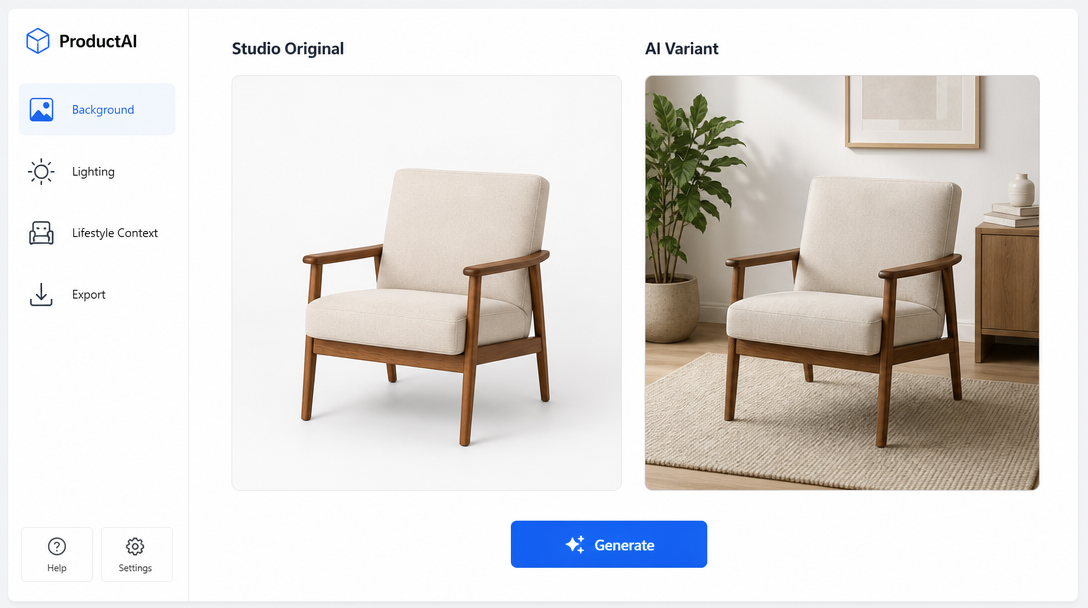
The 2026 generation of image models is close enough to studio quality for background swaps, lifestyle context, seasonal recolours, lighting variants, and set extensions that the difference is invisible at delivery size. The failure modes are narrower than they were and mostly concentrated in three places: hands and complex human interaction with the product, hero-critical brand details like embossing and label geometry, and multi-subject scenes where continuity across a set matters. On regulated categories, the failure modes matter more, and the supplements category in particular punishes label errors hard.
The practical response is not to avoid AI on those briefs, it is to source-shoot the specific frames where AI breaks and use AI everywhere else. That is the entire hybrid argument in one sentence. Skilled art direction on the AI stage covers most of the remaining gap, which is why the tool matters less than the person driving it.
Rights, liability, and disclosure
Every competing article on this topic skips the layer that actually keeps commercial work legal. Talent releases, category-specific advertising codes, and AI-disclosure guidance from the ACCC and the AANA are not optional. If a person appears in your AI output and their likeness resembles a real individual, you have a rights problem the model licence will not solve for you. Our deeper explainer on rights and IP in AI product photography covers the mechanics.
For regulated categories, the picture tightens further. Therapeutic goods, food, alcohol, and financial services carry additional disclosure and substantiation requirements that make photorealistic AI imagery risky when the depicted product state, effect, or usage context is material to the claim. The safe path is to source-shoot the compliance-sensitive frames and use AI for the extensions where the depiction is neutral. This is not a legal opinion, it is standard risk hygiene.
The source shoot as an amortised asset
This is the argument no competitor owns and the one that actually reshapes the ROI conversation. One well-planned studio day, shot with AI extension in mind from the pre-pro stage, produces a source library that feeds 40 to 80 downstream assets across social crops, hero variants, seasonal recolours, lifestyle context swaps, OOH extensions, and even motion storyboards. The studio day is the fixed cost. Every AI-derived asset after that is close to marginal-zero.
Run the numbers on a typical challenger-brand quarterly. A single $28,000 shoot day amortised across 60 finished assets lands at $467 per finished asset before AI extension costs, and the AI stage adds only a modest amount on top. Compare that to the $700 to $1,200 per finished asset a pure studio workflow would deliver on the same volume. This is the actual commercial argument, and it only exists if the shoot is briefed for AI extension from the start rather than retrofitted afterwards.
Decision framework for commercial briefs
- Catalogue at scale, no talent, standardised composition: AI-only. There is no craft argument for the studio route at this end.
- Campaign hero, first-of-kind concept, talent in frame: studio-led hybrid. Shoot the hero, generate the extensions.
- Brand launch or repositioning: studio for the anchor set, AI for every derivative across channels. Treat the shoot as a library.
- Regulated category with compliance-material depiction: studio for anything the claim depends on, AI only for neutral extensions.
- Always-on social and A/B creative testing: AI-only, driven off a source library refreshed every quarter.
Frequently Asked Questions
Is AI commercial photography good enough for national campaigns?
For extensions off a strong source shoot, yes. For the campaign hero itself on a first-of-kind concept with talent, not yet, and probably not for another cycle. The honest hybrid answer beats both extremes.
How much cheaper is AI than a studio day in Australia?
For catalogue work, roughly an order of magnitude cheaper. For campaign work, the studio day is not replaced, it is amortised, which changes the per-asset cost dramatically without eliminating the shoot line.
Do we need to disclose AI-generated imagery in Australian advertising?
The AANA and ACCC guidance is category-dependent, and the safe rule is to disclose when the depiction is material to a claim or when a reasonable consumer would be misled by assuming the image was photographic. Legal review, not a blog post, is the right answer for a specific brief.
What about talent likeness and rights?
Any recognisable human likeness in AI output carries the same rights profile as a photograph of that person, and possibly a worse one. Use released talent, or use AI in ways that do not depict identifiable individuals.
Which AI tools work for commercial briefs?
The tools that let you control brand guidelines, reference imagery, and multi-channel aspect ratios in a single pipeline. Marketplace-first tools rarely clear that bar. The tool landscape shifts every quarter, so the answer changes.
Can we run this in-house?
You can run the catalogue side in-house once the pipeline is set up. Campaign and hybrid work benefits from an agency team because the craft ceiling is the operator, not the tool.
How long does a hybrid brief take end to end?
A pre-pro week, a shoot day, and one to two weeks of AI extension and QA. Roughly three to four weeks from brief to full delivery for a 60-asset campaign package.
What is the biggest mistake brands make here?
Retrofitting AI extension to a shoot that was not briefed for it. Plan the extension in pre-pro, or accept a much smaller yield from the source library.
The honest answer to 'AI or studio' in commercial photography is that the framing is already out of date. The real question is how you brief a shoot so it feeds a much larger downstream library, and how you run that library so the brand stays consistent across every channel it lands in. That is the workflow Absolutely AI is built around, and it is the one that makes the maths, the craft, and the compliance layer all line up.