AI Commercial Photography: 7 Real Brand Campaigns and What They Proved
Zalando reported a 14% engagement lift on AI-generated model imagery. Superside benchmarked an 85% production cost reduction for select fashion e-commerce clients. Coca-Cola shipped a fully AI-assisted Holiday spot. Absolutely AI has watched this shift happen in real time, and the pattern is now clear: AI commercial photography is no longer a lab experiment, it is a live line item on brand marketing budgets.
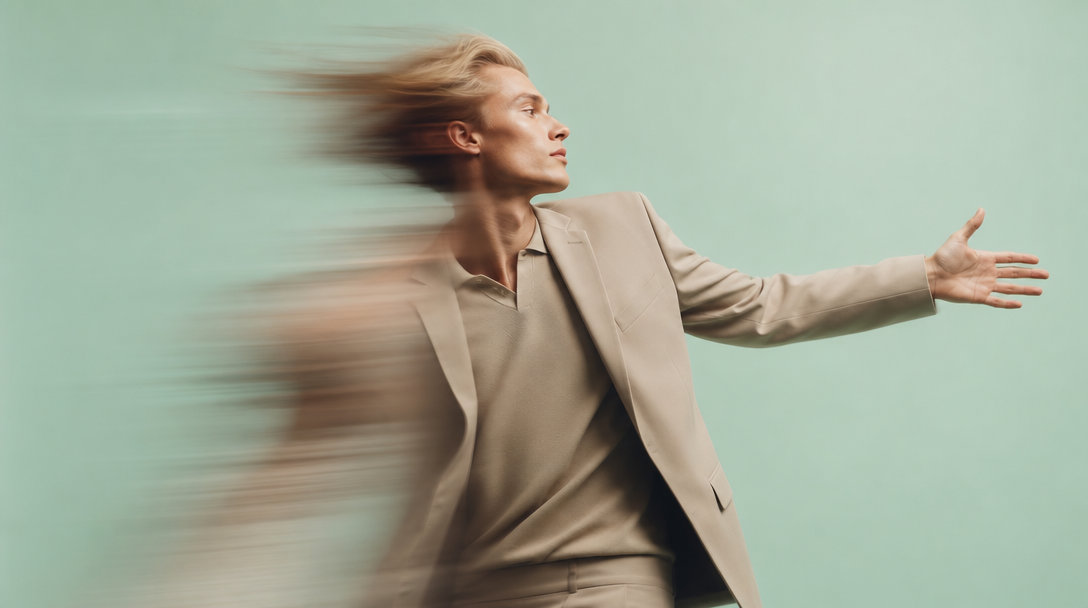
The most useful way to understand where AI commercial photography actually sits in 2026 is to stop reading the discourse and start reading the campaigns. Named brands, dated launches, quantified outcomes. This is a guided tour of seven real projects, the tool stacks behind them, what they achieved, and what an AI commercial engagement looks like when a brand hires a studio like Absolutely AI to run one end to end.
Why commercial photography is AI's first big brand win
Commercial photography is unusually well suited to AI adoption because the buyer's economics are punishing. A national fashion retailer needs the same jacket photographed on eight body types, in four seasonal environments, across six aspect ratios, and refreshed every drop cycle. That is not a craft problem, that is a throughput problem, and the industry has been quietly optimising for throughput for a decade already.
AI collapses the two most expensive slots in a traditional shoot brief: the environment build and the reshoot cycle. A creative director can now stage a Moroccan riad, a Tokyo alleyway, and a Palm Springs poolside for the same product in an afternoon. That is why the earliest adopters are e-commerce and FMCG, not editorial or luxury. Volume brands feel the pain first and the productivity gain is immediate, which our team at product photography sees in every intake call.
The hybrid model is how the good campaigns actually get made
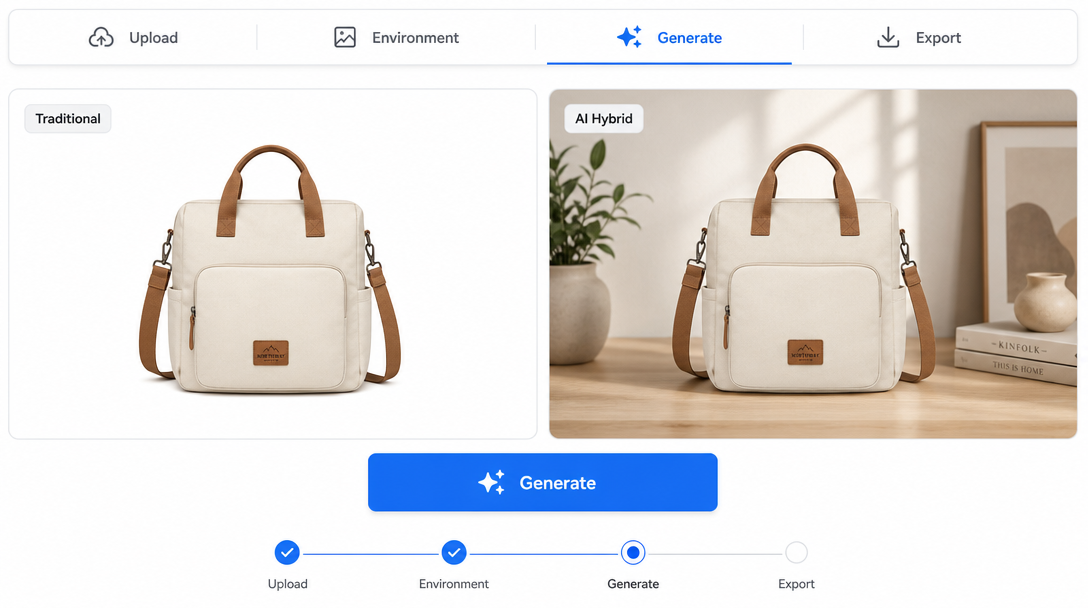
Almost every serious AI commercial campaign in 2025 and 2026 has used a hybrid pipeline: photograph the physical product on a controlled studio background, then composite that hero product into an AI-generated environment. Pure text-to-image generation of the product itself is still where quality control breaks down for anything with a defined SKU, logo, or texture the customer will match against the physical item in hand. The nuance is covered in more depth in our AI vs traditional product photography breakdown.
| Approach | Turnaround | Quality ceiling | Ideal use case |
|---|---|---|---|
| Traditional shoot | 3 to 6 weeks | Highest for hero + luxury | Flagship campaigns, editorial covers, on-body luxury |
| Hybrid AI (studio product + AI environment) | 3 to 7 days | Campaign-grade across all channels | Seasonal drops, always-on social, catalog expansion |
| Full-AI generation | 24 to 72 hours | Concept and social only | Mood films, concept boards, disposable social units |
The comparison table matters because the wrong pipeline destroys the campaign. A brand that sends a full-AI generation into a hero e-commerce slot ends up with an SKU mismatch and a returns spike. A brand that sends a hybrid pipeline into a mid-funnel social series ends up with campaign-grade output at social speed. Choosing correctly is the first job of the creative director on the account, and it is a decision our AI consulting team walks new brands through in week one.
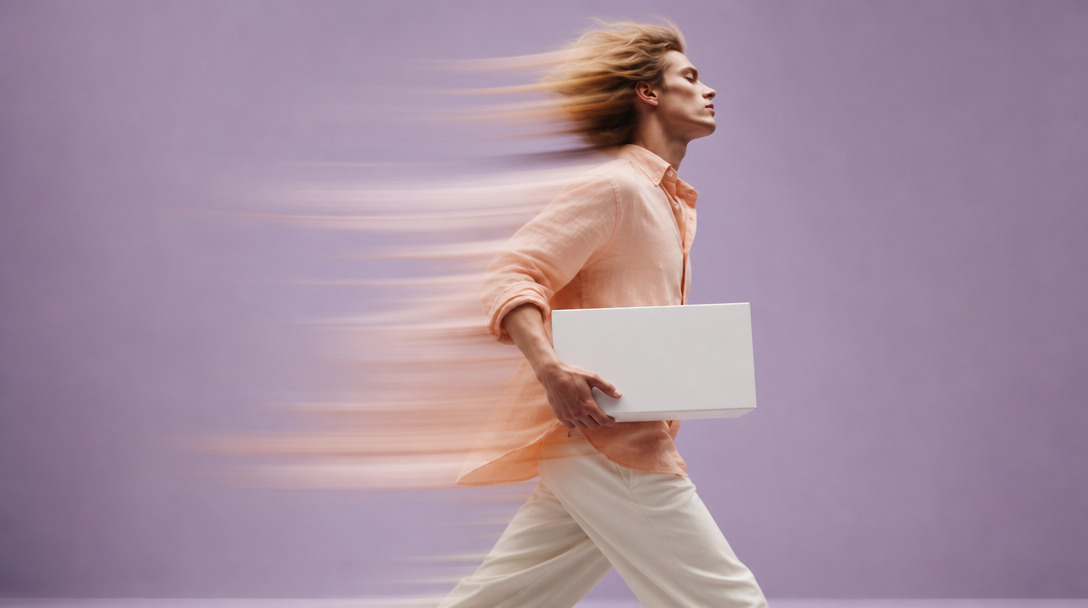
Case study one: fashion and e-commerce at scale
Mango Teen, Sunset Dream, July 2024. Mango's youth line launched a summer campaign in which the entire environment, from the pastel dusk to the poolside architecture, was generated in Midjourney and refined through Adobe Firefly, with the garments composited from studio captures. Mango reported it as their first end-to-end generative campaign and the launch coincided with a measurable lift in engagement across the Teen line's social channels. The insight that only AI made possible: five distinct summer worlds shot in a season when only one location shoot would have fit the calendar.
Zalando digital doubles, 2024 to 2025. Zalando publicly stated it now uses AI-generated model imagery for roughly 70% of on-model editorial, with cited production time compression from six to eight weeks down to three to four days per campaign. Their internal reporting flagged a 14% engagement lift on AI imagery over the equivalent traditional shoots in test cells. The pipeline uses proprietary tooling built on Stable Diffusion foundations with a curated model library that includes talent who have licensed their likeness.
H&M digital twins, March 2025. H&M partnered with thirty models to create licensed digital twins, deployed initially across social and campaign imagery. The insight impossible without AI: talent can appear in Stockholm and Seoul in the same week without a flight. The tension impossible to ignore: the industry conversation about model day-rate substitution moved from theoretical to live overnight, a topic we cover in our rights and IP explainer.
Case study two: FMCG and product-on-shelf
Coca-Cola Holiday, November 2024. Coca-Cola shipped a fully AI-assisted Holiday film built with Runway, Kling, and an internal creative team, remaking the visual DNA of the classic Holidays Are Coming spot in generative motion. The reception was polarised, which is itself the finding: FMCG brands have to plan their communications strategy around AI backlash as a first-class variable, not a footnote. The film pipeline around campaigns like this now looks nothing like the traditional agency brief.
Wayfair catalog derivatives, ongoing. Wayfair uses AI environments to derive dozens of room-scene variants from a single studio product capture, allowing the same sofa to appear in a coastal cottage, a Brooklyn loft, and a Scandi apartment for different audience segments. This is the most operationalised, least glamorous use of AI commercial photography, and it is where most of the actual industry volume lives today.
Case study three: challenger brands with no shoot budget
Kalshi NBA Finals, June 2025. Prediction market Kalshi ran a national linear TV spot during the NBA Finals produced almost entirely with generative tools for a reported budget in the low thousands, against category incumbents spending seven figures on the same slot. It is the cleanest example on the record of AI as a creative equaliser: a challenger brand bought national reach it structurally could not have afforded twelve months earlier.
Popeyes AI diss track, 2025. Popeyes' AI-driven diss campaign against a competitor showed that fast, culture-native creative can now be produced inside a news cycle rather than around one. The insight: AI commercial content has collapsed the response window from weeks to hours, which changes what a challenger brand's content operation should even look like.
What AI commercial photography still cannot do
Honest scope-setting is what separates a serious studio from a hype merchant. AI still struggles with the specular behaviour of luxury fabrics under motion, with the microtextures of skin at extreme close-up on hero talent, and with anything requiring a genuine live event or documented moment. It is unreliable for regulated categories where the on-pack claim must exactly match the depicted product. Photographer Tim Tadder has been among the most articulate industry voices on where the ceiling actually sits, and his critiques land where they should.
The right posture for a brand is not maximalism but portfolio thinking: hero luxury and covers stay traditional, always-on social and catalog expansion moves to hybrid AI, and pure concept exploration moves to full-AI. Our branding practice helps clients draw those lines before the first shot is generated, not after.
How an AI commercial photography brief actually runs
The workflow inside a modern AI studio follows a repeatable rhythm. Brief and strategy is day one to two. Concept generation across Midjourney, Firefly, and internal tooling is day two to four. Studio capture of the physical product happens in parallel where hybrid capture is required. Hybrid composition and iteration runs day four to six. Quality control, brand compliance, and disclosure review is day six to seven. Delivery in every channel-native aspect ratio closes the week. A commercial engagement typically ships 20 to 40 finished assets against a single brief on that timeline.
Disclosure is now a live compliance question, not an ethics seminar. H&M and Mango labelled their AI-generated imagery in-campaign. Coca-Cola did not label the Holiday spot and absorbed the reaction. The framework we recommend is simple: disclose when the depicted human is generated or digitally cloned, disclose when the environment could reasonably be mistaken for a place the brand promises the product will function in, and stay silent when the AI intervention is purely production efficiency on an already-photographed product.
Frequently Asked Questions
Is AI commercial photography suitable for a luxury brand?
Selectively, yes. Luxury flagships and hero covers should stay traditional. Always-on social, look-book expansions, and concept films can move to hybrid AI without disturbing the brand's visual bar, provided the studio running the work has real luxury creative direction on the account.
How long does an AI commercial photography campaign take?
A hybrid AI campaign typically runs concept to final delivery in five to seven working days. Pure full-AI mood work can close in 24 to 72 hours. Traditional shoots on the same brief usually take three to six weeks.
What tools are actually used on real campaigns?
The recurring stack across the case studies covered here is Midjourney and Adobe Firefly for still imagery, Stable Diffusion and ComfyUI for controlled production pipelines, and Runway plus Kling for motion. Studio capture of the physical product almost always sits alongside the generative work in a hybrid pipeline, as our tool breakdown covers in more depth.
Do we need to disclose AI in the imagery?
Disclose when the depicted human is generated or digitally cloned, and when the environment could reasonably be mistaken for a real place the brand implies. Silence is defensible when AI is used purely as a production tool on an already-photographed product, but the industry norm is trending toward more disclosure, not less.
What sort of brand is best positioned to start with AI commercial photography?
Brands with high SKU count, frequent seasonal drops, always-on social calendars, and a channel mix that demands many aspect ratios of the same asset. Challenger brands with limited traditional budgets are also natural early adopters because AI meaningfully expands what they can produce at all.
How is a modern AI studio different from a traditional agency?
The creative direction bar is identical. The production model is not. A modern AI studio ships more variants, more aspect ratios, and more concept exploration per brief, and it operates on a weekly rather than monthly clock. Senior creative direction still owns every frame that ships.
Every campaign covered here was live commercial work by a named brand with a documented outcome. That is the correct standard of proof for a marketing director evaluating whether AI commercial photography is a live option for the next planning cycle. If it is, the next step is a specific brief, not a general conversation. Absolutely AI runs commercial photography intakes on a rolling basis and the shortest path from this article to a campaign in market is a short call about the drop you have coming up next quarter.