Kling 4.0 for Brand Video: What It Actually Means
Kling AI unveiled 4.0 at Advertising Week New York in late September 2026, and the headline spec is doing the rounds: thirty seconds of generated video in a single pass. The team at Absolutely AI has been testing it against live brand briefs since the Flash variant hit limited early access. The short version: this is less a feature bump and more a rewrite of how brand video gets scoped, briefed, and shipped. Here is what changes, what does not, and how to deploy it this quarter.
When Kling AI announced 4.0 on 28 September 2026 and showcased it on stage at Advertising Week New York, most coverage ran straight to the spec sheet. That is the wrong lens for brand teams. The thing that matters is not that a single prompt now returns thirty seconds of video. The thing that matters is that the stitched-clip workflow, the one every AI video shop has been quietly living with for two years, just collapsed into one generation. Shot lists, continuity passes, keyframe stitching, the whole middle of the pipeline shortens dramatically. Budgets, timelines, and briefs all have to move with it.
What Kling 4.0 actually is, and what it is not yet
Kling 4.0 Flash is in limited early access on the annual tier as of October 2026, with the full 4.0 release rolling out through the month. Flash is the faster, lower-cost variant; full 4.0 is the quality tier. Across public coverage there is some ambiguity between what is in preview, what is behind a paywall, and what is generally available, so treat anything you read about 4.0 as a moving target until your account shows the feature live.
It is worth placing 4.0 in the lineage. Kling 2.x and 2.5 Turbo were strong single-shot tools, competitive on motion and physics but still bounded by short durations and shaky continuity across cuts. 4.0 is a different proposition: longer takes, multi-shot continuity, and reference-locked characters and products. The tool category has shifted from clip generators to narrative generators, and 4.0 is the clearest expression of that shift so far.
The specs that matter for brand work
Stripping the marketing gloss, five capabilities actually change what a brand team can commission:
- Single-pass generation up to 30 seconds. Previous generation tools topped out around five to ten seconds per clip. A standard social cutdown now fits in one generation.
- Multi-shot continuity toward roughly two minutes stitched. Characters, lighting, and wardrobe hold across cuts without a separate reference pipeline.
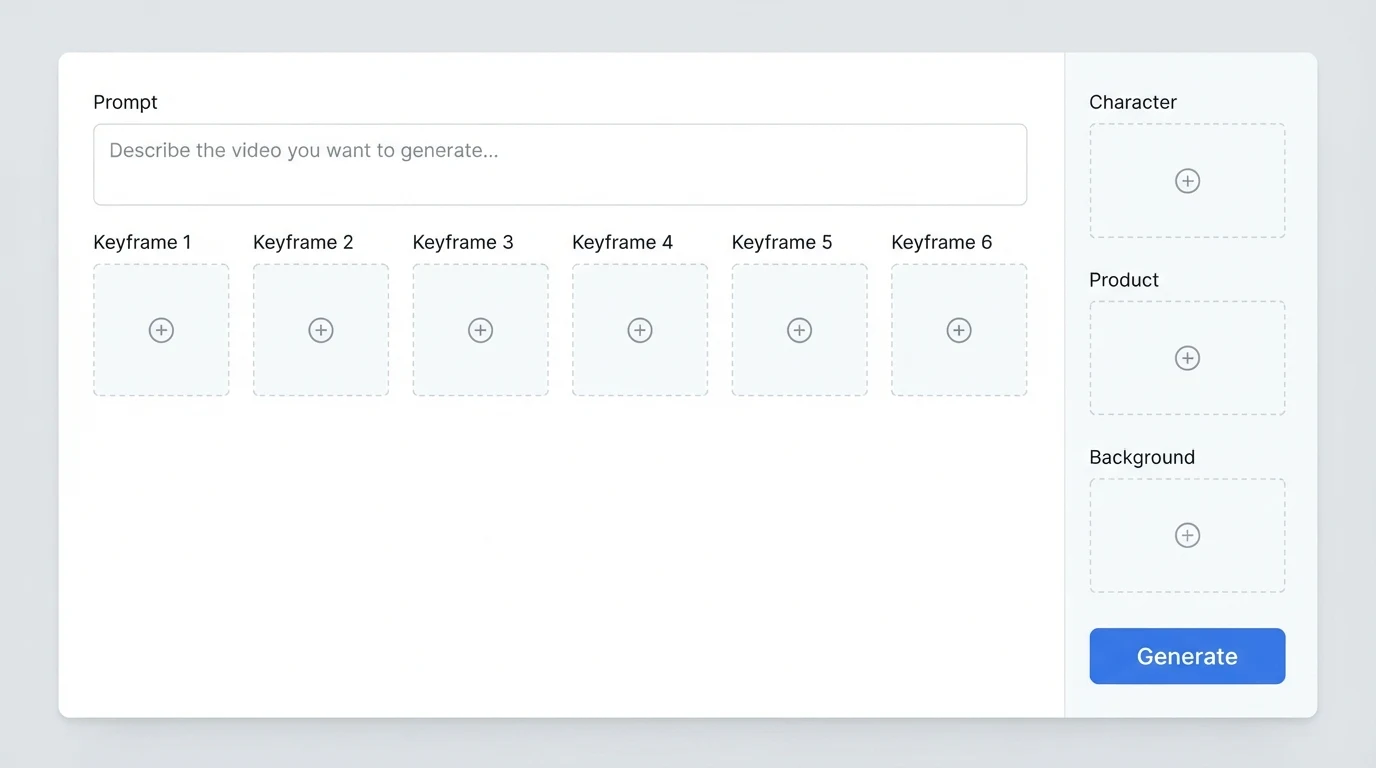
- Up to ten keyframes per generation. You can pin narrative beats, so the model interpolates between your chosen moments instead of improvising the whole arc.
- Omni Reference. Up to ten reference images, five reference clips, and seven subjects can be locked into a single generation. This is the feature that finally makes product fidelity and character consistency workable for commercial briefs.
- Native stereo audio and lip-sync across more than ten languages. Localisation stops being a separate post stage.
There is also a reported prompt window near eight thousand tokens and a Director Mode that expands and structures prompts automatically. In practice this means the brief itself becomes a creative artifact rather than a one-line request, which is a shift we will come back to.
What this unlocks for brand teams
The thirty-second ad without a camera is the obvious one, and it is real, but it is not the most interesting unlock. Four workflow changes matter more:
Character and product consistency across scenes
The killer gap in every prior AI video tool was that your hero bottle, your packaging, or your spokesperson drifted between cuts. Omni Reference closes that gap for most product categories. For skincare, supplements, and food brands in particular, the fidelity now sits at a level where paid social is on the table rather than a stretch goal; our team has written separately about how this plays out for skincare.
Localised campaign assets without a second shoot
Multilingual lip-sync means a master film can be regenerated in ten-plus languages with mouth movements that track the dub. For brands running regional variants, this collapses a line item that used to need a localisation vendor into a batch job.
Rapid concept testing before committing to live shoot
Hero films still get a camera. But the five concepts you were weighing before approving the hero? They can be generated in a day and paid-tested in a week. The commercial decision on which concept earns the budget gets made on real audience data instead of a stakeholder room.
A/B creative testing at twenty times the volume
Performance teams running Meta and TikTok know the volume game. 4.0 makes it practical to ship twenty variants of the same core idea, with different opening hooks, pacing, and payoff beats, into a paid social program every fortnight.
Where it still breaks for brands
Honesty matters here. 4.0 is a step forward, not a solved problem, and the places it still breaks are predictable.
Commercial rights, personality rights, and watermarks. Free-tier output carries a watermark. Commercial use terms vary by plan and are evolving. Personality rights, meaning the right to generate a likeness that resembles a real person, remain the single highest-risk area; a stylised actor the model invents is not safe to assume is clean. For anything running as a paid ad on Meta or TikTok, legal sign-off on the output is still required, and the right answer for most brands is to brief this through a studio rather than DIY it.
Vendor-claimed specs versus confirmed capability. The thirty-second number is accurate for favourable prompts. Complex multi-subject scenes with heavy motion still show artefacts, hand distortions, and physics breaks under stress. Treat the spec sheet as a ceiling, not a floor.
What still needs a camera. Talent-led hero films, tactile product hero moments where you need the actual pour, splash, or texture of a specific product, and campaigns anchored on a founder or athlete all still want live production. The AI versus traditional question is no longer either-or; it is a shot-by-shot decision inside a single campaign.
How Kling 4.0 compares to the field
Veo 3, Sora 2, Hailuo from MiniMax, and Runway Gen-4 are all legitimate options for brand video right now. Each has a different sweet spot.
| Tool | Strongest at | Weakest at | Best brand use |
|---|---|---|---|
| Kling 4.0 | Long single-pass takes, character and product lock, multilingual lip-sync | Preview-vs-GA ambiguity, complex multi-subject physics | Narrative social cutdowns, localised campaigns, pre-vis |
| Veo 3 | Prompt adherence, cinematography feel, native audio | Access gating, slower iteration | Premium brand films where feel matters |
| Sora 2 | World coherence, imaginative scenes | Rights framework, product fidelity | Concept exploration, moodfilms |
| Hailuo (MiniMax) | Expressive character motion, speed | Shorter durations, continuity | Punchy social hooks, UGC-feel content |
| Runway Gen-4 | Editor-grade control, inpainting, workflow integrations | Raw generation quality vs leaders | Post pipelines, finishing, VFX |
For a brand team standing up its first AI video program this quarter, the honest recommendation is to run two tools in parallel rather than pick one. Kling 4.0 plus Runway Gen-4 is the most useful pairing right now: Kling for narrative generation, Runway for cleanup, inpaint, and finishing.
How to actually deploy Kling 4.0 this quarter
A deployment plan beats a wishlist. Here is how we would stage it for a brand bringing AI video into the marketing mix for the first time.
Week 1: paid-social variants
- Pick one existing live film with known performance data.
- Generate ten variants in Kling 4.0, varying hook, pacing, and payoff.
- Push into a Meta or TikTok test cell against the control.
- Read the data in seven to ten days.
Week 2: localisation pass
Take the winning variants and regenerate them in your top three non-English markets using the lip-sync feature. Compare pickup against the English control in each market.
Week 3: concept exploration for the next hero
Before you commit a camera budget, generate five concept routes for the next hero film. Use these as pre-vis for stakeholder sign-off and as a paid-social test to validate which route the audience actually reacts to.
Week 4: pitch films and sales enablement
The quiet winner. Internal pitch films, investor updates, and sales deck video get generated in a day instead of being skipped. The ROI on this one is almost pure margin because the alternative was no video at all.
The brief-writing shift this forces
The single most under-discussed consequence of 4.0 is what it does to the creative brief. When a prompt produces five seconds, the brief is a shot description. When a prompt produces thirty seconds with ten pinnable keyframes and a reference library, the brief is a mini treatment. The craft moves back toward classical storytelling: beats, turns, payoff, lighting continuity, wardrobe logic. Teams that treat Kling 4.0 as a faster clip generator will get faster clips. Teams that treat it as a short-film generator will get short films, and that is where the commercial advantage actually sits.
Frequently Asked Questions
When was Kling 4.0 released?
Kling AI announced 4.0 on 28 September 2026 and showcased it at Advertising Week New York in early October 2026. Kling 4.0 Flash entered limited early access on the annual tier, with the full 4.0 release rolling through October 2026. Treat any specific capability as subject to change until it appears live in your account.
Can I use Kling 4.0 output in a paid ad campaign?
Commercial use is permitted under paid tiers, with watermark removal tied to subscription level. The caveats that matter are personality rights for any generated likeness, brand and product trademark fidelity, and the specific platform policies of Meta, TikTok, and YouTube on AI-generated creative. Legal sign-off on the final output is still required, and the safest path for high-spend campaigns is to run the generation through a studio that will indemnify the delivery.
What is the difference between Kling 4.0 Flash and the full 4.0?
Flash is the faster, lower-cost variant designed for iteration and volume. Full 4.0 is the quality tier with the full feature set, including the longer single-pass durations and the complete Omni Reference stack. Most brand teams will use Flash for variant testing and the full tier for finishing the hero cut.
Which competitor is the biggest threat to Kling 4.0?
For brand video specifically, Veo 3 is the closest head-to-head on narrative quality and native audio, while Runway Gen-4 competes on editor-grade control rather than raw generation. Sora 2 is further along on imaginative scenes but behind on commercial product fidelity. The best brand programs today use two tools in parallel rather than committing to one.
How much does Kling 4.0 cost?
Pricing sits on tiered subscriptions with the full 4.0 feature set gated to the annual plans. Public tier pricing changes frequently and is best checked at klingai.com before scoping a project. For a brand team, the more useful number is the total cost of a campaign including creative direction, review cycles, and finishing, which is where studio engagement economics tend to beat raw tool subscriptions.
The bottom line
Kling 4.0 is the first AI video tool that lets a brand team scope a thirty-second ad as one generation instead of a stitched workflow. The specs matter, but the real shift is in the brief: creative directors are writing short-film treatments again, not shot lists. The brands that will get the most out of this quarter are the ones that pair Kling 4.0 with disciplined concept development and finishing craft, not the ones that treat it as a faster clip tool. The team at Absolutely AI is running 4.0 live on brand briefs now, and the pattern is clear: the tool rewards taste, not prompt tricks.