AI Video for Sports Marketing: The 2026 Marketer's Playbook
Sports marketing runs on moments, deadlines and fragmented fan audiences, and AI video has moved from novelty reel to a working production tool for brand spots, personalised sponsor assets and automated highlight packages. Absolutely AI works with clubs, leagues and sponsors as they reframe what is shootable and what is generative. This piece is a playbook: the use cases, the toolchain, the rights trap and the week-by-week workflow.
Sports marketing runs on moments, deadlines and fragmented fan audiences. In 2026 the production economics behind that work are being rewritten by a generation of AI video tools that are finally good enough for broadcast-adjacent creative, cheap enough for hyper-personalised sponsor assets, and fast enough to turn around the kind of highlight packages that used to live inside linear broadcast rights. Absolutely AI works with clubs, sponsors and agencies as they rebuild their creative pipelines around that shift. This piece is a working playbook: the use cases, the toolchain, the rights trap and the week-by-week workflow a brand lead can run from Monday morning.
Why AI video is reshaping sports marketing in 2026
Three forces are pushing sports brands toward generative video at once. Production cost per asset has collapsed for anything that does not require a stadium, a shoot day or an athlete call. Speed has reversed, with concept-to-rough-cut now measured against the news cycle rather than a traditional post schedule. And multilingual, multi-market reach can be baked in at generation time instead of layered on in post, which matters when a Premier League or NBA sponsor is now expected to activate across half a dozen regions in parallel. The caveat is important: live action still matters, and anything that depends on the sweat, the crowd roar or the recognisable athletic moment belongs on a real camera. The question is not whether AI replaces the shoot, but which slice of the annual slate it absorbs. See our view on cinematic AI film work for how we think about the split.
What that reframes for a marketing director is the shape of the content calendar itself. The budget that used to buy one hero spot and a handful of social cutdowns can now fund a hero shoot plus a generative long tail: localised cutdowns, athlete-led personalisation, sponsor variants and reactive content around results and transfers. The brands that are winning are the ones treating generative video as a parallel pipeline rather than a cheaper version of the old one, which is how an AI-native marketing partner typically approaches the planning phase.
The five highest-leverage use cases
1. Hero brand spots that blend AI with real footage
The most defensible use of generative video in sport right now is the hybrid spot: a traditionally shot core, extended with AI-generated environments, crowd scenes, or impossible camera moves. BodyArmor's 'Field of Fake' campaign, which built a satirical world around the trope of fabricated sports stories, and Nike's 'Airborn' treatment are both quoted in trade press as examples where generative tools opened up imagery that would have been impractical to shoot. The lesson for a brand team planning a generative commercial is that AI should sit inside a clearly authored piece of filmmaking, not pretend to be the whole thing.
2. Athlete-led personalisation at scale
A single base clip of an athlete, licensed properly, can seed many variants that address a specific fan by name, local club, home ground or season-ticket row. This is the use case that justifies the category to a CFO, because it collapses the gap between a hero spot and a direct-response asset. The economics shift as audience size grows: a smaller fan base makes sense as a one-to-few activation, while a tier-one league needs batched, template-driven rendering. The adjacent craft here is closer to a social-first creative pipeline than to a traditional TVC.
3. Dynamic sponsor insertion and localisation
Geo-swapped logos, dubbed voiceovers and market-specific product shots used to be an expensive post-production problem. In a generative workflow, the sponsor layer is a variable at generation time: the kit, the hoarding, the end card, the language of the match-day call. This is where sponsors with multi-market deals can finally run creative that honours each region's buying habits rather than exporting a single English-language asset with subtitles. If the plan is to systematise this across a season, the content pipeline is where it lives.
4. Automated highlights and social clips
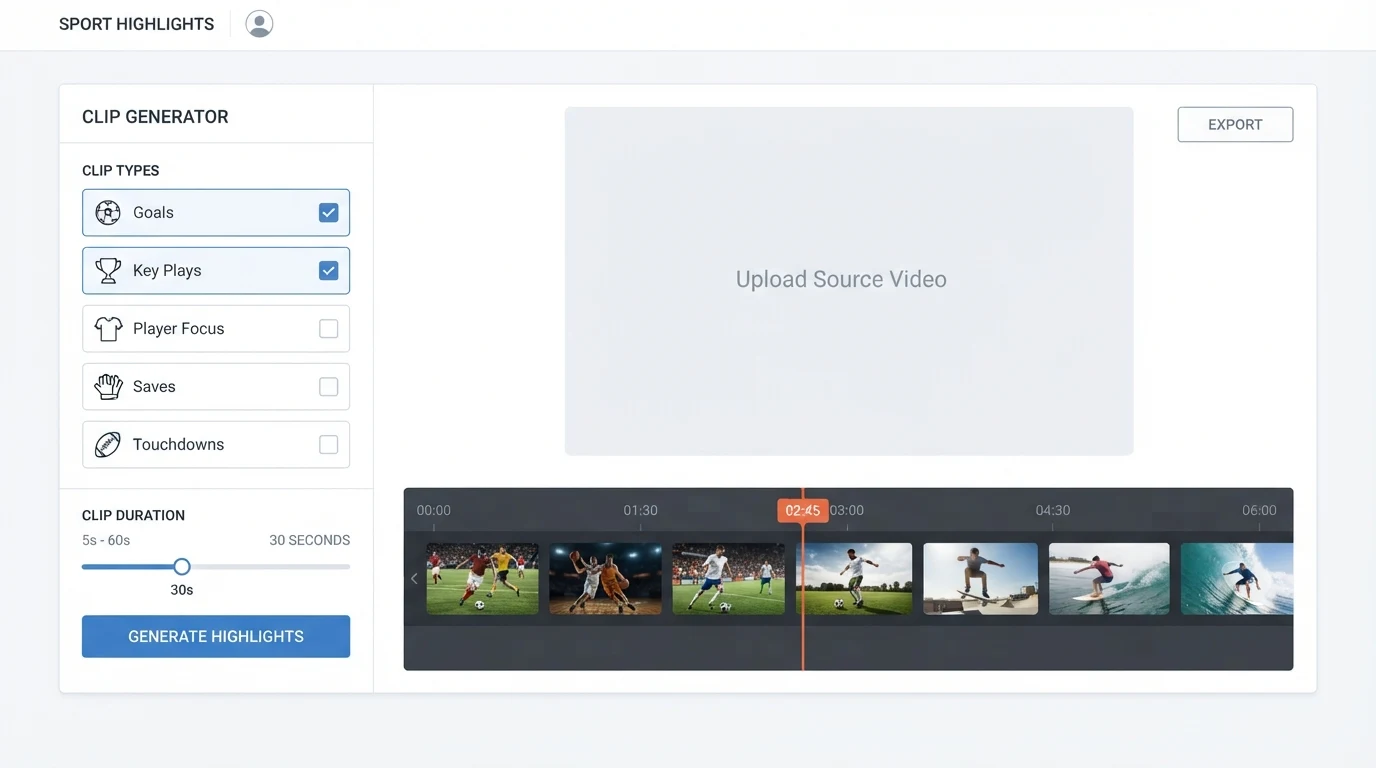
Platforms like Minute.ly and auto-clipping tooling from the broadcast side, including Ateme's work in this space, are already carving long-form matches into publishable social edits, often with branded intros, outros and sponsor bugs applied by rule rather than by hand. For clubs with a small social team and a weekly fixtures list, this is often the first AI investment that pays for itself inside a season. Pair it with motion graphics and the output starts to look like a dedicated animation unit rather than a shortcut.
5. Rights-respectful athlete likeness activations
The headline use case, and the riskiest. Mission Foods' campaign featuring Lionel Messi with the Argentine Football Association, and the Malaria No More spot in which David Beckham's likeness was dubbed into multiple languages using synthetic voice and face work, are the public examples most often cited as doing this responsibly, because the athlete and the governing body signed off on the specific use. The non-negotiable in any likeness project is explicit, scoped consent, and the brand-side playbook starts there, not in the tool.
Case studies worth copying
BodyArmor's 'Field of Fake' is the current reference point for a brand using generative video self-aware. The campaign leaned into the discourse around synthetic media rather than hiding its tools, which turned a technology question into a brand voice question. For teams working through their own hero concept, the pre-production stage is where that decision gets made, which is why we spend so much time on AI storyboarding for brand video.
Mission Foods' partnership with the Argentine Football Association, which used an AI-driven dub of a Messi message, is the cleanest example of how a likeness-led activation looks when the governing body is in the room. The campaign ran as reported with the AFA's and the player's involvement, which is the point: scoped consent for a specific message in specific languages. Teams planning their first likeness piece should treat the structure as a TVC-style pre-production process rather than a social experiment.
On the volume side, Infront's work with Minute.ly on automated highlight packaging across rights deals, and campaigns like Heinz's 'A.I. Ketchup', which used generative imagery as the central creative device, show the two ends of the spectrum: operations automation and conceptual flex. Most sports marketing programs will sit between them, which is where a social-first storyboard approach earns its keep.
The AI video toolchain for sports teams and sponsors
No single model wins. The honest answer in late 2026 is that teams run a stack, picking per-shot based on motion, likeness fidelity, and whether the shot includes a kit, a logo or a crowd. The table below is a working comparison for the sports use case specifically, not a general ranking. Deeper notes on how pre-production shapes which model gets used live in our AI pre-production guide.
| Tool | Best for sports work | Watch-outs |
|---|---|---|
| OpenAI Sora | Cinematic hero shots, dreamlike environments, stylised crowds | Athletic motion still inconsistent on complex ball physics |
| Google Veo | Longer takes, camera moves, atmospheric stadium exteriors | Kit and logo accuracy often needs post clean-up |
| Runway Gen-4 | Director-friendly controls, image-to-video, VFX integration | Short clip lengths require stitching for long form |
| MiniMax Hailuo | Fast iteration, strong on human faces and gesture | Resolution ceiling can sit below broadcast finish |
| HeyGen avatars | Athlete and brand-rep talking-head work with multilingual dubbing | Lip-sync can give away synthetic voice in close-up |
| Opus Clip and Minute.ly | Highlight segmentation and social cutdowns at scale | Rule-based editing misses narrative moments without human QA |
The operating pattern is to let each tool do what it is best at and treat the colourist, editor and compositor as the layer that unifies the look. This is also the point at which the choice between a hosted stack and a managed studio becomes real, which we unpack in our piece on AI storyboard generators versus an agency.
Brief to published spot in a week
A workable production rhythm for a mid-complexity AI sports spot runs across five working days, assuming the brief and the athlete release are already in place. Full budget framing lives in our breakdown of AI video ad pre-production cost.
- Day 1, concept and script. Lock the single idea, the format map (16:9, 9:16, 1:1), the athlete beats and the sponsor insertion points. Decide what is shot and what is generated.
- Day 2, storyboard and model selection. Build the frame-by-frame visual plan, assign shots to Sora, Veo, Runway, Hailuo or a shoot day, and lock the master style reference.
- Day 3, generation and iteration. Produce the generative shots in parallel, with a creative director reviewing against the storyboard throughout the day. Flag any likeness or kit frames for compliance.
- Day 4, athlete, legal and broadcast QC. Walk the cut through the athlete or their representation, the governing body or sponsor if applicable, and run the technical pass for broadcast delivery specs.
- Day 5, localisation and publish. Render market variants, sponsor swaps and language dubs, then push to the publishing stack across broadcast, OTT and social.
Rights, likeness and the uncanny athlete trap
The single most common place these programs come apart is the rights conversation. SAG-AFTRA's position on performer AI, player association clauses in the major North American leagues, FIFPRO's work on footballer image rights, and the growing body of misleading-image policy across the ad platforms all converge on the same requirement: explicit, written, scoped consent for the specific use, with a plain-English description of how the likeness will be rendered, where it will run and for how long. The brand side needs its own guardrails, and this is where a short AI consulting engagement at the beginning of the season tends to pay back the entire campaign.
The 'uncanny athlete' trap is the softer failure mode. A technically-licensed likeness that lands as off, plastic or wrong-feeling to the fan base damages the athlete's brand and the sponsor's at once. Treat the fidelity bar as a brand decision, not a model-capability decision, and let the athlete's team see the finished frame before anyone else.
Measuring AI-produced sports creative
The honest measurement answer is that AI-produced sports creative needs to be judged against the same metrics any other sports creative gets judged against: click-through, cost per thousand, assisted conversion for ticketing and merchandise, and brand or sponsor recall from a proper study. What AI changes is the denominator. When the asset cost is lower and the variant count is higher, the right comparison is portfolio-level, not spot-against-spot, and attribution needs to be built in at brief stage rather than reconstructed after the fact. We tend to walk through that scaffold with brand teams at the start of an engagement.
What is next: real-time stadium and personalised recaps
The next step is already visible in pilots. Real-time stadium creative, where the LED ring around the pitch runs generatively rendered sponsor content tuned to the match state. In-broadcast AI sponsor overlays that swap by market in the OTT feed. Personalised post-match recap videos sent to each season-ticket holder, with their player, their seat and their result folded in. The operational layer under all of this is pipeline automation, and the sports brands that invest in an automation partner now will have a two-season head start.
When to use AI video and when to shoot
A short decision framework for the Monday-morning brief. Shoot when the moment itself is the creative: the trophy lift, the crowd, the recognisable in-game action, the match-day atmosphere. Generate when the creative is about an impossible, unshootable or endlessly-variable idea: the surreal brand world, the many personalised fan variants, the multilingual sponsor cutdown, the archive-feel reconstruction. Blend when the hero concept needs both, which is most of the time. The tie-breaker is the brand voice question: does this spot earn the right to feel synthetic, or should it feel real? Our comparison piece on AI storyboards versus traditional storyboards digs into the same question one step upstream.
Frequently Asked Questions
Is AI video good enough for broadcast sports spots in 2026?
For hybrid work, yes. The current generation of models produces broadcast-adjacent imagery when combined with live-action anchors, grading and human-led editorial. For a fully generative hero spot in a top-tier sponsorship slot, most brands are still choosing to shoot the human moments and generate the surrounding world.
Do we need the athlete's permission to use AI video of them?
Yes, in writing, scoped to the specific use. A general sponsorship or image-rights deal does not automatically cover synthetic likeness. Union positions and player association clauses increasingly require a separate schedule for AI uses, and the ad platforms' misleading-image policies apply regardless.
Can we personalise video for individual fans at a reasonable cost?
At scale, yes. A single base shoot plus a template-driven generative stack can produce many fan-specific variants from one asset. The economics work above a certain audience size and template count; below that, hand-crafted variants are often still cheaper.
Which model is best for athletic motion?
None of them yet handles full-body athletic movement with ball physics reliably across a long take. Current practice is to shoot the live motion and use generative tools for environments, crowds, transitions and surreal brand worlds, rather than for the hero sporting action itself.
How do we avoid the 'uncanny athlete' look?
Treat the fidelity bar as a brand decision rather than a model decision, keep close-ups short, favour wider framings when the likeness is synthetic, and route every frame featuring the athlete through their team before publication.
How quickly can we turn around a reactive social cut after a match?
With an automated highlight tool plumbed into the match feed and a pre-approved set of brand templates, a social cut can be live quickly. A fully bespoke generative reaction piece is a same-day job rather than a same-week one, provided the storyboard templates were built in advance.
What does a good first project look like for a club or sponsor?
Pick one of three starter projects: a localisation pass on an existing hero spot, an automated highlights pipeline for one competition, or a scoped athlete-led personalisation pilot for a defined fan segment. Each gives a measurable result inside a quarter without betting the entire brand on a single generative hero.
How do we measure the lift from AI-produced creative?
Same metrics as any other creative, with portfolio-level comparison rather than spot-against-spot. Build the measurement scaffold with a brand lift study at the top, ad platform metrics in the middle, and ticketing or merchandise attribution at the bottom. The point of AI production is more variants, so the measurement needs to see variants.
Sports marketing is now a hybrid craft. The teams and sponsors who move first are the ones treating AI video as a parallel creative pipeline, built with the same rigour as a traditional shoot and governed by a tight rights-and-likeness framework. Absolutely AI runs that pipeline alongside clubs, leagues and brand teams who want the capability inside the house, not outside it.