AI Ecommerce Imagery for Fashion: The 2026 Playbook
Fashion ecommerce teams are quietly rebuilding their content pipelines around AI imagery, and the ones doing it well are shipping full collections in days instead of weeks. This playbook from Absolutely AI walks through the workflow, the tool landscape, the quality bar, and the legal guardrails a brand needs before letting AI imagery near a live product detail page in 2026.
Fashion ecommerce has spent two decades optimising every part of the funnel except the photography line item, and that line item is now the single biggest bottleneck between a sample landing in a studio and a SKU going live. AI imagery has crossed the threshold in 2026 where garment-faithful on-model generation, ghost mannequin swaps, and editorial reference-conditioning are production viable for most categories. The teams winning with it are the ones treating it as a workflow problem, not a tool-purchase problem, and that is where Absolutely AI spends most of its client onboarding time.
Why fashion ecommerce is moving to AI imagery
The economics are hard to argue with. A traditional on-model shoot for a 200 SKU drop runs sample logistics, model day rates, studio hire, hair and makeup, digitech, and retouching, and it typically takes three to six weeks from garment arrival to live PDP. AI imagery collapses that to a flat lay capture step plus a generation and QA pass, and the per-SKU marginal cost falls by an order of magnitude once the pipeline is set up. Brands scaling into new markets are also using it to expand size and skin tone representation without the reshoot cost that historically killed those projects, and there is a useful breakdown of the underlying cost structure for AI ecommerce photography if you need a finance-facing view.
The four image jobs on a fashion PDP
Not every fashion image is the same product, and it helps to separate the jobs before choosing an approach. Most fashion PDPs need four distinct assets, each with a different quality bar and a different AI readiness level in 2026.
- Flat lay and ghost mannequin. Highest AI readiness. Garment-faithful generation from a single flat lay is essentially solved for wovens and structured knits.
- On-model hero. High AI readiness. Modern garment-conditioned diffusion holds drape, seam lines, and print alignment convincingly for most categories.
- Lifestyle and editorial. Medium AI readiness. Excellent for scale content, weaker where a specific narrative or location is central to the brand story.
- Detail and fabric close-ups. Lowest AI readiness. Sequin, sheer, leather grain, and hand embroidery still reward a real macro shot.
How AI fashion imagery actually works
The underlying technology matters because it dictates what your QA process needs to catch. Garment-faithful generation uses a diffusion model conditioned on a reference image of the actual garment, usually a flat lay or ghost mannequin shot, so the drape, seams, print, and colour are preserved rather than reinvented. On-model transfer places that garment on a generated or reference model, and the better systems use a separate identity condition so you can hold a consistent model roster across a collection. Reference-conditioned editorial layers a mood or location reference on top for lifestyle work, and virtual try-on is essentially the same stack pointed at a customer-uploaded body image. LoRA fine-tunes let you bake in a house model, a brand aesthetic, or a fabric behaviour, and the same principles carry across into brand photography workflows more broadly.
Tool landscape 2026
The market has split into fashion-specialist tools and generalist creative stacks, and most serious brands end up using one of each. Here is an honest read on the main options as of 2026, with pricing described qualitatively because published rates change monthly.
| Tool | Best at | Pricing posture | Integration |
|---|---|---|---|
| Botika | Fast flat-lay to on-model swap, catalog scale | Per-image subscription tiers | Shopify app, API |
| Vue.ai | Enterprise catalog automation, tagging + imagery | Enterprise contract | PIM, DAM, marketplace feeds |
| Rawshot.ai | Editorial and lifestyle scenes | Credit-based | Web app, export |
| WearView | Virtual try-on and on-model rendering | Per-image subscription | Shopify, custom API |
| SellerPic | Marketplace sellers, quick turnarounds | Low-cost subscription | Web app |
| Stylitics | Outfit bundling and styled sets | Enterprise contract | Ecommerce widgets |
| Generalist stacks (Wireflow, ComfyUI, gpt-image) | Custom pipelines, brand-specific LoRAs, editorial hero work | Compute plus build cost, quoted per scope | Anywhere via API |
Fashion-specialist tools win on speed to first output and Shopify-shaped integrations. Generalist stacks win when you need a brand-specific look that no off-the-shelf tool will render correctly, which is why the studios building bespoke pipelines lean on the generalist side and layer in custom content workflows around them.
Building the workflow
A production-grade AI fashion imagery workflow is a linear pipeline with QA gates at each step, and treating it that way is what separates the brands shipping clean PDPs from the ones publishing uncanny hands. The core sequence looks like this.
- Brief. Lock the model roster, the scene grammar, the aspect ratios, and the brand-safe colour targets before any garment arrives.
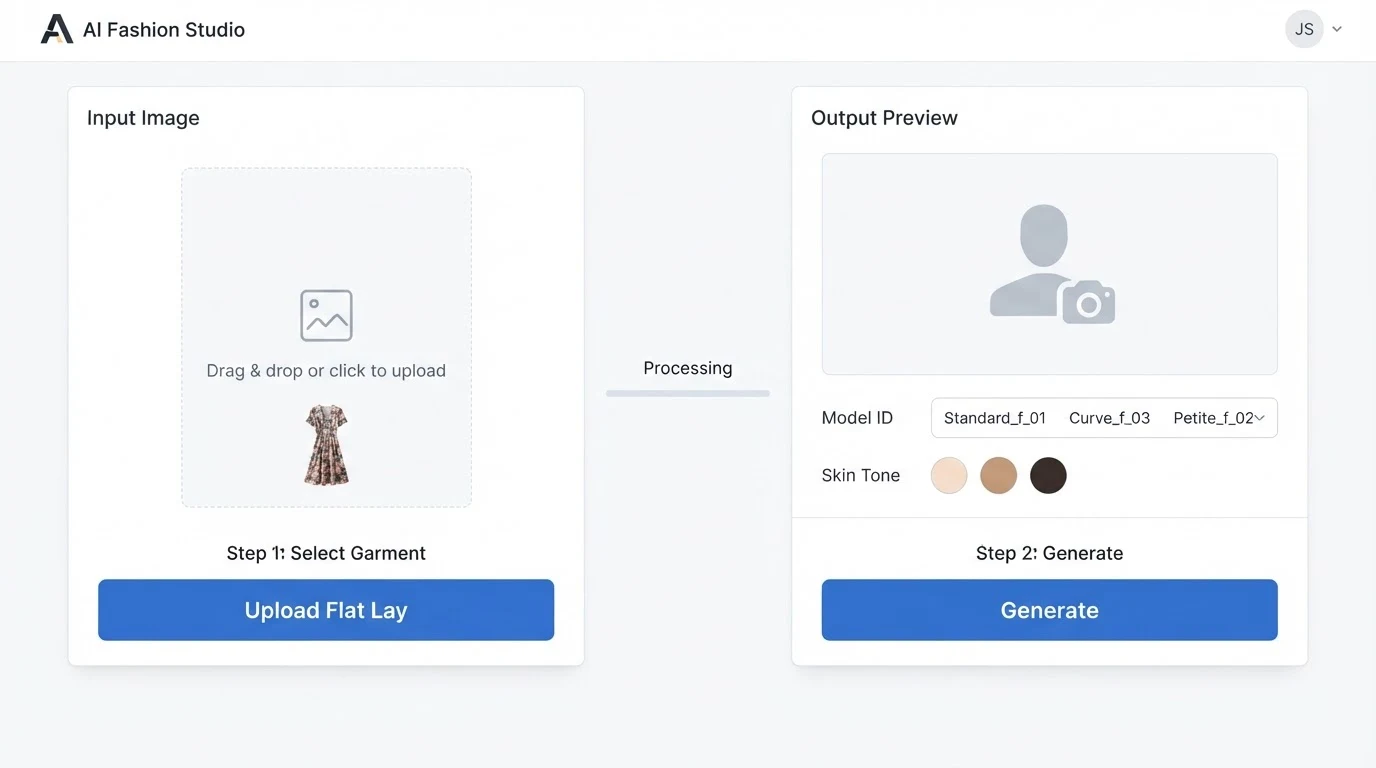
- Flat lay capture. Shoot the garment on a neutral backdrop with consistent lighting, front and back, laid flat or on a ghost mannequin. This is the ground truth every downstream image inherits from.
- AI on-model generation. Run the flat lay through your chosen tool with the model identity and scene condition. Generate multiple variants per SKU.
- QA pass. Human review against the checklist below. Kick anything with fabric distortion, hand artefacts, or colour drift back for regeneration.
- Retouch. Light retouch on the winners: skin cleanup, minor seam corrections, background consistency across the collection.
- PIM and Shopify upload. Push finals into the PIM with correct alt text, SKU mapping, and disclosure metadata. The Shopify-specific integration steps are worth walking carefully.
Quality control checklist
The single most common failure mode in AI fashion imagery is shipping a technically impressive image that quietly breaks brand trust. A tight QA checklist prevents most of that. Reject and regenerate on any of these.
- Garment fidelity: seams, darts, buttons, and print alignment match the flat lay
- Colour accuracy: sRGB-correct swatch match, no drift under studio white balance
- Seam continuity across the whole garment, especially at armholes and side seams
- Hand and foot integrity: correct finger count, no fused digits, natural wrist geometry
- Size representation: model body actually matches the garment size listed
- Background consistency across every image in the collection, so the PDP grid reads as one shoot
- Model identity consistency, so the same model IDs recur cleanly across categories
Legal, ethical and disclosure
The regulatory environment tightened materially in 2025 and 2026, and fashion is one of the categories regulators are watching most closely. The EU AI Act requires clear disclosure when synthetic imagery is used to represent a product, and the ASA in the UK and FTC in the US have both issued guidance that AI-generated models must not be presented in ways that mislead on fit, size, or material. Practical implications: retain a model release for any real person whose likeness informs a LoRA, disclose AI imagery in alt text or a visible badge where the jurisdiction requires it, and never use AI to shrink a garment onto a smaller body than it was cut for. The catalog imagery guide covers the disclosure metadata pattern in more depth.
ROI math
The finance case usually closes itself once someone actually models it. A traditional on-model shoot for a 200 SKU drop lands in a per-image cost band that includes sample freight, model fees, studio, crew, and retouch. AI imagery replaces most of those inputs with a flat lay capture step and a generation cost, and the per-SKU cost typically falls by 70 to 90 percent depending on category complexity. Time to live drops from weeks to days, which pulls sell-through forward and reduces markdown risk on seasonal ranges. Reported conversion lift is mixed and category-dependent, but the consistent finding is that more images per PDP, more angles, and more contextual lifestyle shots move conversion, and AI is what makes that volume affordable.
When NOT to use AI imagery
There are still places where a real shoot wins, and pretending otherwise is how brands damage themselves. Luxury hero campaigns where the story is the location, the model, or a specific creative director's eye should stay on film. Tactile fabrics like sequin, sheer chiffon, leather grain, and hand-beaded embroidery still reward a macro lens because the light behaviour is what sells the garment. Editorial storytelling that hinges on a specific human performance is not what diffusion models do best. A useful default is: AI for scale content, studio for the hero campaign that scale content links back to, and the same logic applies across lifestyle photography workflows.
Getting started: a 30-day pilot
The lowest-risk way in is a scoped 30-day pilot on a single category. Week one: pick 20 SKUs, brief the model roster, capture flat lays. Week two: generate on-model imagery across two or three tools in parallel and compare. Week three: run the QA checklist, retouch winners, and publish to a soft-launched collection page. Week four: measure conversion, time on page, and return rate against a matched control, then decide whether to roll out to the full catalog.
Frequently Asked Questions
Is AI fashion photography legal?
Yes, in every major market, provided you handle model likeness rights correctly and follow disclosure rules under the EU AI Act, ASA guidance in the UK, and FTC guidance in the US. The legal risk sits in misleading the customer about fit, size, or material, not in the use of AI itself.
Does AI imagery hurt conversion?
Published data is mixed but generally neutral to positive when the imagery is high quality and consistent across the PDP. Conversion lift usually comes from being able to afford more images per SKU rather than from the AI itself.
Can AI handle plus-size and diverse skin tones?
Yes, and this is one of the strongest arguments for it. A single flat lay can be rendered across a full size range and a diverse model roster at negligible marginal cost, which is economically prohibitive with traditional shoots.
How accurate is fabric drape in 2026?
Excellent for wovens, structured knits, denim, and most jerseys. Weaker for sheer, sequin, heavy leather, and highly technical performance fabrics, where a real macro shot still wins.
Do we still need a photographer?
Yes, for the flat lay capture step and for hero and editorial work. The role shifts from volume shooter to creative director and reference-image specialist, which is usually a more valuable use of the same headcount.
What about returns?
The evidence so far suggests AI imagery does not increase return rates when the QA checklist is enforced. Returns spike when imagery misrepresents fit or colour, which is a QA problem regardless of whether the image was shot or generated.
How do we disclose AI imagery?
Follow the strictest jurisdiction you sell into. In practice this means a visible badge or alt-text disclosure on any image where the model or scene is AI-generated, and a clear statement in your PDP metadata.
Can we bake in our house look?
Yes, through LoRA fine-tunes trained on your existing shoot library. This is how brands preserve a recognisable aesthetic while scaling volume, and it is the part of the pipeline where a specialist studio adds the most value.
Where this leaves you
AI ecommerce imagery for fashion is not a future capability any more, it is a live production tool that most competitive brands are already using in some form. The winners in 2026 will be the ones who treat it as a workflow discipline, hold a real QA bar, disclose cleanly, and reserve studio time for the hero work that still needs it. If you want a scoped pilot built around your catalog and your brand aesthetic, Absolutely AI runs 30-day engagements designed to answer exactly that question.