AI Brand Photography for Startups: The Full Workflow
Most early-stage startups look like they were photographed by a friend with a phone, and it costs them credibility before a customer ever reads a word. AI brand photography closes that gap without a five-figure shoot, but only if you treat it as a production discipline instead of a magic button. This is the workflow Absolutely AI uses when a founder needs 20 campaign-ready assets by Friday.
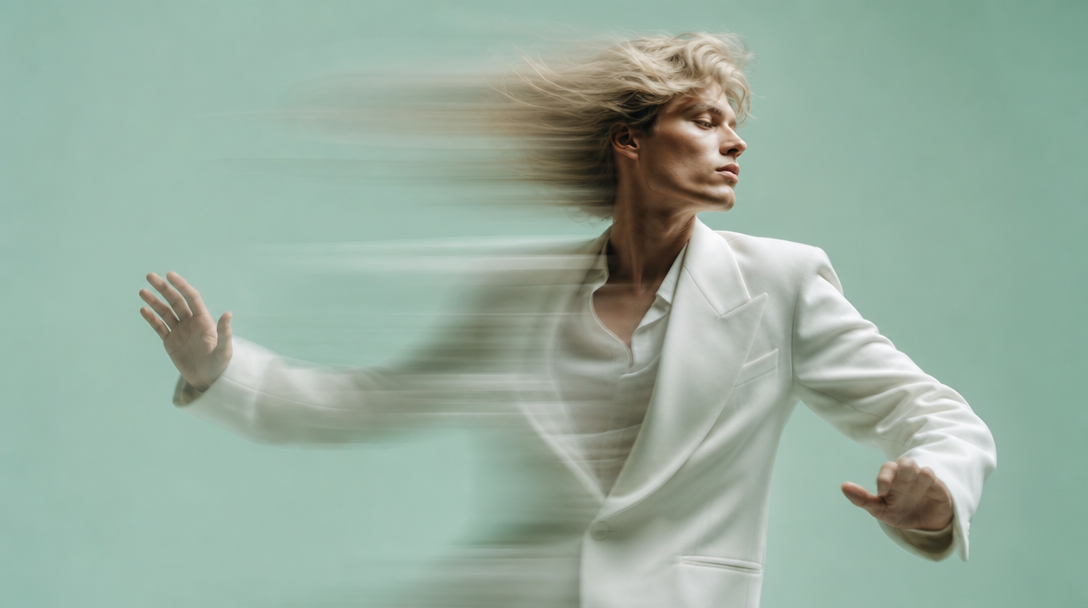
The visual bar for a seed-stage startup has quietly moved. Investors, buyers, and press now expect the same production polish from a two-person team that they expect from a Series B brand, and generic stock photography gives you away in the first scroll. AI brand photography, run through a creative-director-led process at an AI agency like Absolutely AI, is how most early teams are closing that gap in 2026. It is not a shortcut, it is a different production pipeline with its own rules.
Why startup visuals can no longer look amateur
Three things changed at once. Feed algorithms started favouring native-quality photography over recycled stock, DTC benchmarks pushed hero imagery into short-form video territory, and reference-conditioned generation put a professional-looking image within reach of a team that could never have booked the shoot. The startups that ignored the shift are now spending twice as much retrofitting a brand identity after launch, which is a topic we cover in more depth in our breakdown of how AI lifestyle shoots actually work.
The awkward middle ground is what kills founders. A single hero image from a real photographer next to five phone snaps and two royalty-free stills reads as unfinished. Buyers do not consciously notice the mismatch, they just bounce. A coherent AI-generated set, briefed properly, outperforms a mixed bag every time because the brand feels intentional even when the individual assets are less technically perfect than a studio shot.
What AI brand photography actually is, and what it isn't
AI brand photography is the use of generative image models, conditioned on reference imagery and a locked brand system, to produce a coherent set of on-brand visuals across every format a startup needs. It is not stock, because the assets are unique and unrepeatable. It is not product photography in the narrow ecommerce sense, though it can include it. It is closest in spirit to a small in-house content studio, which is why our primer on what AI lifestyle photography is starts with the same distinction.
What it is not: it is not Midjourney freeform art, it is not a fully autonomous system, and it is not a replacement for a creative director. Every serious output we ship starts with a brand brief, a moodboard, and a set of reference images, then goes through the same rounds of review a traditional shoot would.
The five deliverables every early startup needs
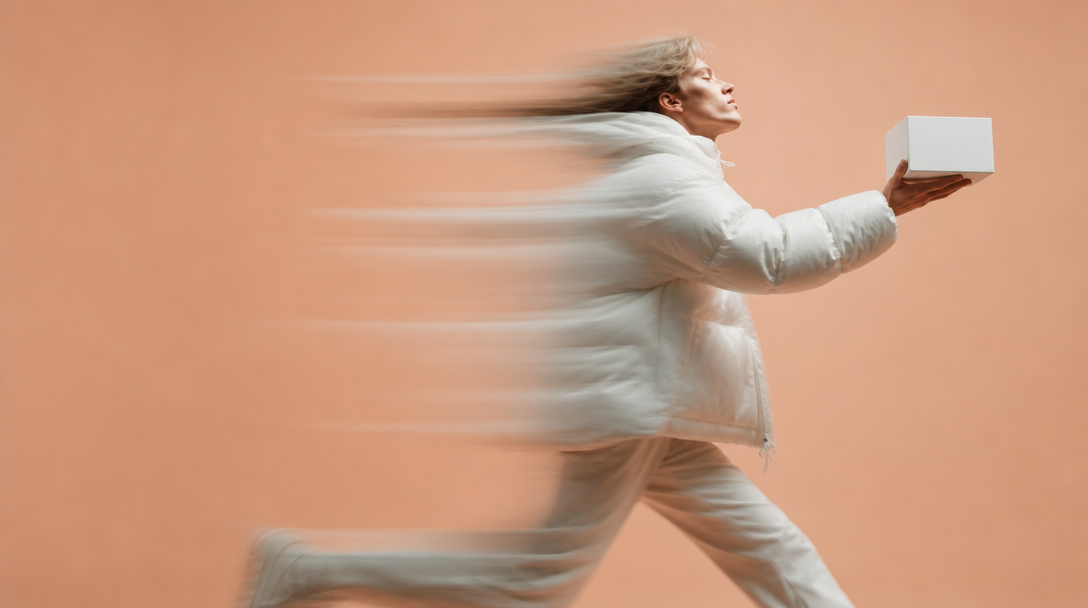
Nine out of ten startup briefs we see collapse into the same five deliverables, and the tool you reach for should change for each. Trying to force one generator to cover all five is where most in-house attempts fall apart, a mistake we flag in our guide to AI lifestyle imagery for ecommerce brands.
- Founder headshots. Consistent talent, editorial lighting, three to five wardrobe changes. Reference conditioning on the actual founder is non-negotiable.
- Hero lifestyle. The image that lives on the homepage, the deck cover, and the launch tweet. Wide aspect, strong negative space for headline overlay.
- Product or mockup shots. Clean, brand-lit, background-controlled. Ghost mannequin for apparel, floating product for accessories, in-context for hardware.
- Vertical social ads. 9:16 with human subjects, room for CTA overlay, at least three variations per angle for creative testing.
- Brand scene-setters. The atmospheric shots that appear behind quotes, in press kits, and between sections. Often the most overlooked and the most brand-defining.
Honest cost comparison
Founders ask us for real numbers, not vendor marketing, so here is what a comparable 20-asset brand shoot actually costs across the three routes we see teams weigh up. For a deeper breakdown by asset type, our AI lifestyle imagery cost guide runs the same maths at more granularity.
| Route | Typical cost (AUD) | Turnaround | Revision cost | Best for |
|---|---|---|---|---|
| DIY AI stack (Pebblely, Flair, Midjourney) | $150 to $600 in subscriptions | 2 to 5 days if you know what you're doing | Free but time-heavy | Solo founders, pre-launch |
| Freelance photographer, one-day shoot | $2,500 to $6,000 | 2 to 3 weeks including edit | $150 to $400 per additional asset | One-off launch, single deliverable type |
| Creative-director-led AI brand shoot | Quoted per scope | 3 to 7 days | Included in cycle | Full brand system, multi-format campaign |
| Full agency traditional shoot | $15,000 to $60,000 | 4 to 8 weeks | Expensive reshoot | Series A+, national campaign |
The DIY route is genuinely cheap on cash but expensive on founder time, which is the resource most teams cannot spare during a launch window. The traditional shoot is worth it once brand recognition drives measurable revenue, rarely before. The middle option exists because the DIY quality gap is real, and it is what most of our early-stage clients settle on. We compare the two extremes head-to-head in our AI lifestyle shoot vs traditional shoot analysis.
How to brief an AI generator like a creative director
The single biggest predictor of output quality is the brief. Founders who write "modern lifestyle photo of my product" get generic slop. Founders who write like an art director get campaign-ready assets in two rounds. The structure we use on every project is subject, setting, lighting axis, palette, mood, camera language, aspect ratio, and reference images, in that order.
Reference images do more work than any prompt. Two or three examples of the exact tone you want, plus one of your product or founder for identity conditioning, will beat 500 words of prose every time. Study the sets we pulled apart in our best AI lifestyle photography examples piece to see what a properly referenced brief looks like in the final output.
The brand-consistency problem
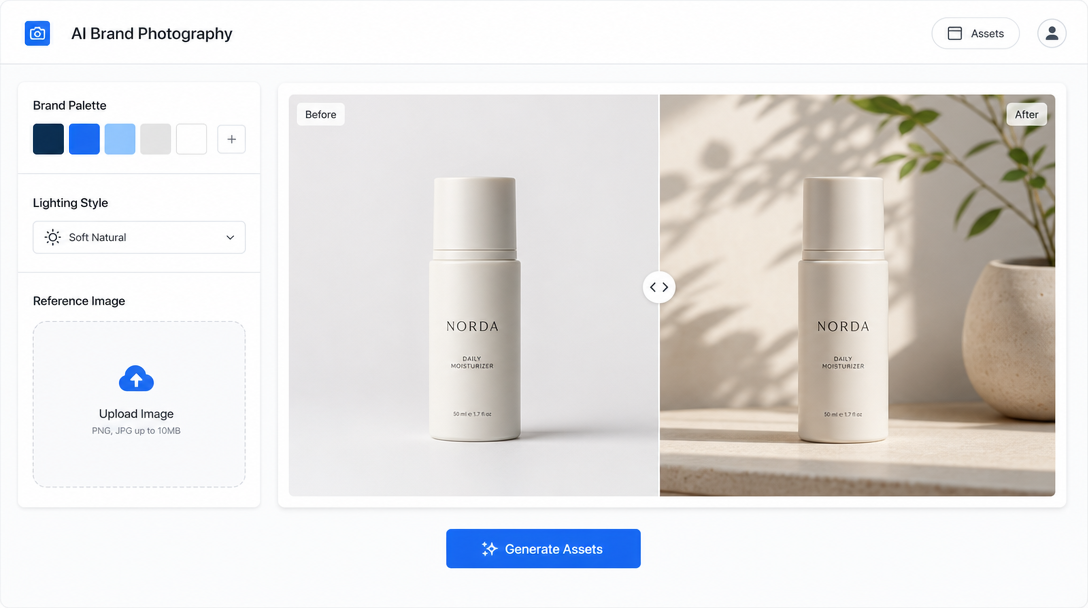
You can generate 20 individually excellent images that still feel unrelated, and this is the failure mode most startup teams hit on their second or third batch. The fix is a locked visual system agreed before generation begins: one recurring talent or archetype, one lighting axis, one colour grade applied in post, and a small family of backgrounds that repeat across the set. Consistency beats novelty every time on a brand shoot, a principle we explore in our writeup on AI lifestyle photography for fashion.
Vertical language matters too. A SaaS brand wants clean daylight, natural laptop settings, and confident human subjects. A DTC consumer brand wants warmer light, texture, tactile hero moments. Food and beverage lives on top-down and macro. Professional services leans editorial portrait with strong negative space. Mixing the languages inside one brand is the giveaway that the shoot was assembled rather than art-directed.
When AI still isn't the right call
We turn away work every month because the brief is wrong for the medium. AI still struggles with brand-specific packaging that must be pixel-accurate, with complex multi-subject scenes involving four or more people interacting, with any shot requiring literal event coverage, and with hands doing complicated things. When those failure modes matter more than cost or speed, hire a photographer. When they don't, our AI commercial production workflow will move faster and cheaper than any alternative.
Frequently Asked Questions
How long does a full startup brand shoot take with AI?
A 20-asset set with proper creative direction typically ships in 3 to 7 days from signed brief. Solo DIY runs longer because most of the time goes into brief iteration, not generation. Traditional shoots run 4 to 8 weeks including scheduling, shoot day, and post.
Can AI brand photography use my actual founder's face?
Yes, with the right identity-conditioning workflow. We use a small set of reference photos of the real person, generate a locked identity model, then produce the wardrobe and setting variations from there. The output is recognisable as the founder, not a generic look-alike.
Which AI tool is best for startup brand photography?
No single tool covers the full brief. Pebblely and Flair.ai are strong for product shots, Caspa AI and Rewarx Studio for on-model apparel, AI SuitUp for founder headshots, and Midjourney for scene-setters and mood imagery. A creative-director-led workflow stitches the best of each together against a single brand system.
Will AI-generated images hurt my brand credibility?
Only if they look generated. The tells are hands, symmetry that is too perfect, and the plastic-skin lighting of default model outputs. Reference conditioning, real founder identity, and human retouching on hero shots close the gap. Most buyers today cannot distinguish a well-directed AI brand shoot from a real one.
Do I still need a photographer for anything?
For pixel-accurate product packaging, for real event coverage, for anything that will be printed at billboard scale, and for the founder portrait that goes on the cap-table page, hire a human. Everything else is fair game for AI in 2026.
How many rounds of revision are realistic?
Two rounds is standard on a well-briefed project. Round one nails the visual system and identifies the two or three assets that need adjustment. Round two lands them. Projects that spiral past three rounds almost always trace back to a brief that skipped reference images.
From brief to campaign in a week
The startups getting the most from AI brand photography treat it as a production discipline, not a novelty. That means a proper brand brief, locked references, a coherent visual system, and a creative director in the chair. If you want that workflow run for you against a real launch deadline, that is exactly what the Absolutely AI brand production service is built to deliver.