AI Commercial Imagery at Scale: The Production Playbook
Scaling AI commercial imagery is not a prompting problem, it is a production problem. Once a campaign passes fifty images, the real question stops being 'can this model make a nice shot' and starts being 'will image 187 still look like the same brand as image 3'. At Absolutely AI we run these pipelines every week, and this piece is the operational playbook we wish existed when we started.

Scaling AI commercial imagery is not a prompting problem, it is a production problem. Once a campaign passes fifty images, the real question stops being 'can this model make a nice shot' and starts being 'will image 187 still look like the same brand as image 3'. At Absolutely AI we run these pipelines every week for brand campaigns, and most of what makes them work happens before a single generation call is made. This piece walks through the operational chapters that get skipped in tool round-ups: how to build a reference layer, how to hold consistency across a run, how to structure client approvals, and where humans still own the frame.
Why 'Scale' and 'Brand Consistency' Are In Tension
Every generative model drifts. Sampler noise, prompt paraphrasing, subtle differences in reference weight, even the order of tokens can nudge output away from the brand centre. On a single image this looks like creative variation; across a 200-shot campaign it looks like your product came from three different factories. The real constraint at scale is not per-image quality, it is coherence across a run, and that is a very different engineering problem to solve.
Competitors avoid naming this because their pitch is that AI is 'good enough' out of the box. It is not, at campaign volume. A serious AI production workflow assumes drift as the default and builds every stage around suppressing it, from reference curation to seed management to QC sampling. Treat consistency as the deliverable, not the images themselves.
The mental model we use: a campaign is one artefact rendered as many frames, not many frames stitched into a campaign. Every decision in the pipeline should ask 'does this protect the artefact', not 'does this make a nicer individual shot'. That reframing changes what you optimise for, and it is what separates a studio operation from a prompt-and-pray workflow.
Building the Brand Reference Layer Before Generation Starts
Before we generate anything for a client, we build a reference layer. This is the operational chapter no one else writes about, and it is where 70 percent of consistency is actually won. A reference layer has three components: a curated image library, a set of style-reference conditioning weights, and where the budget allows, a LoRA fine-tuned on the brand's product or character.
The image library is not a Dropbox of hero shots. It is curated by axis: lighting setup, camera angle, surface material, colour palette, and mood. A good reference is a single-variable exemplar, showing exactly one thing the brand does. Bad references are busy hero images that force the model to guess which element to lock. We tag every reference with what it is teaching the model, and we version the whole library each time the brand evolves.
On top of the library sit two technical layers. IP-Adapter and style-reference conditioning let us inject visual DNA into a generation without hard-locking composition, which is right for lifestyle and editorial work. LoRA fine-tuning trains a small adapter on the brand's specific product, character or aesthetic, and is the correct tool when a hero product needs to appear pixel-consistent across dozens of contexts. Read our breakdown of where each tool actually earns its place before choosing.
Reference layers are living assets. When a brand launches a new SKU, retires a colourway, or shifts its visual identity, the library and any LoRAs must be updated in lockstep, with old versions archived rather than deleted so historical campaigns remain reproducible. Version control on references is version control on the brand.

The Production Pipeline: How a Campaign Run Actually Flows
A real campaign run moves through eight stages, and skipping any of them shows up in the final work. The pipeline is: brief intake, concept prompts, reference alignment, generation, QC filtering, editing and retouching, format adaptation, delivery. Each stage has an owner, an input artefact and an exit criterion, and each one is where a specific class of problem gets caught.
Concept prompts are written against the brief and the reference library, not in isolation. A good concept prompt is a short scene description plus explicit references to library entries and any locked parameters like seed range, aspect ratio or style-reference weight. This is also where the campaign creative direction gets encoded into something the pipeline can execute repeatably.
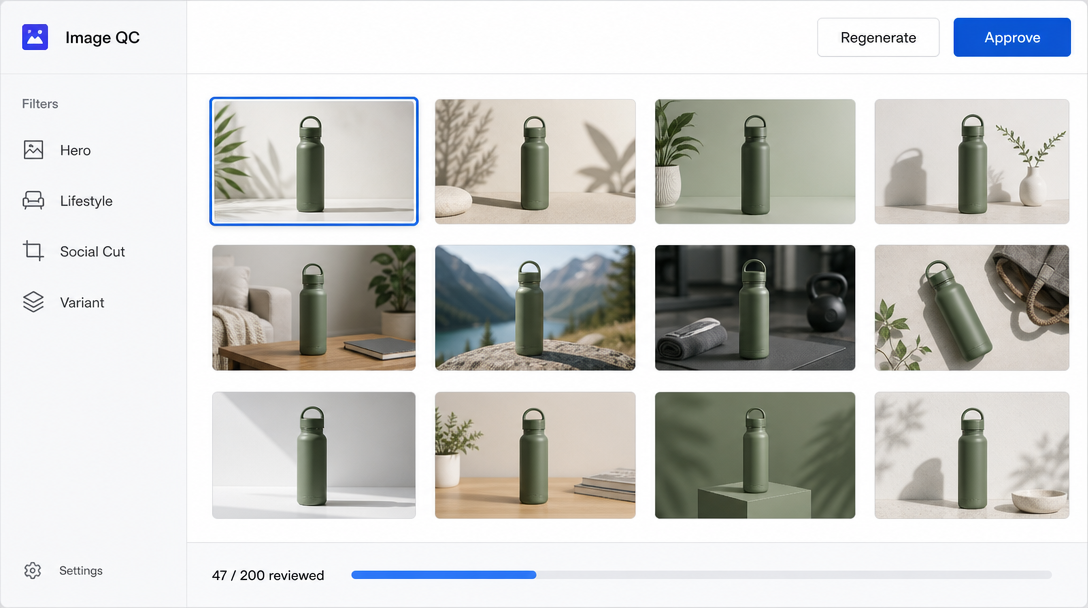
Generation itself is the shortest stage. Most of the value sits in QC filtering, where a human passes over a raw batch and rejects drift, artefacts, anatomical failures and brand deviations before anything is edited. We typically over-generate by 3 to 5 times the final count, then filter down. Editing and retouching cleans the survivors, format adaptation cuts every deliverable to its required aspect ratios and platform specs, and delivery packages the tiered output.
The tiered output model is important because it makes the pipeline predictable to price and deliver. A single campaign run typically produces hero shots, lifestyle contexts, social cuts and format variants as one bundle. The client is not buying images by the piece, they are buying a run, and that framing sets correct expectations on both sides.
Campaign Run Deliverable Tiers
| Tier | Purpose | Typical count | Consistency requirement |
|---|---|---|---|
| Hero | Above-the-fold, PDP hero, primary ad frame | 3 to 8 | Highest, LoRA-locked product |
| Lifestyle | Context, editorial, brand storytelling | 15 to 40 | Style-reference weighted, contextually flexible |
| Social cuts | Vertical, square and story ratios | 30 to 80 | Cropped and re-composed from hero and lifestyle |
| Format variants | Regional, seasonal, A/B testing frames | 50 to 150 | Seed-locked derivatives with controlled variation |
Holding Consistency Across a 200-Image Run
Consistency at volume is a compound of small technical choices. Seed locking gives you reproducibility across variants: same seed, adjusted prompt, and the model returns a near-relative of the original rather than a stranger. This is how you generate a hero shot and then produce fifteen aspect ratios of the same conceptual image rather than fifteen different images that happen to share a subject.
Style-reference weighting is the second lever. Too low and the run drifts toward the model's default aesthetic; too high and every image collapses onto the reference and loses variety. We tune weight per tier: hero shots ride high on reference weight, lifestyle sits mid, exploratory frames sit lower. ControlNet then handles compositional control where we need a specific pose, layout or product placement locked while the surrounding scene varies.
Batch prompt patterns matter more than most teams realise. Rather than writing 200 unique prompts, we write a small set of base patterns with slotted variables (setting, lighting, secondary props) and iterate through combinations. This is what makes a run feel like a family of images rather than a collage. Sampling-based QC then reviews a stratified subset early in the batch, catches systemic drift before we burn compute on all 200, and adjusts parameters before the full run kicks off.
The final judgement call is regenerate versus manually edit. Small brand-mark errors, minor colour shifts and background artefacts are cheaper to retouch in post. Anatomical failures, wrong product geometry and structural composition problems are almost always cheaper to regenerate with tightened parameters. Getting that call right is the difference between a profitable run and a margin-killing one.
The Review and Approval Pipeline
The single biggest hidden cost in AI commercial work is unmanaged revision rounds. Every extra round eats the margin that made the run viable in the first place, and most of them are avoidable with a properly staged approval pipeline. We split client review into two distinct gates: concept approval and output approval, and we never let them collapse into one meeting.
Concept approval happens before generation. The client signs off on the reference layer, the mood, three to five concept frames per tier, and the tiered output plan. This is the round where changes are cheap, because nothing has been generated at volume yet. Front-loading alignment here is the single highest-leverage move in the whole workflow, and it is why our brand governance step sits before generation, not after.
Output approval happens on the full run and is scoped tightly: the client is approving the batch as a campaign artefact, not redesigning individual frames. Revisions are grouped into a single defined round with a clear brief, not treated as an open-ended conversation. Staging environments help here: a private review gallery per campaign, with per-image comment threads, keeps feedback structured and traceable rather than lost in a Slack channel. Read our note on how AI and traditional shoots compare through the client's lens if you want the buyer-side view.
Campaign Economics vs a Traditional Shoot
The cost story people usually tell about AI imagery is a per-image comparison, which misses the actual economic shape of a campaign. A traditional shoot day carries fixed costs that do not scale with output: a location or studio fee, talent day rates, crew, catering, equipment hire, and post-production per selected frame. A tight run produces maybe 40 to 60 usable frames on a shoot day.
An AI production run replaces most of that fixed cost with studio time (creative direction, reference building, QC, editing), compute, and revision rounds. The shape is different: lower fixed floor, higher marginal flexibility, and a much lower cost to add more format variants or regional cuts to an existing concept. Where the traditional shoot forces a reshoot for a new aspect ratio, an AI run generates it as a derivative.
The hidden variable in both models is revision rounds. On a traditional shoot, revisions mean a reshoot, which is why brands accept the frames they got. On an AI run, unlimited-feeling revisions are the trap: cheap-looking rounds compound until the margin disappears. Our published cost benchmarks for the Australian market break this down in more detail. The takeaway: price the run, cap the rounds, and treat concept approval as the moment revisions get spent.
Where Humans Still Own the Work
Honesty about failure modes is what makes an AI production partner worth trusting. Current models are still weak in specific, predictable places, and pretending otherwise erodes credibility fast. Reflective and transparent materials (chrome, glass, iridescent finishes) drift in ways that are hard to control with references alone. Complex textile textures (specific weaves, technical fabrics) blur under generation and often need photographed overlays.
Pixel-accurate logos and packaging typography are the most common failure mode we see brands underestimate. Models approximate letterforms; they do not render them. Any final commercial image with brand marks needs a compositing pass where the actual vector logo is placed cleanly over the generated frame. The same applies to product-specific detail work: connector shapes, button counts, precise proportions on a hero product all need reference-locked LoRA plus human QC, and sometimes a hybrid retouch from a real product photo.
Likeness and IP considerations are the other hard boundary. Recognisable talent, licensed characters and third-party trademarks stay out of the generation pipeline entirely, and any campaign involving them routes through traditional production or licensed hybrid workflows. This is a topic worth its own read: our note on rights and IP in AI product photography covers the practical shape of it.
Choosing an AI Production Partner
If you are commissioning AI commercial imagery at campaign scale, the decision criteria are different from choosing a photographer. Ask about the reference workflow, not the prompt workflow: a partner who cannot describe how they build and version a reference library is running a prompt shop, not a production one. Ask to see multi-image consistency proof: three or four shots of the same product in different contexts, without cherry-picking.
Ask how QC works, specifically what happens between raw generation and delivery. Ask about revision terms in writing, because unbounded revisions are how AI production runs bleed margin on both sides. Ask about brand governance: who owns the reference layer, how it evolves with the brand, and what happens to your LoRA and references if you change partners. A serious partner has clean answers to all of these.
Frequently Asked Questions
How many images can you produce in one campaign run?
A typical campaign run delivers between 60 and 200 final images across hero, lifestyle, social and format-variant tiers, from a single concept and reference layer. We usually generate 3 to 5 times that volume upstream and filter down through QC.
Do you use my product photos to train a model?
Where a brand needs pixel-consistent hero products, we train a brand-specific LoRA on supplied product references. The LoRA is your asset, versioned to your brand, and does not get reused across other clients. For lighter-touch consistency we use IP-Adapter and style-reference conditioning without training a dedicated model.
What is the typical turnaround for a run?
From locked concept approval, a mid-scale run (around 80 to 120 finals) takes 5 to 10 business days end to end, including QC, editing, format adaptation and one revision round. Rush timelines compress QC and are quoted separately.
How do you handle brand logos and packaging text?
Logos and packaging typography are composited from vector or high-resolution photographic sources onto the generated frames in post. We do not rely on the model to render brand marks accurately, because current generation models cannot do it reliably.
What happens if the images drift halfway through a run?
Sampling-based QC catches drift early, before we commit compute to the full batch. If drift appears, we adjust reference weight, seed range or prompt patterns and re-run the affected slice. This is a normal part of the pipeline, not a failure state.
Can you match an existing photography style my brand already uses?
Yes. That is exactly what the reference layer is for. Give us a curated set of existing brand imagery and we build a reference library and, if needed, a LoRA that lets the pipeline produce new work in the same visual language.
How are revision rounds structured?
Revisions are grouped into defined rounds with a scoped brief. Concept approval happens before generation, output approval happens on the full run, and one revision round is included with additional rounds priced clearly upfront. Front-loaded concept approval is where we protect margin on both sides.
Can you integrate with our DAM or PIM?
Yes. Final deliverables can be pushed to a DAM or PIM with metadata (SKU, tier, ratio, campaign, version) attached so images land in your system correctly tagged rather than in a delivery folder someone has to sort.
Wrapping Up
Producing AI commercial imagery at scale is not a story about models, it is a story about pipelines. The teams making this work look reliable are the ones who treat reference libraries, QC checkpoints, tiered outputs and revision management as the actual product, and treat the generation call as one step in a much larger workflow. If you are planning a campaign at scale and want to see how the pipeline runs end to end, talk to Absolutely AI about a scoped production run.