How AI Lifestyle Shoots Work: The Full Pipeline Explained
AI lifestyle shoots have moved from novelty into the mainstream creative toolkit, but the gap between a stock-looking output and a campaign that reads as premium comes down to process, not prompts. This guide walks through the full pipeline Absolutely AI uses to produce lifestyle imagery for brand and marketing teams, from brief to hero selection, including the failure modes most vendors quietly skip over.

Most explainers on AI lifestyle imagery treat it like a single-tool trick: type a prompt, get a picture, ship it. That framing is why so much AI-generated brand content still looks like a stock site with the saturation turned up. At Absolutely AI we run lifestyle shoots as a repeatable creative pipeline with the same stages a traditional shoot would have, which is what separates output that sits on a brand's homepage from output that gets rejected in the first review.
This piece is written for the buyer evaluating vendors, not the buyer who has already picked one. It is deliberately agnostic about tooling and focused on method, because method is what decides whether the twelfth frame of your campaign looks like it came from the same shoot as the first. If you want the format primer first, our breakdown of AI lifestyle photography is a useful companion read.
What counts as an AI lifestyle shoot
An AI lifestyle shoot is imagery that combines three elements: a product, an environment, and human context. That is the definition that matters, and it is the one that separates lifestyle from adjacent categories. A packshot is product on a background, with no environment and no human. A stock-style scene is environment and humans with a product dropped in later, which is exactly why those images feel disjointed.
A true lifestyle frame has all three baked in together, so the light on the product matches the light on the model and the room, the reflections agree with each other, and the product sits in the scene the way a real object would. If you want to see how this differs from pure product work, our walkthrough of AI product photography covers the packshot side in detail.
The five stages of an AI lifestyle shoot
Any lifestyle shoot, AI or traditional, moves through the same five stages. Skipping one is the single biggest predictor of a bad result, and it is what agencies and in-house teams evaluating vendors should look for.
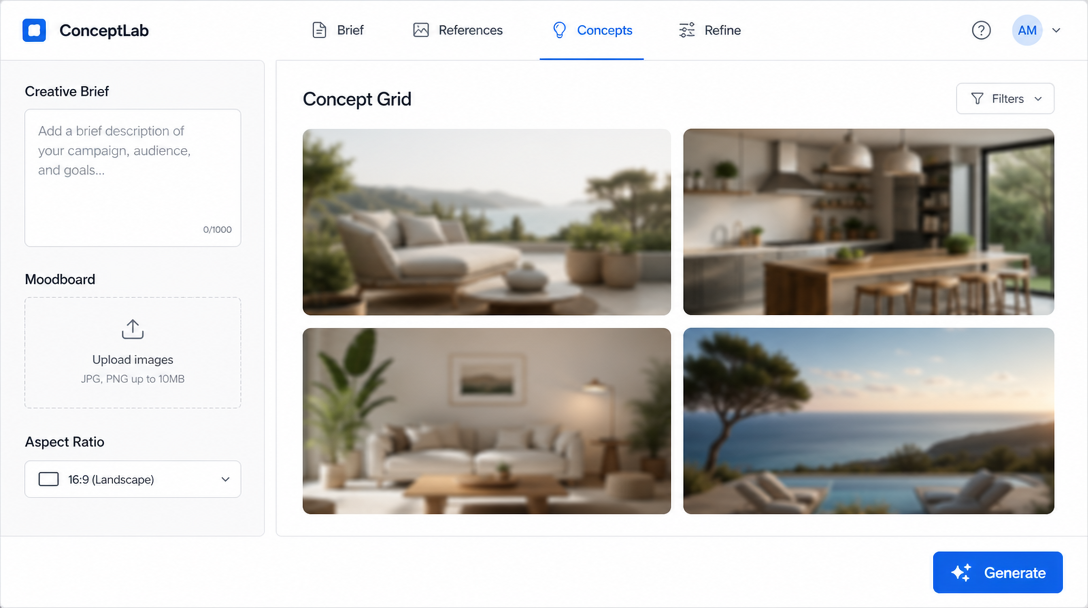
- Creative brief. Product, audience, tone, three to five key messages, deliverables list with aspect ratios, and non-negotiables. This is identical to a traditional shoot brief.
- Reference gathering. Packshots of the actual product, moodboard imagery for tone and lighting, talent references for the model type, and any brand-locked palette or typography. References condition the output far more than the prompt.
- Concept generation. Grids of exploratory frames, usually four to twelve per direction, that show the range of what the models can produce inside the brief. This is where creative direction happens.
- Hero selection. Choose the winning frames per deliverable. On a real project this is a client review, not an internal one.
- Final refinement. Upscale, clean up hands and text, adjust colour to the brand palette, and export to the aspect ratios in the brief.
Vendors that talk only about prompts have skipped stages one, two, four, and five. That is why their samples look impressive in isolation and fall apart across a campaign. A properly run AI commercial pipeline treats those five stages as non-negotiable.
What the AI is actually doing under the hood
You do not need to be an engineer to hire an agency, but you do need enough of the mechanics to spot a vendor who is bluffing. Modern lifestyle imagery is generated by diffusion models, which start with pure noise and iteratively denoise it toward an image that matches a text and image conditioning signal. That signal is where the craft lives.
Reference conditioning, often implemented with ControlNet or its successors, lets the pipeline lock in composition, pose, depth, or edges from a reference image while letting the model generate everything else. Product masking isolates your actual packshot so the model treats it as a fixed object and paints the environment around it rather than reinterpreting the bottle. Model consistency techniques, whether embedding-based or LoRA-based, keep the same face across a twelve-frame campaign instead of drifting into a new person every shot. Lighting harmonisation is a final pass that re-lights the composited scene so the product, model, and environment all agree on where the sun is.
None of this is a single button. It is a chain of controlled steps, which is why credible AI creative consulting conversations quickly move from tools to workflow.
Inputs that decide whether the output looks like a brand or a stock site
The inputs matter more than the model. In production, we consistently see that a mediocre model with strong inputs beats a state-of-the-art model with weak inputs. Here is what actually moves the needle.
- Packshot quality. A clean, colour-accurate, well-lit product photo is the single most important input. Garbage in, garbage out is unusually literal here.
- Moodboards. Six to twelve images that define the light, palette, and emotional tone. These condition the output more than any adjective in the prompt.
- Brand palette locks. Explicit hex values, not "warm neutrals", pulled into the pipeline as reference chips.
- Aspect ratio. 1:1 for feed, 4:5 for Instagram, 9:16 for Reels and TikTok, 16:9 for web hero. Each ratio needs its own generation pass, not a crop.
- Talent references. A locked model identity, age range, and styling direction. Without this you get a different person every frame.
- Prompt structure. Subject, action, environment, light, camera, mood, in that order. Consistent structure across a set produces consistent output.
The pattern here is unglamorous but real: the creative brief and moodboard do more work than the prompt. If you are briefing a vendor and they have not asked to see your brand book, that is the signal. Fashion and beauty teams building this out from scratch should look at our notes on AI lifestyle photography for fashion for category-specific input examples.
Where AI lifestyle shoots still fail (and what to do about it)
This is the section competitors skip because it undermines their sales pitch. AI lifestyle imagery has predictable failure modes, and pretending otherwise is how brands end up with rework bills or, worse, a live campaign that gets ratioed on social.
- Hands. Still the most common tell. Fixed with inpainting passes or masked regeneration on the winning frame, not by re-rolling the whole image.
- Packaging text. Models cannot reliably render legible copy on a bottle or box. The fix is to composite the real packshot back over the generated environment, not to prompt harder.
- Reflective surfaces. Glass, metal, and glossy plastic often show reflections that make no physical sense. Reference conditioning helps, hand cleanup finishes the job.
- Repeated faces across a campaign. The model drifts. Solved with a locked identity embedding or a small fine-tune on approved talent references.
- Physically implausible product placement. Bottles that float, straps that cross through arms, shadows going the wrong way. This is caught in QC, not fixed in generation.
An honest agency runs a QC rubric on every grid before it goes to a client: composition, brand fit, physical plausibility, hand check, text legibility, and continuity with sibling frames. If the vendor cannot describe their rubric, they do not have one.
Traditional shoot vs AI shoot vs hybrid
Most premium brands do not choose between AI and traditional. They run hybrid workflows where AI generates the concept range and, on high-stakes hero frames, a photographer shoots the winning direction with real talent. Our detailed comparison of AI and traditional lifestyle shoots goes deeper on this, but the summary sits below.
| Dimension | Traditional shoot | AI shoot | Hybrid |
|---|---|---|---|
| Turnaround | 4 to 8 weeks | 3 to 7 days | 2 to 4 weeks |
| Iteration count | 1 concept direction | 4 to 12 concept directions | 4 to 12 concept, 1 shot |
| Creative control | Highest on the day | Highest at brief stage | Highest overall |
| Physical plausibility | Guaranteed | Requires QC | Guaranteed on hero |
| Best use case | Flagship hero campaign | Volume social, ecommerce | Premium brand at scale |
The hybrid pattern is what most of our brand clients settle on within a quarter of working with us. Volume and social lives in AI, the flagship annual campaign gets a live shoot, and both feed off the same brief and moodboard. Ecommerce teams weighing the economics should read our note on what AI lifestyle imagery actually costs before locking a model in.
A worked example: skincare hero, social vertical, and lifestyle scene from one brief
Take a mid-market skincare brand launching a new serum. The brief calls for a 16:9 web hero, a 4:5 feed post, a 9:16 story frame, and three lifestyle scenes for the PDP. Traditional route: one shoot day, one model, one location, and every asset is a crop or a re-light of the same frame.
The AI pipeline runs differently. Stage one, the brief locks tone ("quiet luxury, cool morning light, Australian coastal"), talent ("early 30s, warm skin, natural styling"), and the palette. Stage two, references go in: packshot of the serum, twelve moodboard frames, three talent references, hex codes for the brand palette. Stage three, we generate a grid per deliverable, so the 16:9 hero, the 4:5 feed, and the 9:16 story are each generated natively at their ratio rather than cropped, which preserves composition. Stage four, the client picks a hero direction per format. Stage five, packshot composite, hand cleanup, colour lock, export.
Total elapsed time on that project is typically five to seven business days, and the output is a set of frames that share one visual world across three aspect ratios and six deliverables. Ecommerce teams running this pattern regularly can see the operational side in our notes on AI lifestyle imagery for ecommerce brands.
Frequently Asked Questions
Is it legal to use AI-generated humans in advertising?
In Australia, the UK, and the US, yes, provided the imagery is not deceptive about a product's performance or a real person's endorsement. The compliance surface sits in advertising standards (ASA in the UK, ACCC in Australia, FTC in the US) and in the platform policies of Meta, TikTok, and Amazon, which increasingly require disclosure for synthetic media in political and, in some cases, commercial contexts. Treat it as a real legal question and check current guidance at the time of the campaign.
Do I need model releases for AI-generated humans?
You do not need a release for a fully synthetic person because there is no person to release rights. You absolutely do need one if the model was trained on, or the output resembles, a real named individual. Reputable pipelines lock talent identity to a fictional or licensed reference specifically to avoid this.
How many revisions should I expect?
A well-run pipeline generates enough variation up front that most projects need one or two rounds of refinement rather than five. If you are on round four, the brief was thin.
Can AI match a specific photographer's style?
It can approximate a style through moodboards and reference conditioning, and that is the ethical line most agencies work within. Directly cloning a named living photographer's style is a legal and reputational risk we advise against.
What resolution can I get out?
Native generation is typically 1024 to 2048 on the long edge, and upscaling passes take that to 4K or higher without visible artefacts on most surfaces. Billboard-scale print is possible but should be planned into the pipeline from stage one.
How do I know if a vendor is doing this properly?
Ask to see their brief template, their moodboard process, and their QC rubric. If they only show you final frames, they are selling outputs. If they show you the workflow, they are selling a pipeline.
AI lifestyle shoots reward the teams that treat them as a real creative process rather than a prompt trick, which is exactly how Absolutely AI runs them: proper brief, locked references, generated grids, honest QC, and a clean hybrid path when the campaign warrants it. If you are evaluating vendors and want to pressure-test a brief before commissioning, that is the conversation to have first.