AI Brand Identity Photography: A Practitioner Playbook
Most brands trying AI photography end up with a Midjourney grid that looks like eight different companies. AI brand identity photography is the opposite discipline: generating product, lifestyle, founder and campaign imagery that reads as one coherent visual system across every touchpoint. At Absolutely AI we treat it as a system problem, not a prompt problem, and this playbook shows the artefacts a brand team actually needs.
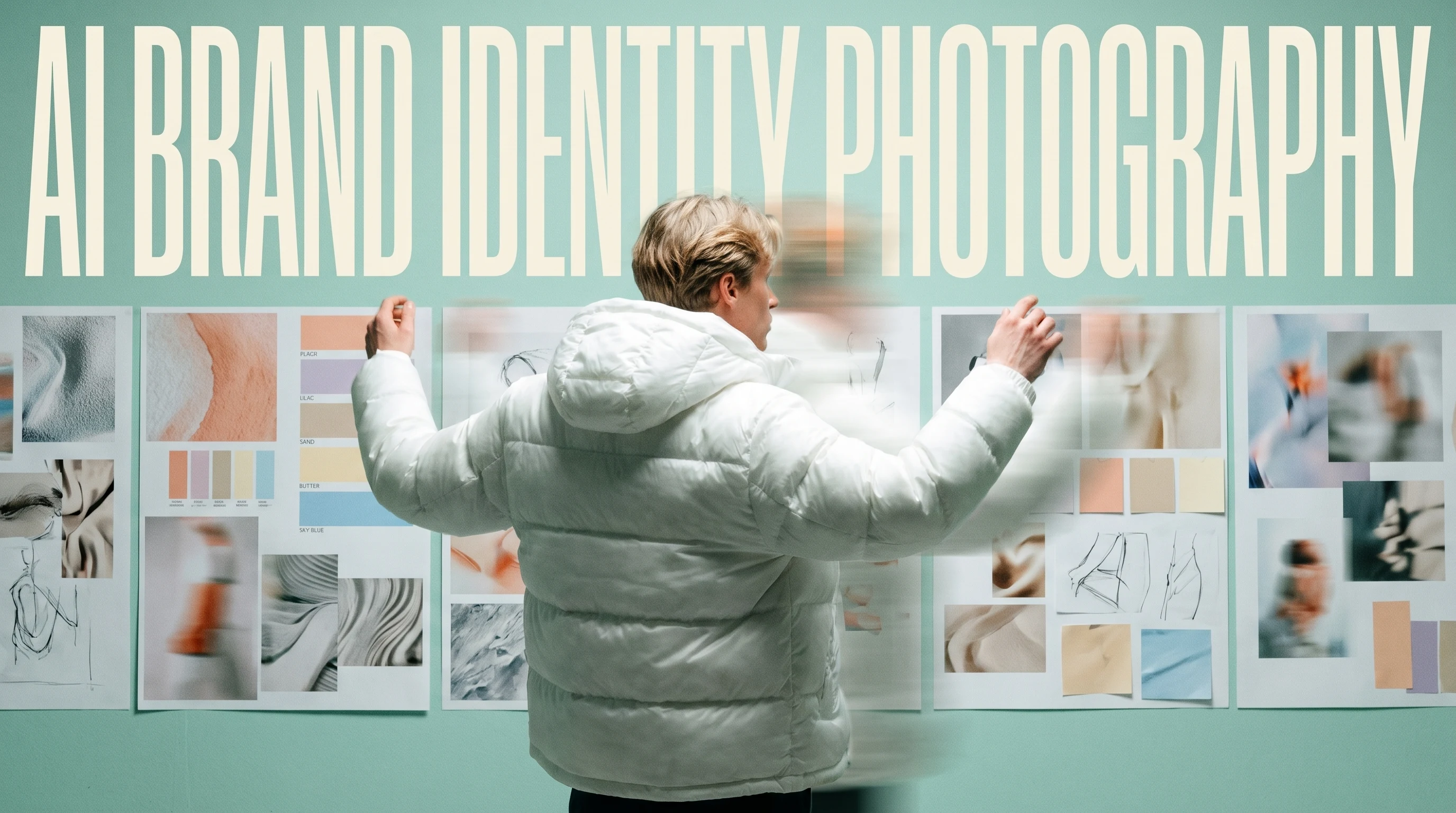
Most brands trying AI photography end up with a Midjourney grid that looks like eight different companies. AI brand identity photography is the opposite discipline: generating product, lifestyle, founder and campaign imagery that reads as one coherent visual system across every touchpoint. At Absolutely AI we treat it as a system problem, not a prompt problem, and this playbook shows the artefacts a brand team actually needs.
The gap between a one-off cool image and a repeatable brand look is where every in-house team gets stuck. What follows is the operational spine: what the discipline actually is, the building blocks, a style-guide skeleton, an honest tool comparison for 2026, and a 30-day rollout that fits alongside your quarterly hero shoots rather than trying to replace them.
What 'AI brand identity photography' actually means
Generic AI image generation optimises for a single striking frame. A traditional brand shoot optimises for a hero campaign. AI brand identity photography sits between the two: a repeatable capability to produce on-brand imagery on demand, at any scale, for any channel, that still feels like it came from one studio. It is closer to a productised photography practice than to prompt tourism.
Three pillars define it. Character and product consistency means the same founder, the same bottle, the same model recurs across a set without morphing between frames. Style consistency means the lens, grain, colour science and post-treatment behave as one aesthetic. Brand-system consistency layers the palette, lighting recipes, composition rules and mood over the top so that even a new subject slots in cleanly.
If any one pillar is missing the output collapses into stock. All three together produce something a design director will actually sign off, and something a customer will read as your brand rather than as AI.
Why traditional brand shoots break at scale
The quarterly hero shoot is not the problem. The problem is the eleven weeks between shoots, when the social team, the paid media team, the lifecycle team and the PR team all need fresh, on-brand imagery for launches, seasonal beats, localisation and A/B tests. Reshooting is impossible on that cadence, and stock never matches.
Cost per deliverable is the second failure. A single production day can produce twenty to forty usable frames. Modern channels want hundreds per month, cut to a dozen aspect ratios, refreshed weekly. The economics of running that volume through traditional production do not close, and briefs get quietly downgraded to whatever the internal designer can fake in Photoshop.
The honest framing is hybrid. Book the photographer for the hero campaign and the founder portraits. Use AI brand identity photography to fill every gap between shoots, extend the campaign into new formats, and localise for markets the hero shoot never covered.
The building blocks of a consistent AI brand look
Every consistent AI brand output rests on the same four building blocks. Skip one and the system leaks; get all four right and a mid-tier model will outperform a senior prompter working ad hoc.
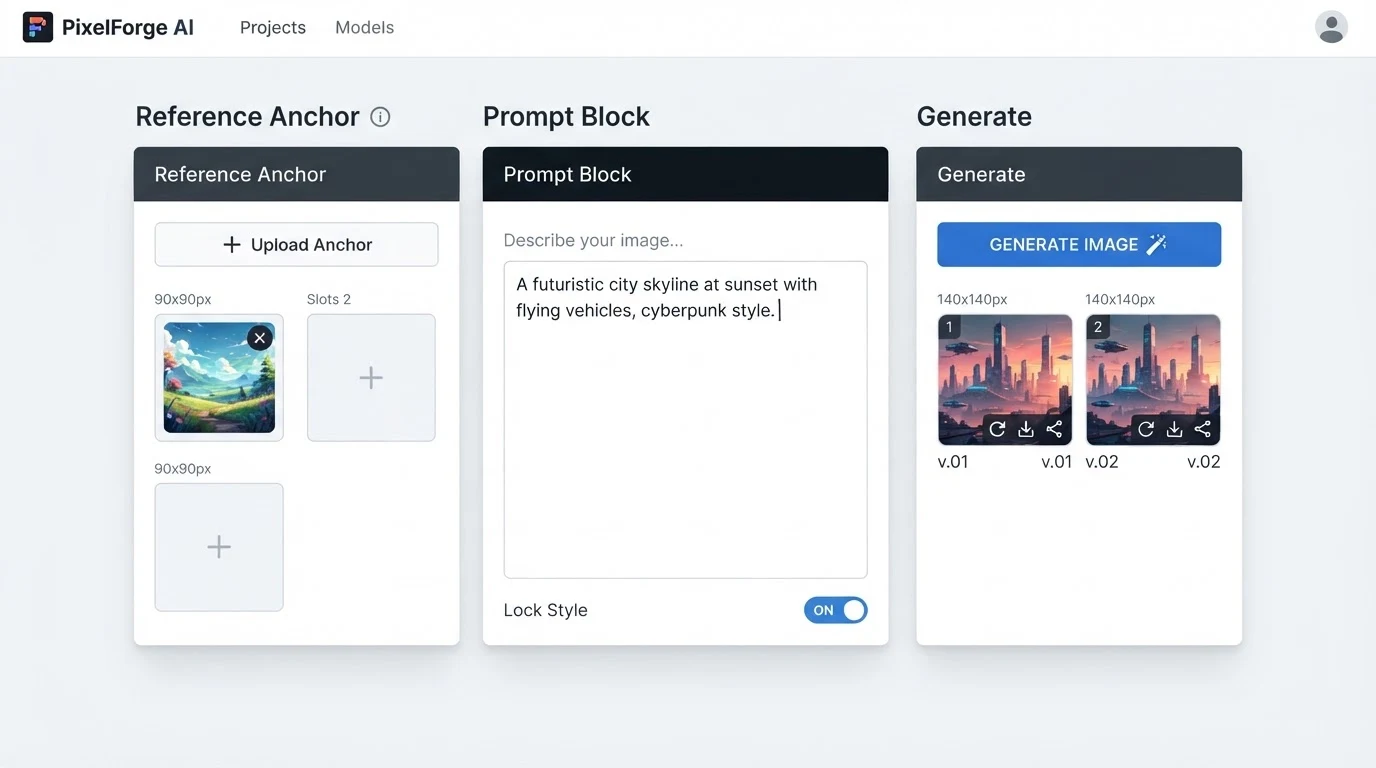
- A reference anchor set. Three to twenty curated images that cover the angles, lighting conditions, expressions and product states you plan to generate. This is the visual DNA the model refers back to.
- A locked prompt block. A reusable text template that encodes brand descriptors: lens, film stock, lighting adjective, colour palette, composition rule, mood word, negative prompt. Only the subject slot changes between generations.
- A fixed seed strategy. Locking seeds within a shoot cluster keeps character features and lighting stable across a series. New clusters get new seeds; nothing floats.
- A style library. Named recipes (Studio White, Golden Hour Coastal, Editorial Cool) that combine a reference set, a prompt block and a seed range. Any team member can pull a recipe off the shelf and get on-brand output.
Character reference (cref) and style reference (sref) tools in Midjourney, and LoRA fine-tuning in the Flux ecosystem, are the mechanisms most teams reach for. The mechanisms matter less than the discipline of writing the anchor set and the prompt block down as artefacts your team actually maintains.
Building your AI brand photography style guide
A traditional brand book has logos, colours and typography. An AI-ready brand book adds the layers that a generation model needs to render your world. Below is the skeleton we hand to clients when we build one alongside their AI brand photography system.
| Section | What it encodes | Example |
|---|---|---|
| Colour palette | Named hues with prompt descriptors and hex | Bone (#F1EBDD), matte cream, warm off-white |
| Lighting recipes | Three to five named lighting states | Soft north daylight, high-key studio, low golden hour |
| Composition rules | Framing, negative space, subject placement | Off-centre subject, generous headroom, no symmetry |
| Wardrobe library | Silhouettes, textures, fabrics, era cues | Linen, unbleached cotton, oversized tailoring |
| Prop library | Recurring objects that appear across shoots | Ceramic vessel, paper backdrop, single stem |
| Do-not-generate list | Categories the brand refuses to publish | Plastic packaging, neon, chrome, stock smiles |
The point of writing this down is that any generation tool becomes an execution layer. Swap Midjourney for Flux next year and the guide still applies. Without it every prompt is a rebuild.
Workflow: from brief to on-brand asset
The pipeline itself is unglamorous, which is exactly why it works. Every asset moves through the same five stages, and a human art director owns two of them.
- Reference upload. The correct anchor set for the recipe is loaded. If none exists, the brief triggers a small shoot or a curation pass first.
- Prompt template. The locked prompt block is filled with the subject variables from the brief. No free-form prompting.
- Generation. Batches of four to sixteen frames per subject at the recipe's seed range.
- Curation. Art director cuts the batch to a shortlist and flags any drift from the style guide. This is where taste enters the system.
- Light retouch. Colour match to the palette, hand and eye cleanup, edge polish, aspect-ratio versioning.
The workflow is the same whether the deliverable is a single lifestyle frame or a hundred-SKU refresh for an ecommerce catalogue. Only the batch sizes change.
Tools that actually do this well in 2026
The tool landscape has settled enough to write honest guidance. Pick based on what your brand look demands, not on which model has the loudest release notes.
| Tool | Best at | Trade-off |
|---|---|---|
| Midjourney (cref + sref) | Fast style locking, editorial feel, moodboard-driven work | Weaker at exact product replication and typography |
| Flux with LoRAs | True character and product consistency after fine-tuning | Requires a training pipeline and a technical owner |
| Ideogram | Layouts with legible text, packaging mocks, poster comps | Less filmic than Midjourney out of the box |
| Orchestration platforms | Chaining reference sets, prompt blocks and post steps | Adds a workflow layer to learn |
| Photta / Typeface / getimg | Team-friendly interfaces over the underlying models | Ceiling capped at what the wrapped models can do |
Most serious brand systems in 2026 combine two of these: a Midjourney or Flux backbone for hero imagery, plus Ideogram or a layout tool for anything with type. Wrapper platforms are useful for team access but never define the ceiling.
When AI brand photography fails
Being honest about the failure modes is part of the discipline. Founder likeness at close crop still shows uncanny hands, wrong eyes and off catchlights, and no client wants that as their About page. Regulated categories (medical devices, financial products, alcohol in some markets) carry disclosure obligations that make generated hero imagery a legal risk. Hero campaign shots that a whole quarter is built around still deserve a real photographer.
The rule we give clients: if the image will be blown up at 2 metres, appear on the founder's LinkedIn header, or run in a regulated ad channel, book the photographer. Everything else, particularly the volume tier that keeps your channels alive between shoots, is a fair use of an AI-first pipeline.
Governance, rights and disclosure
Three governance questions are worth answering before you publish at scale. Training data provenance: does your chosen model have a clean training story or a live lawsuit? Model release equivalents: if you generate a person who resembles a real individual, do you have the right, and do you have a written policy for refusing lookalike prompts? Disclosure: some markets and platforms now require AI-generated imagery to be labelled, and most brands prefer to get ahead of that with a plain-language policy on their site.
None of this is a blocker. It is a fifteen-line policy document, a named owner, and a checkbox in your curation stage. Skipping it is what creates the crisis.
A 30-day rollout for a brand team
The rollout below is what we run with clients who want the capability in-house rather than fully outsourced. Roles matter more than tools: an art director owns taste, a prompt engineer owns the templates, a retoucher owns finish.
- Week 1. Audit existing brand assets. Cut the anchor reference set. Write v1 of the AI style guide.
- Week 2. Build three named style recipes covering your most common deliverables. Lock prompt blocks and seed ranges.
- Week 3. Pilot on one real brief per channel. Art director reviews every frame. Document what breaks.
- Week 4. Refine the guide from the pilot's failures. Ship a request intake form. Set a weekly curation ritual.
By day 30 you have artefacts, not experiments: a guide, a recipe library, a workflow and a named owner. That is the point at which AI brand identity photography stops being a novelty and starts being infrastructure.
Frequently Asked Questions
How is AI brand identity photography different from just using Midjourney?
Midjourney is a generation engine. AI brand identity photography is the system wrapped around it: reference sets, locked prompt blocks, seed strategy, style recipes and an art director in the loop. The engine matters less than the system.
Do we still need a photographer?
Yes, for hero campaigns, founder portraits at close crop, and any regulated context. AI fills the volume tier between quarterly shoots rather than replacing the shoot itself.
How many reference images do we need to start?
Three to twenty per style recipe is the working range. Fewer than three and the model drifts. More than twenty and you dilute the signal. Curate ruthlessly.
Which tool should we pick in 2026?
Most brand systems combine two: a Midjourney or Flux backbone for imagery plus Ideogram or a layout tool for anything with type. Pick based on your brand's actual output mix.
How do we keep our founder recognisable across generations?
Use character reference (cref) in Midjourney or a fine-tuned LoRA in Flux, always seeded within a locked range, and cap the crop above a certain tightness. Below that crop, book a real photographer.
What roles do we need internally?
Three at minimum: an art director who owns taste and curation, a prompt engineer who owns templates and recipes, and a retoucher who owns finish. The same person can wear two hats early on.
How do we handle rights and disclosure?
Write a fifteen-line policy covering training-data choice, lookalike refusal and channel-by-channel disclosure. Name an owner. Add a curation-stage checkbox.
How fast can this be up and running?
A disciplined team ships v1 in 30 days: week one audit and guide, week two recipes, week three pilot, week four refinement. After that it is a weekly ritual, not a project.
Where to take this next
AI brand identity photography rewards teams that treat it as a system: artefacts you maintain, roles you name, recipes you can pull off a shelf. The individual images are the output; the guide, the anchor set and the prompt block are the asset. If you want a partner to build that system with you, Absolutely AI runs this playbook end to end, from the first reference cut through to a live library your team can operate on their own.