Casting AI Models for Lifestyle Photography: A 2026 Guide
Most AI imagery tools sell casting as a dropdown. Lifestyle photography has never worked that way. At Absolutely AI we treat casting as a brief and a discipline, not a slider, because the character inside a lifestyle frame is the campaign. This is how we cast, direct, and hold AI talent consistent across a full brand shoot.

Most AI imagery platforms sell casting as a dropdown menu. Choose an age band, a skin tone, click generate. That workflow is fine for a flat lay, but lifestyle photography has never been about picking a face. It is about casting a person into a role: a Sunday morning, a first coffee, a moment of relief after a long week. In serious lifestyle work, casting is the first act of direction, not a filter, and it deserves a real brief before a single prompt is written.
What 'casting' actually means in an AI lifestyle workflow
Casting is not an ethnicity slider. It is the deliberate assembly of demographic, psychographic, wardrobe, gesture, and gaze into a single character who reads as real inside a specific brand world. A twenty-eight year old woman in linen with tired shoulders and a half-smile is not the same character as a twenty-eight year old woman in athleisure with a wide grin and open posture, even if both share the same base face. The first is a Sunday skincare customer. The second is a Monday supplement customer. Different casting, different campaign.
The prompt is where casting gets written, and every clause carries information. Age band gives a rough face age, but occupation, energy level, weekend routine, and daily wardrobe register do the actual character work. A properly directed lifestyle shoot treats this like a casting session with a director in the room, not a search bar with filters.
The three casting approaches in 2026
There are three real ways to cast an AI model right now, and they trade against each other on control, consistency, cost, and rights. The right choice depends on how many assets the campaign needs and how tightly the character has to hold across the set.
Stock virtual model libraries sit at one end. Photoroom, Claid.ai, and Zawa all publish curated model libraries built for ecommerce swap-ins. They are fast, legally packaged, and licensed for commercial use, but the pose vocabulary is limited and the same face turns up across a hundred other brands' feeds. Prompt-native casting in Midjourney, Flux, and Ideogram sits in the middle: full control over character, styling, and scene, but consistency across a campaign requires the character reference features, seed locking, and disciplined prompt hygiene. Brand-owned characters sit at the far end. Training a LoRA on a proprietary character, whether based on a real model hired for a training day or fully synthetic, produces a locked cast that renders identically across every asset.
| Approach | Control | Consistency | Cost | Rights |
|---|---|---|---|---|
| Stock virtual libraries | Low | High within library | Low | Bundled licence |
| Prompt-native (Midjourney, Flux, Ideogram) | High | Medium, needs cref and seed | Medium | Depends on jurisdiction |
| Brand-owned LoRA | Very high | Very high | High upfront, low per asset | Cleanest, owned by brand |
For most campaigns beyond a single hero shot, the cost model tips toward LoRA training somewhere around the third or fourth deliverable, because per-asset generation cost drops sharply once the character is locked.
Writing the casting brief
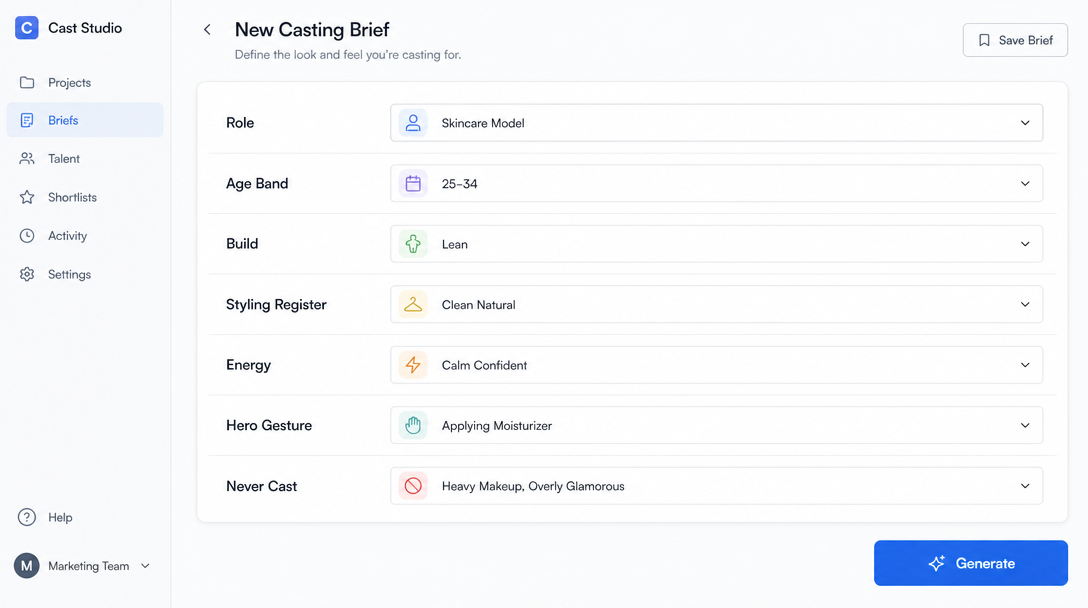
The single change that lifts an AI lifestyle brief from generic to campaign-ready is writing a proper casting document. The template below covers everything a base model needs to render a consistent, on-brand character rather than a demographic average.
- Role in the story: what this character represents to the customer
- Age band: a five-year window, not a single number
- Build and stature: proportions, not measurements
- Styling register: linen and neutrals, corporate tailored, streetwear, athleisure, editorial
- Energy: still and considered, mid-motion, laughing, wistful
- Hero gesture: the specific movement inside the frame
- Gaze: to camera, off-frame left, downcast, closed eyes
- Never cast: face types, styling directions, or demographics that are off-brand

A worked example for a skincare hero: role is a mid-thirties customer at the end of a difficult week; age band thirty-two to thirty-seven; build slender with natural shoulders; styling register cream linen and unbleached cotton, no jewellery; energy quiet and relieved; hero gesture applying serum with two fingers to the cheekbone; gaze soft, off-frame right toward a window; never cast: high-glam makeup, tanned hollywood polish, wet-look hair. That paragraph is a brief. A dropdown is not.
Character consistency across a campaign
A lifestyle campaign is rarely a single frame. It is a hero, three lifestyle scenes, five ecommerce cutdowns, two vertical social edits, and a set of stills for the site. The character has to be the same person in every asset. This is where prompt-native casting most often fails, because a small prompt change can shift the face by ten percent and the whole set stops feeling like one shoot.
Midjourney's character reference feature and Flux LoRA training are the two production-grade tools for holding a cast. Seed locking helps within a single session but does not survive prompt drift or model updates. A brand that plans to shoot more than one campaign off the same character should train a LoRA on that character once and pay the cost back across every future asset. This is the same logic that drives investment in an in-house AI content system rather than one-off generations booked project by project.
Character reference images should be built as a small library: front, three-quarter, profile, laughing, neutral, and closed-eyes, each in consistent studio light. That library is the equivalent of a physical model's book, and it feeds every downstream shoot without a re-cast.
Diversity as strategy, not a checkbox
The dominant marketing angle in the virtual model space is the promise of a diverse library. That framing solves the wrong problem. A brand does not need a demographic average. It needs to cast for its specific customer, which is a far narrower brief than diversity as a headline.
Base models also carry stereotype defaults that need to be actively broken. Prompting for a woman drinking coffee pulls a strong statistical centre every time. Prompting a specific age band, a specific city, a specific occupation, and a specific weekend routine gets past that centre and produces a character who reads as an individual. Cast for the person the customer would recognise as themselves, not the demographic that focus tests as broadly acceptable. Fashion brands in particular have learned this the hard way with campaigns that read as focus-grouped rather than styled.
Likeness, rights, and the 'no real named person' rule
The legal picture in 2026 is clearer than it was two years ago, and stricter than most brands realise. The EU AI Act requires disclosure that imagery is AI-generated in most commercial contexts. US right-of-publicity law, especially in California, New York, and Tennessee, treats an AI likeness of a named person the same as an unlicensed photograph. The SAG-AFTRA agreements from the 2023 strike set a template that other jurisdictions are now copying into their own guidance.
Practical rule: do not prompt for the likeness of any named real person, alive or dead, ever. Do not train a LoRA on scraped celebrity images. If a character is trained from a real hired model, keep a signed release covering AI training use, campaign duration, and geographic scope. The paper trail that would justify a traditional shoot still applies here. Even a fully synthetic character benefits from an internal record of the brief, the prompts, the training set if any, and the sign-off, because a serious brand engagement will ask for it before the first asset ships.
Aitana Lopez, Lil Miquela, and Yoox's Daisy are the useful reference points. Each is a synthetic character with a documented rights position, not a scraped likeness. That is the model any brand commissioning long-lived AI talent should be following, whether the character will appear once or run for three years.
Directing the AI 'actor'
Once the cast is set, direction becomes the layer that decides whether the shot reads as lifestyle or as stock. Gaze, hand placement, product interaction, and micro-expression are all promptable, and all of them fail silently if the brief leaves them implicit.
Prompt hands into a specific position. Fingers wrapped around the mug, thumb visible, three fingers behind. Prompt product interaction into a specific verb. Applying, pouring, closing the cap, holding at eye height. Prompt micro-expression into a specific emotion. The half-smile of recognition, not simply smiling. The QC pass then checks hands, wrists, product scale against the face, reflections in glass, shadow direction, and any implied text on packaging. Most rejections cluster in those five places. The same discipline applies whether the deliverable is a still image or a short lifestyle film cutdown.
When to hire a human instead
There are shots that AI casting should not be doing yet, and pretending otherwise costs brands money and trust. Hero brand films with spoken dialogue and named-talent equity belong on a real set. Food-in-mouth product interaction still reads as uncanny across every current model. Testimonial content that will be edited from long-form footage of a real customer needs to be a real customer. Named ambassador campaigns need the actual ambassador.
The honest recommendation is a hybrid model: a human shoot for the hero and the testimonial, an AI cast for the supporting commercial assets that would otherwise never get produced because the budget could not stretch to a second shoot day. That split is where most well-run 2026 brand programmes are landing, and it is a healthier position than either extreme.
Frequently Asked Questions
Do AI-cast lifestyle models need model releases?
Fully synthetic characters do not need a traditional model release, but they do need an internal brief and provenance record. If any real person's images fed the training set, a signed release covering AI training and commercial use is required, and any release should specify duration and geographic scope.
How many reference images does a Flux LoRA need to lock a character?
Between fifteen and thirty images covering multiple angles, expressions, and lighting conditions is the working range in 2026. Fewer than fifteen tends to overfit to a single pose and the character stops feeling three-dimensional across the campaign.
Can Midjourney character reference hold a character across a full campaign?
The cref feature holds a face reasonably well within a single session but drifts across prompt changes, model updates, and long time gaps. For anything beyond a small set of assets, a trained LoRA is more reliable and cheaper per asset in the long run.
Is disclosure required when using AI models in commercial imagery?
Under the EU AI Act, yes, in most commercial contexts. In the US it is best practice and increasingly required by platform policy and retailer guidelines. Disclose in the campaign credit line or asset metadata rather than burying it.
How do we avoid the AI look in lifestyle casting?
Specificity in the brief. Age band, occupation, energy, gesture, and styling register beat generic descriptors every time. Then discipline in QC on hands, product scale, and the small tells that read as synthetic to a scrolling customer.
Should we train a LoRA on a real hired model?
If the character is going to appear in more than three campaigns, yes. Hire a model for a training day, sign a release covering AI use, and own the character for the life of the licence. The economics start to make sense fast at scale.
What is the biggest casting mistake brands make with AI lifestyle imagery?
Treating casting as a filter rather than a brief. The dropdown mindset produces stock imagery. The casting-brief mindset produces campaigns that customers recognise themselves inside.
AI lifestyle photography lives or dies on casting, and casting is a discipline before it is a tool. The brands that ship the best AI-cast lifestyle work in 2026 are the ones that write real briefs, hold their characters consistent through LoRAs and reference libraries, direct gaze and gesture with intent, and know which shots still belong on a physical set. Absolutely AI runs each of those steps as part of a lifestyle engagement, from the first character brief through the final QC pass, so the finished set reads as a campaign rather than a generation.