AI Commercial Campaigns: The 2026 Operator's Playbook
AI commercial campaigns have crossed from demo-reel novelty into shipping brand work at real budgets, with Mango, Kalshi, H&M and Coca-Cola all putting synthetic assets in front of paying audiences in the last twelve months. This piece is the operator's manual Absolutely AI wishes existed when the first briefs landed: what actually shipped, what it cost, what broke, and the workflow to replicate it without ending up in a backlash cycle.
Most articles about AI commercial campaigns are galleries. You get a screenshot of the Coca-Cola holiday spot, a link to the Kalshi ad, a paragraph about Sora, and a vague suggestion that everything is changing. What brand teams actually need is different: a map of the spectrum, real numbers behind the shipped work, the tool stack per shot type, and the failure modes that keep senior marketers up at night. That is what the team at Absolutely AI assembles below, drawn from twelve months of hands-on production.
What Counts as an AI Commercial Campaign in 2026
The phrase covers three quite different categories, and most public debate collapses them into one, which is why arguments about "AI ads" get so heated. Getting the definitions right is the first job of any brand brief.
- AI-assisted: Traditional production where AI accelerates pre-production. Individual directors and art directors have used Midjourney for moodboards and Sora for animatic storyboards on Nike-adjacent and spec work since 2024, though no standing practice at a named agency of record has been publicly confirmed. The final commercial is shot on camera. Audiences never see the AI.
- AI-augmented: Real shoots blended with synthetic elements. H&M's digital twin programme lets models license their likeness for extra campaigns without additional shoot days. Product photography compositing, background replacement and multi-market localisation sit here too.
- Fully AI-generated: No camera, no set, no talent day. Mango's teen line campaign and Kalshi's NBA Finals spot were rendered end to end from prompts and reference images. OpenAI's own first ChatGPT brand campaign, "Dish with ChatGPT", went the other way and was shot on 35mm film, which is worth remembering before assuming every AI-company campaign is itself generated.
Almost every published "AI killed the ad industry" hot take is really about the third category, which is still the smallest slice of shipped work. Most brands hiring an AI commercial production partner in 2026 are commissioning something in the augmented middle, where the payoff is speed and scale rather than pure novelty.
The Landmark 2025-2026 Campaigns Worth Studying
These are the campaigns that actually moved the industry conversation, and the ones every brand team asks about in the first meeting. The list is deliberately short: each one taught the market something the others did not.
Coca-Cola, "Holidays Are Coming" (2024)
Coca-Cola remade its 1995 holiday classic in 2024 using a stack including Runway and Leonardo, delivered across three studios in a matter of weeks. The reception was split: the brand shipped on time and on budget, but social response criticised the uncanny motion in the trucks and the loss of the original's warmth. It became the reference point for "technically feasible, emotionally under-cooked."
Mango, Sunset Dream (2024)
Mango's teen line launched with a fully AI-generated campaign, produced in-house, featuring a synthetic model shot against synthetic locations. It was the first major fashion retailer to sell physical product using zero-camera imagery, and the sky did not fall. Sell-through numbers were not publicly disclosed, but Mango has since expanded the programme, which is a stronger signal than any press release.
Kalshi, NBA Finals (2025)
As reported by NPR and covered widely in the trade press, the prediction-market platform ran a Veo 3 generated spot during the NBA Finals, made in about two days for a reported production cost of around $2,000. Traditional comparables for a spot of that profile are usually discussed in the hundreds of thousands of dollars and in weeks rather than days, but that half of the comparison is an approximation rather than a measured benchmark. This is the campaign that broke the cost conversation open, because the production cost was verifiable and the media buy was undeniable.
H&M Digital Twins (2025)
H&M signed 30 models to licence their digital likeness for use in additional campaigns beyond their contracted shoot days. Models keep control and get paid per use. The programme is the clearest working example of the augmented middle: real talent, real consent, synthetic multiplication. Detailed context sits in our breakdown of AI vs traditional production economics.
OpenAI, "Dish with ChatGPT" (2025)
The most instructive entry on this list is the one that was not generated at all. OpenAI's first ChatGPT brand campaign was shot on 35mm film by director Miles Jay through the agency Smuggler with Isle of Any, a deliberate analog choice made within weeks of Sora 2 launching. The company with the most to gain from showcasing generated video chose grain, a real crew and a real kitchen, because the brief called for warmth rather than spectacle. If you are weighing a fully generated route, that decision is worth sitting with: a tool being available is not the same as it being right for the brief.
Toys R Us and Under Armour
The 2024 Toys R Us Sora film was watched closely inside the industry and criticised loudly outside it for the same reason: the motion still read as synthetic. Under Armour's Anthony Joshua spot, by contrast, used AI to composite an impossible training sequence around a real athlete and mostly avoided the uncanny-valley discourse. The lesson is durable: anchoring on a real human face buys enormous forgiveness.
The Production Stack Behind Them
There is no single AI tool. Every shipped campaign uses a chain, and the chain looks roughly the same across brands. The table below is the current working stack as of mid-2026, grouped by job rather than by vendor loyalty.
| Job | Primary tools | What it produces |
|---|---|---|
| Ideation and moodboard | Midjourney v7, Sora storyboards, Ideogram | Style frames, mood direction, character look-dev |
| Hero stills and product imagery | Flux Pro, gpt-image-2, Ideogram | Print, OOH, social stills, reference plates |
| Video generation | Runway Gen-4, Kling 2.5, Veo 3, Sora 2 | Hero motion, b-roll, transitions |
| Voice and dialogue | ElevenLabs, Suno for sonic ID | VO, character voice, music beds |
| Assembly and finish | CapCut, Premiere, DaVinci, After Effects | Cut, grade, sound design, delivery masters |
| Reference conditioning | Runway References, Kling elements, Midjourney omni-reference | Character and product consistency across shots |
The friction is not in any single tool, it is in the seams between them. Teams that ship weekly have either built internal pipelines or use a hosted workflow layer that replaces the ad-hoc chain, which is where our AI automation practice spends most of its time.
Cost and Time Benchmarks
Numbers are the section competitor articles skip, usually because they do not have them. What follows are illustrative estimates assembled from disclosed case studies and public interviews, not measured benchmarks: no published study supports them as industry figures. Treat them as a way to frame the conversation internally, not as data to plan a budget against.
| Campaign type | Traditional benchmark | AI-generated equivalent | Time delta (illustrative) |
|---|---|---|---|
| Broadcast spot (30s, hero motion) | $400k to $800k, 6 to 10 weeks | $15k to $80k, 1 to 3 weeks | ~75% faster |
| Ecommerce product suite (25 SKUs) | $25k to $60k, 2 to 4 weeks | $4k to $12k, 3 to 7 days | ~80% faster |
| Social ad variants (50 cuts) | $40k+, 3 to 5 weeks | $8k to $15k, 4 to 8 days | ~85% faster |
| Localisation across 8 markets | $120k+, 6 to 8 weeks | $20k to $35k, 1 to 2 weeks | ~80% faster |
The Kalshi number is the outlier, not the norm. Most shipping brands land somewhere in the middle of these ranges once real editorial standards, revisions and legal review are added back in. For a category-specific deep dive, our note on AI product photography costs breaks down the ecommerce numbers in more detail.
Where Audiences Push Back
Every campaign in the landmark list generated some volume of backlash. Understanding the pattern is more useful than pretending it does not exist. Four failure modes recur.
- Uncanny motion. Toys R Us and the Coca-Cola remake both drew fire for hero motion that read as almost-right. Faces, hands, secondary motion in fabric and hair, and vehicle physics are the current weak points. If your brief lives in those zones, budget for heavy editorial cleanup or shoot the hero frames traditionally.
- Emotional distance. Audiences forgive synthetic craft when there is a clear reason to use it. The moment a fully AI-generated spot tries to occupy the emotional territory of a Christmas ad or a family moment, the response gets sharp. Category matters.
- Likeness and consent. SAG-AFTRA's 2023 agreement and its 2025 addenda made digital-twin consent contractual, not optional. H&M did it right by signing individual licences per model. Brands that scrape or synthesise recognisable faces without paperwork are one screenshot away from a crisis.
- AI-slop perception. Repetitive prompt aesthetics, over-saturated grades and the tell-tale Sora fluid-camera move mark a spot as AI on first watch. The fix is direction: a specific creative choice, a distinctive palette, considered typography, sound design that does not lean on default library beds. The technology is not the problem, the taste is.
The through-line is that the safest work either anchors on real humans, treats the AI look as a deliberate style choice, or lives in categories where audiences already accept stylisation, like fashion editorials and prediction-market ads. Our team's approach to AI brand photography leans hard on the first two.
A Repeatable Workflow for Brands
Every campaign in the landmark list was produced by a team that had done it before. Repeatability comes from a defined process, not from having the newest model. This is the six-step spine we run internally, shaped by the patterns visible in how the campaigns above were produced.
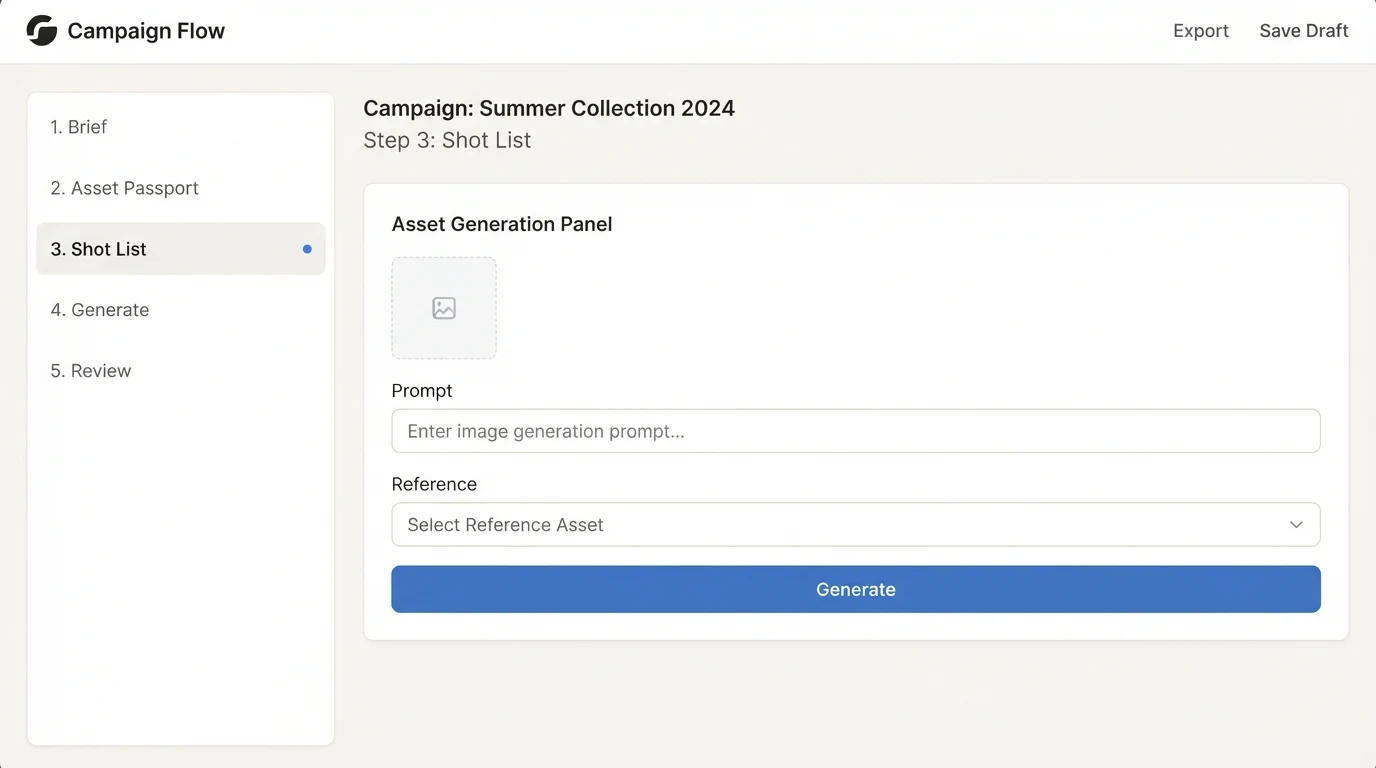
- Brief and category call. Decide up front whether the work is AI-assisted, augmented or fully generated. This determines budget, timeline, legal review and creative direction. It should be a one-page decision, not a running debate.
- Asset passport. Lock the reference set for every recurring element: hero product angles, character face and wardrobe, brand colour swatches, typographic system, and any environment plates. Every generation from this point references the passport. This is what stops character drift across a 40-shot campaign.
- Shot list with intent. Not a prompt list. Write each shot as director's intent (framing, action, emotional beat, camera language), then translate to prompts. Prompts written directly from a brief consistently under-perform prompts written from a shot list.
- Prompt-to-video with reference conditioning. Use Runway References, Kling elements or Midjourney omni-reference to anchor characters and products. Generate in small batches, cast the winners, iterate on the misses. Expect a 3:1 to 5:1 render ratio for hero shots.
- Editorial pass. Cut in a traditional NLE. Grade for a consistent look, replace default AI audio with real sound design, fix problem frames with targeted regeneration or manual cleanup. This step is where AI campaigns stop looking like AI campaigns.
- Legal and likeness clearance. Digital-twin licences on file, training-data provenance documented where required, music and voice cleared, platform disclosure labels applied where the ad network requires them. Do this before the media buy is locked, not after.
Teams delivering weekly volume run this loop as software, not as a checklist. That is where a hosted AI content creation workflow earns its keep, particularly across campaigns with heavy localisation.
Frequently Asked Questions
Is it legal to run a fully AI-generated commercial?
In most markets, yes, provided you own or licence the underlying model outputs, have clearance for any recognisable likeness, and comply with platform disclosure rules (Meta, TikTok and YouTube all now require AI-content labels on synthetic media). SAG-AFTRA jurisdiction applies where union talent or their likeness is involved. The legal risk is almost never the model, it is the inputs and the labelling.
Will an AI commercial look cheap?
It looks cheap when the direction is cheap. The taste bar is set by the same craft decisions that made pre-AI campaigns good: casting, framing, grade, sound, edit rhythm. Kalshi's spot cost a fraction of a broadcast production and does not look cheap. Plenty of six-figure AI campaigns do.
What is the realistic budget floor for a shipping campaign?
A single 15-30 second hero spot with proper editorial and legal review lands between $15k and $80k depending on complexity, revisions and the number of deliverable variants. Ecommerce campaigns start lower. Brands quoting sub-$5k full-service delivery are almost always excluding editorial, sound design, licensing and revisions.
Do agencies still matter?
More than ever, but the shape of the deliverable changes. The agency's value moves from execution capacity to creative direction, brand consistency, category judgment and legal navigation. Brands that fired their agencies to "just use Sora" tend to reappear on the pitch list within two quarters, having produced a lot of on-brief-but-off-brand output.
Which tools should an in-house team standardise on?
As of mid-2026, a credible in-house stack is Midjourney for stills, Runway Gen-4 or Kling 2.5 for hero motion, Veo 3 for photoreal short-form, ElevenLabs for voice, and a conventional NLE for finish. Standardising matters less than picking a stack and building repeatable prompts and asset passports on top of it.
How does this affect ecommerce and product-heavy brands specifically?
The economics are even more favourable than for broadcast. The ROI on AI product photography and full ecommerce suites is now clear enough that most DTC brands with more than 50 SKUs have already moved at least one product line across.
Where does this go in the next twelve months?
Reference conditioning gets sharper, character consistency across long-form gets closer to solved, and the fully generated / augmented line keeps blurring. The competitive edge moves further away from tool access and toward creative direction, brand systems and speed of iteration.
Where This Leaves the Brief on Your Desk
The 2025-2026 case list proves that AI commercial campaigns are a real production category, not a stunt. The brands that shipped well treated the work like production: defined the category, built an asset passport, wrote real shot lists, ran editorial and legal properly, and made deliberate creative choices instead of accepting default AI aesthetics. The brands that shipped badly skipped those steps. If you are scoping the next campaign and want a partner who runs this playbook end to end, from concept through hero motion to delivery masters, Absolutely AI is built for it.