AI Video for Government Campaigns: A Practical Playbook
Public sector communications teams are under pressure to ship more video, in more languages, faster, and with tighter budgets than ever. AI video promises to close that gap, but only if your team can navigate the procurement, disclosure, and accessibility stack that sits around it. This playbook from Absolutely AI maps the compliant path from brief to broadcast for government and public sector campaigns.
Most guides on AI video for government and public sector campaigns stop at the demo reel. The real work starts after the demo, when a public affairs lead has to reconcile a shiny avatar video with a procurement framework, a disclosure policy, an accessibility standard, and a records-retention schedule. This piece treats AI video as a procurement and compliance problem first, and a production problem second, because that is the order public sector teams actually encounter it. For teams that want hands-on support translating that stack into a working pipeline, Absolutely AI runs campaigns inside those constraints every week.
Why Public Sector Teams Are Moving to AI Video Now
Three forces are pulling government communications toward generative video at the same time. The first is budget pressure: media buys have held or grown while production budgets have fallen, so every pound, dollar, or euro of production spend has to stretch across more assets, more aspect ratios, and more languages. The second is multilingual reach, as councils and federal agencies are expected to serve constituents in ten or more community languages without ten separate shoots. The third is turnaround, with public safety announcements, health alerts, and consultation deadlines routinely demanding broadcast-ready video in under 48 hours.
AI video answers all three at once, which is why procurement portals have seen a sharp rise in requests for generative video capability. The question is no longer whether to use it, but how to use it inside the frameworks that already govern public sector communications. The underlying production process is well understood; what is missing from most buyer guides is the compliance scaffolding that sits around that process.
The Six Campaign Types AI Video Is Actually Good For
Not every public sector brief is a good candidate for generative video. The format shines when the asset is informational, needs variants, and benefits from a controlled on-screen presenter or illustrative b-roll rather than a specific location or named individual. The six use cases below cover the overwhelming majority of value we see teams capture.
- Public service announcements and safety alerts: flu vaccination drives, water-safety reminders, bushfire or hurricane preparedness, recycling behaviour change.
- Council and municipal updates: roadworks, bin collection changes, local election information, planning consultations.
- Service explainers: how to use a specific gov.uk, USA.gov, or state portal form, benefits applications, tax lodgement walkthroughs.
- Community engagement and consultation: short briefings that frame a policy question before a survey or town hall.
- Workforce training and onboarding: compliance refreshers, policy updates, induction content.
- Recruitment and crisis communications: role-specific recruitment reels, rapid-response briefings during an incident.
A quick-pick rule: if the brief needs a real named official, a specific protected location, or a traumatic lived experience, use conventional production and reserve the AI pipeline for the explainer and variant layer around it. For everything else, the generative pipeline is faster, cheaper, and more flexible.

Disclosure, Deepfake, and Publicity Rules You Cannot Skip
The legal stack around AI video in government work is denser than most teams realise, and it is tightening every quarter. In the United Kingdom, the Government Communications Service has set clear expectations that AI use in public campaigns is declared where a reasonable viewer would otherwise be misled, and the Advertising Standards Authority applies the CAP Code on a technology-neutral basis, which means an AI-generated ad is held to the same substantiation and misleading-content tests as any other.
In the United States, 18 USC 1913 (the anti-lobbying statute) and the longstanding publicity-versus-propaganda line restrict federal agencies from using appropriated funds for self-promotional or covert communications, and the FTC endorsement guides apply to any synthetic testimonial or avatar presented as a real endorser. A growing patchwork of state deepfake election laws, led by California, Texas, and Minnesota, criminalise synthetic depictions of candidates within specified windows before an election.
In the European Union, Article 50 of the AI Act requires that content generated or materially altered by an AI system be labelled as such in a machine-readable way, with specific carve-outs and timelines that public sector deployers need to track. The practical outcome is simple: every AI-produced public sector asset should carry a clear human-readable disclosure line and, where feasible, embedded provenance metadata.
Accessibility and Language Compliance
Accessibility is not an add-on for government video; it is the baseline the asset is judged against. WCAG 2.2 AA sets the floor for captions, audio description, contrast, and timing; Section 508 extends similar obligations to US federal agencies; and EN 301 549 is the European equivalent that procurement officers will cite in tender responses. Auto-captioning from generative video tools typically lands in the mid-90s for accuracy on clean studio audio, which is below the threshold most agencies will accept for broadcast, so a human caption pass is non-negotiable.
Sign language integration (BSL in the UK, Auslan in Australia, ASL in the US) is increasingly expected on headline PSAs rather than tolerated as a nice-to-have, and the right pattern is usually a composited sign-language presenter in a corner window rather than a generated avatar signing, because the signing community rightly rejects synthetic signers trained without consent. Multilingual voice cloning carries its own consent requirement: if you are cloning a staff presenter into five languages, you need written, revocable consent that covers each language, each use case, and each retention period.
The Procurement Path
Procurement is where most public sector AI video projects quietly die, so it pays to walk the path deliberately. In the UK, G-Cloud 14 is the most common vehicle for buying generative video services as a cloud offering, and the Digital Marketplace listing has to include a clear data-processing statement. In the US, the GSA Multiple Award Schedule is the equivalent, with additional FedRAMP posture required for anything touching federal data, and IL4 or IL5 for defence workloads. In Australia, AusTender listings and IRAP assessment are the parallel.
Four questions decide whether a tool clears procurement. Where is the data processed and stored, and does the vendor guarantee residency in-region? Does the vendor contractually opt your prompts and outputs out of model training by default, or is that an upgrade? Can the vendor produce current SOC 2 Type II and ISO 27001 evidence, and in the US a FedRAMP authorisation at the relevant impact level? And can the vendor meet the records-retention obligation that applies to your agency, which in practice means exporting prompts, model versions, and generated assets into your records system in a format that will survive a FOIA or Freedom of Information request years later.
A Production Workflow That Keeps a Human in the Loop
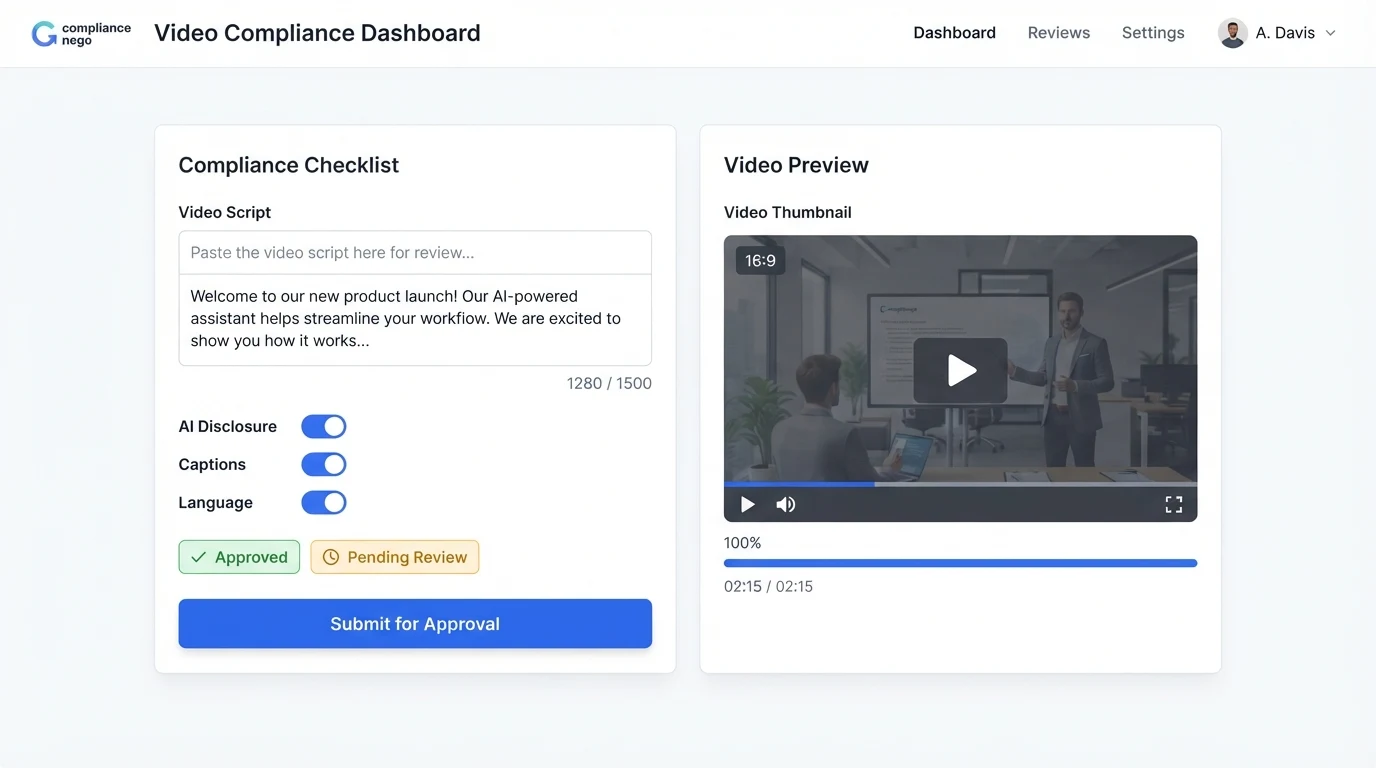
A compliant AI video pipeline has seven stages, and each stage has a named human owner. Brief intake captures the policy objective, the target audience, the disclosure posture, and the accessibility baseline. Script drafting feeds into a legal review that checks factual claims, publicity rules, and any protected-characteristic language. Avatar and voice selection confirms consent paperwork for every synthetic presenter and voice used.
Generation runs inside the approved tool, with prompts and model versions logged. Bias and factual QA is a dedicated pass, not an afterthought, and covers skin-tone representation, gendered occupational imagery, and any numeric claim that appears on screen. Sign-off follows a RACI chart that names the responsible communications lead, the accountable senior officer, the consulted legal and accessibility reviewers, and the informed data-protection officer. Finally, the versioned archive stores the brief, the final asset, the prompts, the model version, and the disclosure line together, so the whole chain is retrievable on request. Agencies that need a turnkey version of this workflow often lean on an AI-first creative partner rather than building it in-house.
Tooling Landscape
The vendor landscape is noisy, and the right choice depends on which stage of the pipeline you need to industrialise. The grid below summarises the practical trade-offs for the most common tools evaluated by public sector buyers.
| Tool | Strength | Watch-out for public sector use |
|---|---|---|
| Synthesia | Enterprise avatar library, SOC 2, strong multilingual dubbing | Residency and training opt-outs vary by plan |
| HeyGen | Fast avatar and voice cloning, broad language coverage | Confirm consent chain on cloned voices |
| Colossyan | Scenario and training focus, workflow collaboration | Smaller stock avatar roster |
| Runway Gen-3 | High-quality generative b-roll and scenes | Less suited to talking-head format |
| Google Veo | Cinematic motion, long-form coherence | Enterprise access and data posture still maturing |
| OpenAI Sora | Strong physical realism in short clips | Enterprise rollout and procurement path evolving |
| Agency pipeline (Absolutely AI) | Orchestrated multi-tool workflow with human sign-off chain | Pricing quoted per scope after a brief review |
Most mature public sector teams end up using two or three tools in combination: an avatar platform for the presenter, a generative scene tool for b-roll, and an editorial layer that assembles, captions, and archives the final asset. The best public campaigns we see treat tooling as a stack, not a single vendor choice.
Three Worked Mini Case Studies
A 60-second recycling PSA for a metropolitan council typically runs as a single synthetic presenter in the council's brand palette, two b-roll inserts generated from council-provided reference imagery, hard-burned captions, and a BSL overlay in post. The pipeline carries a visible on-screen disclosure line and a records export at the end. The same asset is cut into a 15-second social edit and translated into the council's top five community languages, with each voice track pulled from an opt-in consented voice library.
A 45-second online services explainer walking citizens through a benefits portal uses screen-recording as the primary visual, with a synthetic presenter in a corner window and captions throughout. The script passes a dedicated plain-language review before generation, and the final asset is archived alongside the portal version it describes, so an update to the portal triggers a re-record rather than a confusing legacy video. A multilingual public health alert, built in under 24 hours during an outbreak, uses a pre-cleared presenter avatar, a tightly reviewed script, and a batch-translation pass into eight languages, with each language variant checked by a native-speaker reviewer before release.
What Not To Do
A short list of patterns that have ended public sector AI video projects badly. Do not generate synthetic depictions of named political figures, serving officials, or candidates, even in satire or illustration. Do not deploy cloned voices without a written consent chain that covers each language and each campaign. Do not release emergency or safety broadcasts without burned-in captions and a sign-language overlay. Do not scrape stock imagery or social media photographs to train or seed avatars; use licensed, consented reference material only. Do not omit the AI disclosure line to make a creative look more premium.
Checklist and Templates
Before a public sector AI video goes to sign-off, the responsible officer should be able to answer yes to every item on a short checklist: the disclosure line is present and legible, captions and audio description meet WCAG 2.2 AA, sign-language overlay is included where required, every synthetic presenter and voice has consent on file, prompts and model versions are archived, the data-processing chain is in-region, and the asset has cleared factual and bias QA. A standard RACI template and a procurement question set can live alongside the project brief, so the next campaign starts from a known-good baseline rather than reinventing the wheel.
Frequently Asked Questions
Do we have to disclose that a video was made with AI?
In most jurisdictions relevant to public sector work, yes. UK GCS guidance, EU AI Act Article 50, and FTC endorsement rules all push toward clear human-readable disclosure where a reasonable viewer would otherwise be misled, and machine-readable provenance labelling is increasingly expected on top.
Can we use an AI avatar of a real official?
Only with explicit, written, revocable consent from that official that covers the specific campaign, the languages, and the retention period, and only where the use would not breach anti-lobbying or publicity-versus-propaganda rules in your jurisdiction. For political figures and candidates, the answer is almost always no.
How do we meet accessibility standards with AI video?
Treat auto-captioning as a draft, run a human caption pass, add audio description where visual information is load-bearing, and composite a sign-language presenter for headline PSAs. WCAG 2.2 AA, Section 508, and EN 301 549 are the standards to cite in your tender responses.
Which procurement framework should we use?
In the UK, G-Cloud 14. In the US, the GSA Multiple Award Schedule with the FedRAMP posture required for your data impact level. In Australia, an AusTender listing with an IRAP-assessed vendor. In every case, confirm data residency, training opt-outs, SOC 2 and ISO 27001 evidence, and records-retention export in the contract.
How long do we have to keep the prompts and model versions?
Follow your agency's existing records-retention schedule for communications assets, and treat the prompt, the model version, and the generated output as a single record. In practice this means exporting them from the tool into your records system at the point of publication, in a format that will survive a FOIA or FOI request years later.
Can AI video be used for crisis communications?
Yes, and it is often the only way to hit a 24 to 48 hour window across multiple languages. The guardrails are the same as any other asset: disclosure, accessibility, consent, factual QA, and a sign-off chain, compressed but not skipped.
Conclusion
AI video is not a shortcut around public sector communications standards; it is a new production surface that those standards extend across. Teams that treat it as a procurement, compliance, and accessibility problem first, and a creative problem second, are the ones shipping campaigns that hold up under scrutiny months and years after release. If you want a partner that already works inside that envelope, Absolutely AI builds AI commercial and campaign work for public sector and regulated clients end to end.