AI Keynote Topics for Marketing and Creative Conferences
Most AI keynotes for marketing audiences recycle the same enterprise framing that bores creative rooms stiff. At Absolutely AI we see event programmers wrestling with the same gap: the speakers who know AI deeply often cannot read a creative crowd, and the speakers who can read the room are still catching up on the tech. This is the shortlist we recommend when a conference programmer asks what will actually land.

Most AI keynotes for marketing audiences recycle the same enterprise framing that bores creative rooms stiff. The speakers who know AI deeply often cannot read a creative crowd, and the charismatic bureau names are still catching up on the craft. This is the shortlist we recommend to event programmers who want their AI session to be the talk of the week, not the slot people skip to grab coffee. For teams building the muscle internally after the keynote, our AI workshops for creative teams cover the practical follow-up.
What a marketing and creative audience actually wants from an AI keynote in 2026
Event research from Talent Bureau and others consistently shows that more than 45% of marketing event attendees now rank AI as the topic they most want on the agenda, overtaking leadership and purpose. That demand has outpaced supply of good speakers, which is why so many bookings still default to a generic futurist. Agency and brand audiences in 2026 want three things from an AI session: a point of view, work they recognise, and a usable idea they can walk back to the team on Monday.
The failure mode is predictable. A speaker opens with a transformer diagram, spends ten minutes on ChatGPT demos the audience has already run themselves, then lands on a vague ethics warning. Creative directors tune out at the diagram. CMOs tune out at the demo. The room goes quiet and the post-event survey scores drop. For a sense of how we think about teaching this material inside brands, our AI training for marketing teams write-up covers the same ground from the client side.
The 12 best AI keynote topics for marketing and creative conferences
Each of the twelve below has been road-tested with marketing and creative audiences. We have included the audience fit, a three-point talk track, a case study the speaker can anchor to, and a note on who tends to deliver this angle well. The consulting work we do with in-house teams has given us a close read on which of these land and which ones die.
1. AI and human creative collaboration
- For: agency creative directors and in-house creative leads.
- Talk track: why the model is a collaborator not a replacement; the three postures (co-pilot, challenger, intern) and when each works; what gets protected when AI is in the room.
- Case study: a global campaign where the creative team used generative tools in ideation but kept final craft human.
- Known for this angle: creative directors from the independent agency scene, particularly those who have shown the work at Cannes Lions.
2. Generative workflows inside agencies
- For: agency COOs, heads of production, creative operations.
- Talk track: where generative tools compress the pipeline; the roles that disappear versus the ones that multiply; the real economics of a hybrid shoot.
- Case study: a mid-size agency that rebuilt its production stack in a quarter and what broke along the way.
3. Brand voice at scale with LLMs
- For: brand managers, content leads, CMOs of multi-market brands.
- Talk track: building a voice spec a model can follow; the review loop that keeps drift out; why fine-tuning is usually the wrong first move.
- Case study: a retailer running localised brand copy across a dozen markets with one voice spec.
4. The IP and copyright reckoning
- For: CMOs, general counsel, agency leadership.
- Talk track: where current 2026 case law has actually landed; what training-data lineage means for a client's commercial usage; the practical questions to put to a vendor before signing.
- Case study: the recent US and EU rulings that reshaped how agencies document provenance on delivered work.
- Known for this angle: Gerd Leonhard and legal-literate futurists who can hold the room without reading from statute.

5. AI-driven creative effectiveness and testing
- For: performance marketers, CMOs, measurement leads.
- Talk track: pre-flight testing with synthetic panels; what the Ehrenberg-Bass and System1 traditions get right and wrong about this; where creative testing stops being useful.
- Case study: a brand that killed a hero concept pre-shoot after synthetic testing flagged a cultural read the room missed.
6. The death of the brief
- For: strategists, planners, agency new business.
- Talk track: what replaces the ten-page brief when a model can generate twenty routes overnight; the new skill of writing prompts a creative team can run with; where the strategist's job gets harder, not easier.
7. Personalisation versus creativity
- For: CMOs, growth leads, CRM owners.
- Talk track: the false tradeoff; why mass-personalised work is usually worse than one great piece well-targeted; the two or three places where variant generation genuinely moves the needle.
- Known for this angle: Matt Britton and the US consumer-side strategists.
8. Prompt craft as the new creative discipline
- For: art directors, copywriters, in-house creatives.
- Talk track: prompting as writing, not engineering; the reference-pack habit that separates good output from slop; how senior creatives are mentoring juniors on this.
- Case study: a creative team that promoted an art director into a prompt-lead role and what changed in the work.
9. Synthetic audiences and consumer research
- For: insight leads, strategists, research buyers.
- Talk track: where synthetic panels replace qual, where they absolutely do not; the methodological traps; the research buyers who are quietly using this already.
- Known for this angle: speakers from the MMA Global and AMA research tracks.
10. AI-native brand building
- For: founders, challenger-brand CMOs, venture-backed marketing leads.
- Talk track: what a brand looks like when its content system is generative from day one; the brands quietly outproducing incumbents at a fraction of the headcount; the trap of looking generated.
11. A responsible AI framework for marketers
- For: CMOs, corporate affairs, legal.
- Talk track: a working framework (disclosure, provenance, consent, review) that is not just a policy PDF; the brands getting this right in public; what the next regulatory wave looks like.
- Known for this angle: Ross Simmonds and the operator-practitioner speakers who can translate policy into process.
12. Rebuilding the creative operations stack
- For: heads of creative ops, production directors, CMO chiefs of staff.
- Talk track: the DAM, MRM, review and brand-governance stack when generative is baked in; the integrations that matter; where human review stays load-bearing.
How to brief a speaker for a marketing or creative crowd
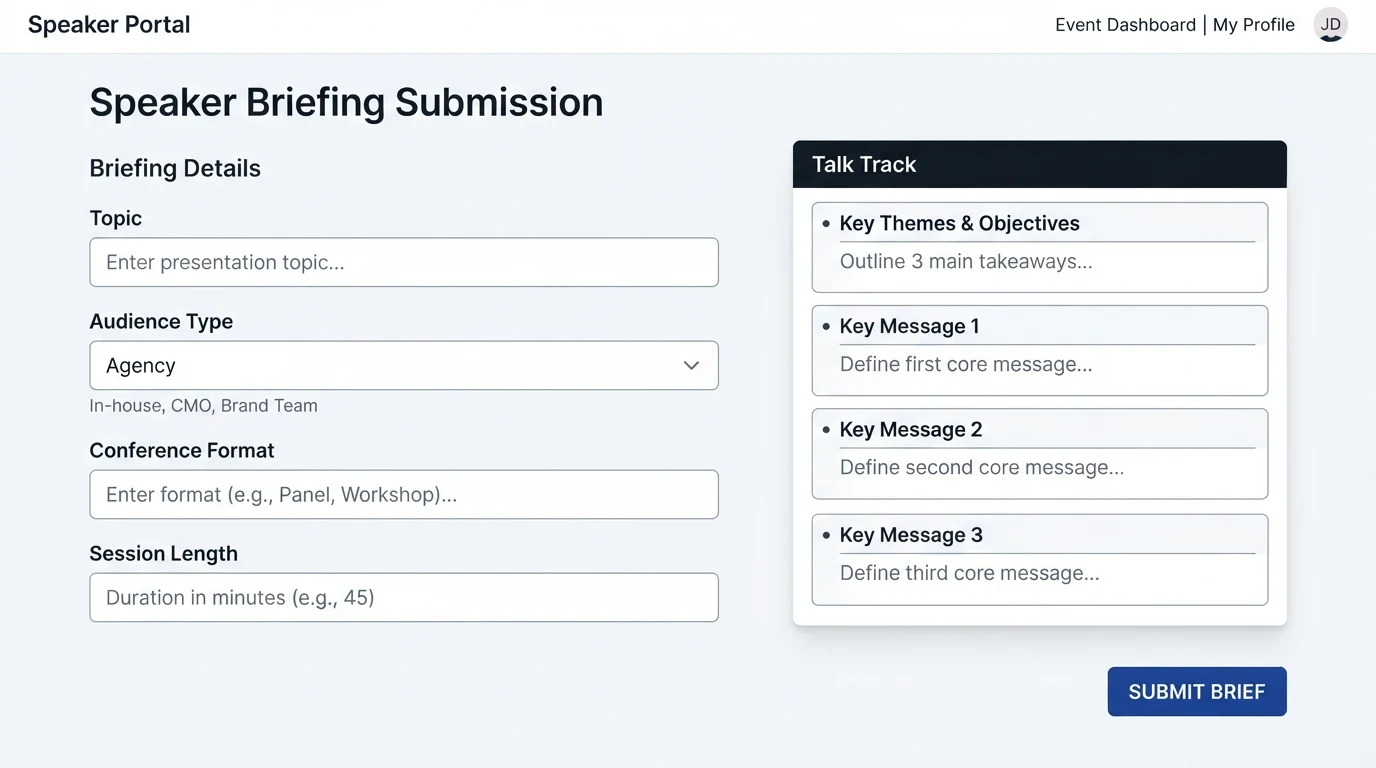
The best keynote in the world fails if the speaker opens with slide one titled "What is a Transformer". Programmers can prevent this with a brief that is specific about what the room already knows. Send the speaker the attendee breakdown by role, the three or four questions the audience asked at the last event, two or three recent campaigns the room will have seen, and a hard list of what to skip. Our AI upskilling guide for in-house creative teams covers the baseline knowledge most 2026 marketing audiences bring with them, which is a useful floor to brief against.
Ban slide one on "what is AI". Ban the ChatGPT live demo unless the demo is doing something genuinely new. Ban the generic ethics closer. Ask the speaker to show real work, name real brands where they have permission, and leave the room with one specific thing to try. Pair the keynote with a workshop slot if the budget allows: a 90-minute hands-on prompt lab after the keynote is the single most requested add-on from conference planners we work with.
Topic to event fit matrix
Not every topic lands at every event. The matrix below is the shorthand we use when a programmer asks which of the twelve to shortlist for their format.
| Topic | Festival (Cannes-style) | Agency internal summit | In-house brand day | SaaS marketing conference |
|---|---|---|---|---|
| AI and human creative collaboration | Strong | Strong | Fair | Fair |
| Generative workflows inside agencies | Fair | Strong | Weak | Fair |
| Brand voice at scale with LLMs | Fair | Fair | Strong | Strong |
| IP and copyright reckoning | Strong | Strong | Strong | Fair |
| Creative effectiveness and testing | Fair | Fair | Strong | Strong |
| Death of the brief | Strong | Strong | Weak | Fair |
| Personalisation versus creativity | Fair | Fair | Strong | Strong |
| Prompt craft as a discipline | Strong | Strong | Fair | Fair |
| Synthetic audiences | Fair | Fair | Strong | Strong |
| AI-native brand building | Strong | Fair | Fair | Strong |
| Responsible AI framework | Fair | Fair | Strong | Fair |
| Creative ops stack rebuild | Weak | Strong | Fair | Fair |
Three keynote title formulas that reliably sell tickets
Programmers often ask us to help workshop the actual session title. Three formulas have outperformed the rest in registration data we have seen across 2025 and 2026 marketing conferences. The right title does more than the abstract for drive-up attendance.
- The reversal. "Why your best creatives should be prompting less, not more" or "The case against AI-generated personalisation". A contrarian framing against the obvious hot take draws the room that is already tired of the obvious hot take.
- The number. "The seven workflows every creative team will have rebuilt by 2027". Specific, promissory, and gives the attendee something to count against.
- The named problem. "Slop, voice drift, and the three other failures killing AI brand work". Names the thing the audience is already quietly worried about.
Frequently asked questions
What does an AI keynote for a marketing conference typically cost?
Speaker fees vary enormously by profile, from under five figures for a rising operator-practitioner to well into six figures for a global bureau name. Fees are quoted per engagement, not published, and most speakers negotiate on format (keynote only, keynote plus workshop, panel moderation) rather than headline rate.
How long should the keynote itself be?
Forty-five minutes with fifteen minutes of moderated Q&A is the format most AI keynotes have settled into for marketing audiences. Longer than that and the room drifts; shorter and the speaker cannot land both the frame and the practical takeaway.
Do workshop add-ons actually work?
Yes, and they are the most under-booked format in the market. A 60 to 90 minute hands-on prompt lab the afternoon after the keynote converts a passive audience into a trained one. Conference planners we work with report this is the single most requested bolt-on in their attendee surveys.
What about hybrid or virtual delivery?
Virtual delivery still underperforms in-room for AI content specifically, because the material rewards back-channel discussion the audience has while watching. If virtual is unavoidable, pair the keynote with a live Q&A window and a short follow-up written piece the attendee can share back at the office.
Should the speaker show live tools on stage?
Only if the demo shows something the audience could not do themselves in five minutes. A live demo of a stock chatbot wastes the slot. A live demo of a workflow the speaker's team has built, with real brand constraints baked in, is one of the strongest segments a keynote can run.
How far ahead should we book?
The strongest AI speakers for marketing audiences in 2026 are booking six to nine months out. Topic preferences also shift quickly in this category, so a brief locked in six months ahead is usually revisited in the final month before the event.
What is the biggest briefing mistake programmers make?
Assuming the speaker will adapt generic material to a creative audience without being asked. The best keynotes are the ones where the speaker rebuilt a third of the deck for this specific room. That only happens when the brief is specific about who the room is and what they already know.
Programming the session
A great AI keynote at a marketing or creative conference is a brief problem as much as a speaker problem. Pick the topic for the room, not the room for the topic, and build the slot around a format that gives the audience something to walk away and use. If you are shaping the AI education track at an upcoming event and want a second read on the shortlist, Absolutely AI runs AI education programmes for marketing and creative organisations and is happy to compare notes.