AI Agency Canberra: How to Choose the Right Partner in 2026
Canberra's AI market splits into two populations that look identical from the outside and feel completely different in practice: government-adjacent builders focused on compliance and custom agent development, and commercial creative studios helping brands make content faster. Absolutely AI sits firmly in the creative camp, working with Canberra brands on cinematic video, imagery and campaigns. This guide helps you self-identify the partner you actually need before you book a single call.
Canberra's AI service market has quietly split into two camps that look identical from the outside and feel completely different once a project begins. On one side are the compliance-first builders working with departments, defence-adjacent primes and public sector contractors. On the other are the creative and marketing specialists helping brands produce content, campaigns and imagery with generative tools. This guide maps the local scene, explains the real differences, and offers seven questions worth asking any Canberra AI agency before signing a scope of work.
What an AI agency actually does in Canberra
Creative AI studios focus on content: brand photography, campaign imagery, short-form video, social ads and the art direction that makes them look like your brand. They treat generative models as production tools, with human creative directors shaping every frame. Creative AI content is the fastest-growing category for commercial brands across the ACT, driven by shorter campaign cycles and more aspect ratios per release.
Agent and automation builders develop custom software. Think retrieval-augmented chatbots, workflow automations, internal copilots connected to a CRM, document pipelines, and multi-step agents that take real actions inside business systems. If your project involves APIs, databases or system integrations, this is the bucket you need, and the deliverable is typically code rather than content. AI automation agency work is the usual industry shorthand.
AI consulting and governance firms sit upstream of both. They audit readiness, draft usage policies, train staff, and advise on risk, especially for organisations with privacy, procurement or classification constraints. For gov-adjacent buyers in Canberra, this layer often runs in parallel with any build. For enterprise brands, AI consulting can also precede a creative engagement to align leadership and legal before production starts.
The Canberra AI landscape in 2026
The enterprise and public-sector end of town includes systems integrators like Data#3, specialist model vendors like Trellis Data, assurance firms like KJR, and research-grade capability out of CSIRO Data61. These groups rarely take on commercial creative work. They tend to serve departments, agencies and large private-sector clients with security, procurement or classification requirements that most brand marketers never encounter.
The agent-building middle includes Canberra-based teams like Sandlabs and Synoptix, with national competitors like 13 Labs delivering remotely into the ACT. Their deliverables are software: chat interfaces, automations, prototype agents and backend integrations. If you're building a product or an internal tool, this is your shortlist. For adjacent capability on go-to-market and launch strategy, AI marketing agency work usually sits alongside the build.
The creative, design and governance edge of the local market is thinner. Design-focused groups like Avian cover user research and interface work, and a small number of creative-AI studios serve brands nationally rather than from a Canberra postcode. Absolutely AI sits in this last group, working with ACT brands on cinematic AI films, imagery and campaign content delivered to commercial standards.
How to choose: seven questions to ask any Canberra AI agency
Ask these questions on your first call. The answers separate serious operators from freshly rebranded freelancers, and they map almost perfectly to the three agency categories above.
- Where does your model inference run, and where is customer data stored? Australian data residency matters for public sector and most regulated industries. Ask about hosting region, data retention and vendor-processing arrangements. For broader context, see our overview of the best AI content agencies in Australia.
- How do you align with the Australian Privacy Act 1988 and the Australian Privacy Principles? A capable partner will walk you through consent, data minimisation and sub-processor arrangements in plain English without reaching for a legal team.
- If your work touches government, what is your IRAP posture, and have you handled anything classified at PROTECTED? For most commercial brands this is irrelevant. For gov-adjacent clients and defence-adjacent primes it is decisive.
- What is your model stack, and will you disclose it? Expect answers naming Flux, Nano Banana, Claude, open-source Llama variants or similar. Vague answers are a red flag, and AI brand photography studios should be especially transparent about which models produce which assets.
- Can you show case studies in our category? Ask for recent work in the same vertical, not just a generic showreel. Category-specific craft is what you're paying for.
- What is your pricing model? Fixed-scope, retainer, or quoted per engagement. The right answer depends on your project shape, and this comparison of agencies and freelancers walks through the trade-offs honestly.
- Do you support ACT business hours, and how do you handle iteration cycles? Fast iteration beats on-site presence for most creative work. Face-to-face still matters for sensitive public sector engagements. Book a discovery call to pressure-test any shortlisted partner before signing.
Creative AI versus technical AI builds: which do you need?
The clearest way to self-sort is to decide what you need delivered. Content and campaigns point one way. Software and automations point another. The comparison below is deliberately simple, and it holds up across almost every Canberra brief we've seen.
| Creative AI engagement | Technical AI build | |
|---|---|---|
| What you receive | Imagery, video, campaign assets, social content | Software, agents, workflows, integrations |
| Who leads | Creative director and production team | Engineering lead and product manager |
| Measured by | Brand quality, channel coverage, speed to market | Uptime, task success rate, cost per transaction |
| Typical cadence | Days or weeks per campaign | Weeks or months per build |
| Pricing model | Project or retainer, quoted per scope | Fixed-scope build plus support retainer |
| Best fit | Marketing, DTC, retail, hospitality, cultural brands | Operations, service, product, internal tools |
Some engagements overlap. A brand launching an AI-powered product may need both a creative studio and an engineering partner. When that happens, run them as separate contracts with separate owners. The two disciplines have different cadences, different review processes, and different definitions of done, and they should not report into the same project lead.
What a creative AI engagement actually looks like
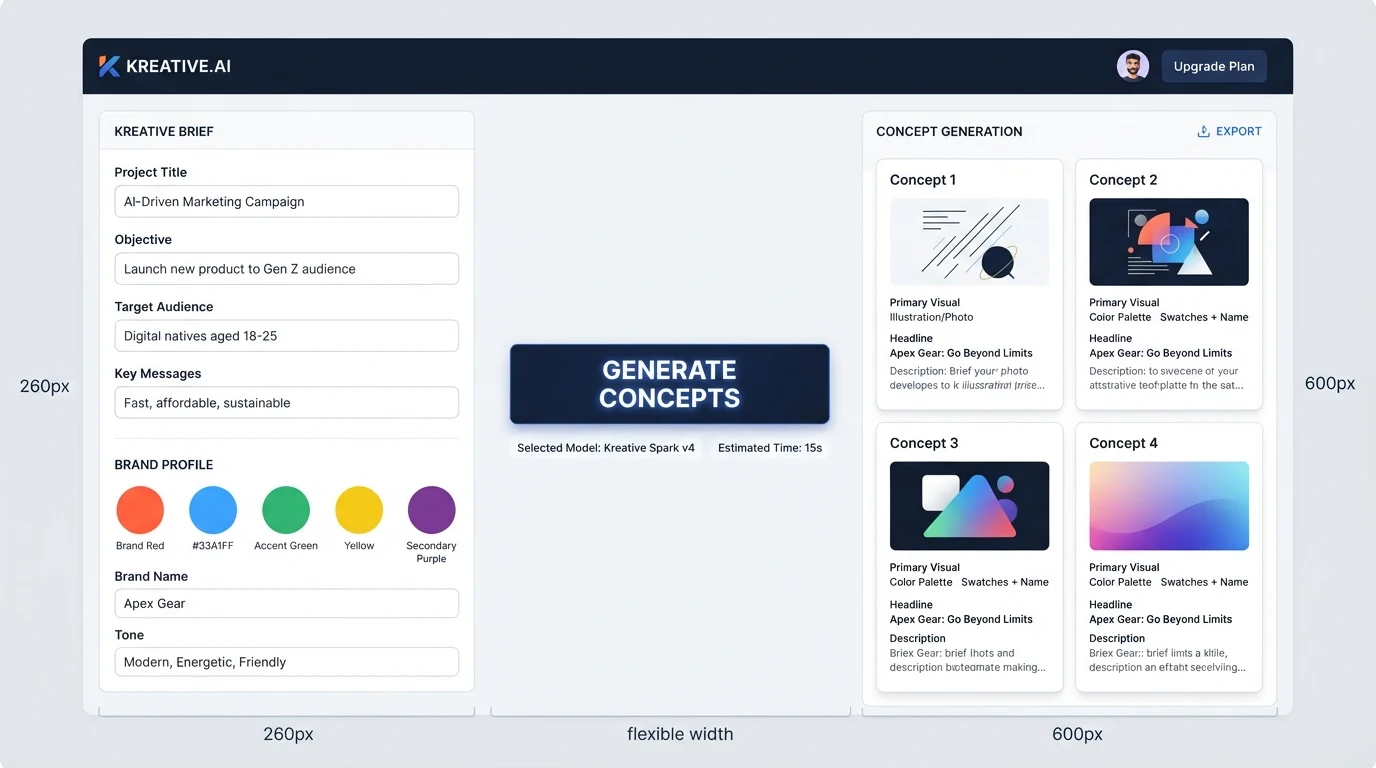
A typical creative project begins with a brief and a short brand profile covering positioning, audience, visual direction and the deliverables required. From there the studio moves into AI commercial concepting, where generative models explore multiple directions quickly, before the creative director narrows to the three or four worth refining into finished work.
Production follows. Concept imagery is upscaled, retouched and extended into full campaign assets across every aspect ratio your channels need. Motion work builds on top of the stills, with cinematic treatment supervised by a filmmaker rather than left to the model. The output reads as premium brand content, not generic AI output, because a human creative director holds the editorial bar at every step.
Delivery wraps with usage guidance: where each asset lives, which crops map to which placements, and how to extend the look later without the brand drifting. For a deeper walk through the mechanics of this approach, read the comparison of an AI content studio versus a traditional studio.
Local versus remote: does a Canberra postcode actually matter?
For most creative work it does not. Briefs, reviews and production can run entirely remotely with cloud-based review tools, and finished assets are delivered the same way whether the agency sits in Civic or in another capital. What matters is the quality of the creative direction and the speed of iteration cycles, not the physical office.
On-site presence does matter for sensitive public sector engagements, cleared facilities, and workshops where classified material cannot leave the room. If you need an agency physically inside a secure facility, hire a Canberra-based firm with the right clearances. If you need brand photography, a brand film or a social ad creative campaign, geography is noise.
Frequently Asked Questions
How much does a Canberra AI agency cost?
It depends entirely on scope. Creative AI engagements are typically quoted per scope or run as a monthly retainer. Technical builds are usually fixed-scope with a support retainer afterwards. Any serious partner will quote in writing after a short discovery call rather than publishing a sticker price, because scope is the single biggest driver of cost.
How long does a creative AI project take?
Short campaigns move in days or weeks rather than months. Larger brand builds including identity, film and photography can run across a season. Timelines compress because generative tools remove the long tail of reshoots and location logistics, not because quality or craft is reduced along the way.
Do I need an agency with government clearance?
Only if your work actually touches government systems or classified material. Most commercial brands in Canberra do not. If you are gov-adjacent but your project is commercial marketing or brand content, a creative-AI studio with strong privacy and data-handling practices is usually sufficient.
How is an AI agency different from a traditional marketing agency?
A traditional agency delivers strategy, creative and media planning across human-led production. An AI-first studio delivers the same disciplines using generative models for production, which changes what is possible on set, in post, and across aspect ratios. The best modern teams blend both approaches rather than treating them as rivals.
Is AI creative lower quality than traditional creative?
Not when a human creative director supervises it. The quality ceiling depends on the taste and craft of the people directing the models, not on the models themselves. Studios that treat generative tools as production equipment, rather than a magic button, produce work indistinguishable from traditional campaigns.
Can an AI agency handle both brand creative and ongoing content?
Yes. Many modern studios run on a hybrid model: a defining brand or campaign engagement up front, followed by a monthly content retainer that keeps social, ad and web assets fresh. This is usually more efficient than a stop-start project cadence, and it keeps a single team accountable for brand consistency.
Choosing the right Canberra AI agency starts with naming what you actually need: content, software, or governance. Once that split is clear the shortlist narrows quickly, and the seven questions above do most of the filtering. For brands looking at the creative side of the market, Absolutely AI builds cinematic campaigns for Canberra and the rest of the country, with senior creative direction on every project.