AI Marketing Consultant in Australia (2026): How to Hire Well
Hiring an AI marketing consultant in Australia is a different exercise in 2026 than it was two years ago. The category has stratified, the tooling has settled, and the real risk now sits in handover, measurement, and vendor independence rather than raw capability. This guide, written by the team at Absolutely AI, walks through what to actually expect, how pricing is structured, and how to spot the operators worth your time.

If you are a marketing director in Sydney, Melbourne, Brisbane, Perth, or Adelaide looking at an AI marketing consultant brief, the first thing to accept is that the title now covers four very different kinds of operator. Some will rebuild your content engine, some will teach your team to prompt, some will plumb HubSpot into Klaviyo through Make.com, and some will do none of the above but will sell you a framework. The team at Absolutely AI has sat on both sides of this table, and the gap between the best and worst engagements is wider than most buyers expect.
What an AI marketing consultant actually does in 2026
The scope has narrowed and sharpened. A credible 2026 engagement sits across five concrete areas: Answer Engine Optimisation (AEO) and Generative Engine Optimisation (GEO) so your brand surfaces in ChatGPT, Claude, Gemini, Perplexity, and Google AI Overviews; marketing automation built in Zapier, Make.com, or n8n; content operations that pair AI drafting with human editorial standards; AI-assisted media buying and creative iteration; and a measurement layer that tracks LLM visibility alongside traditional performance metrics. If a consultant pitches you "AI transformation" without naming at least three of those as deliverables, you are being sold a slide deck.
The work is operational, not visionary. You should expect to see workflows, prompt libraries, custom GPTs or Claude Projects, vector stores, dashboards, and documented SOPs by the end of a strong engagement. Visionary language is a cue to ask harder questions about implementation experience.
Four kinds of AI marketing consultant in the Australian market
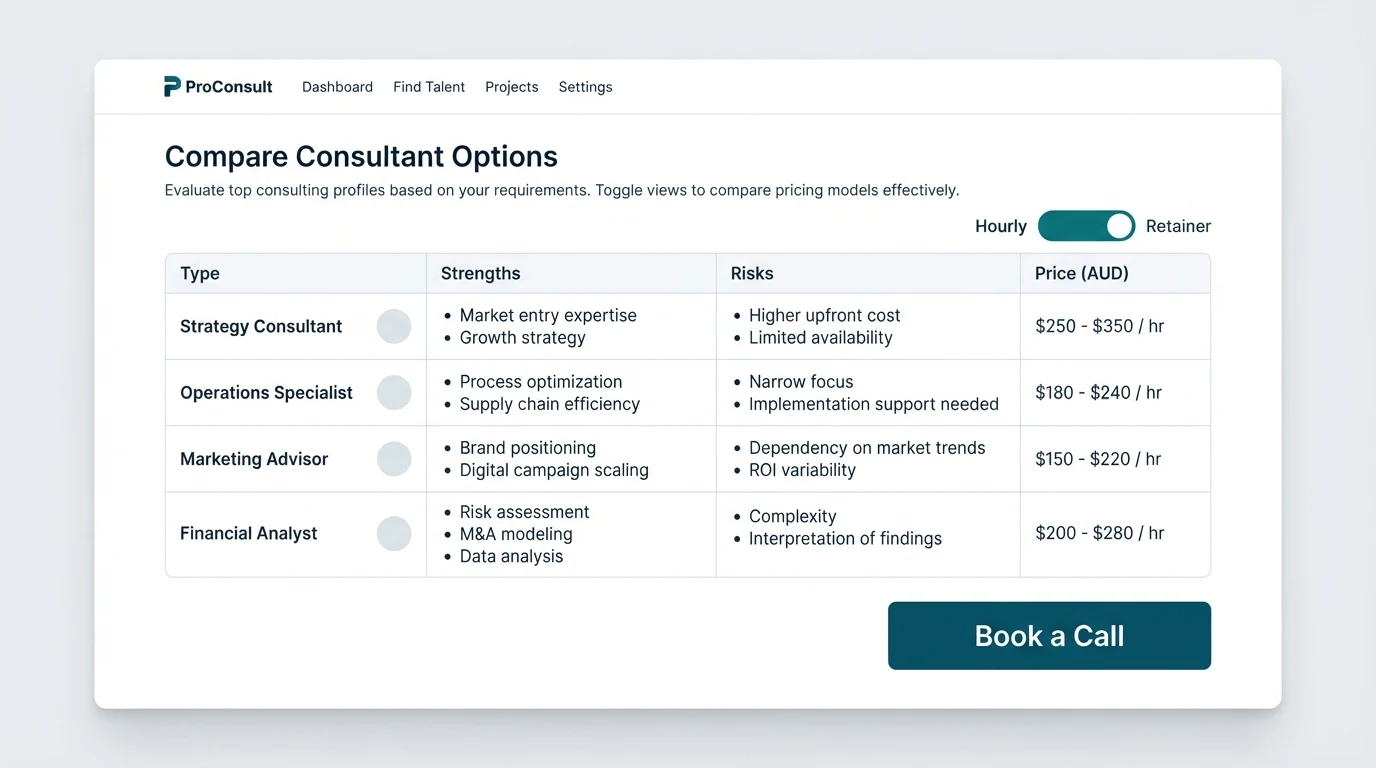
Most Australian buyers are choosing, often without realising it, between four archetypes. Each has a distinct cost structure, risk profile, and sweet spot. The comparison below describes them qualitatively, since pricing varies substantially by scope and seniority and is best treated as a conversation rather than a sticker.
| Type | Strengths | Risks | Pricing model |
|---|---|---|---|
| Independent fractional | Senior operator, direct access, flexible scope, usually ex-CMO or ex-agency lead | Single-person bus factor, limited execution capacity, calendar bottleneck | Hourly or monthly retainer, quoted per scope |
| Boutique AI-native agency | Integrated strategy, build, and creative; current tool stack; team continuity | Smaller client rosters, newer processes, variable governance maturity | Monthly retainer or scoped project, quoted per scope |
| Legacy agency with an AI bolt-on | Established governance, procurement familiarity, broad service menu | AI capability often resides in one team or a partner; retrofit rather than rebuild | Retainer or project, quoted per scope and typically at the higher end of the market |
| Offshore or remote generalist | Lower day rates, broad availability, fast turnaround on well-defined tasks | Time-zone friction, Australian compliance gaps, cultural tone drift, weaker brand judgement | Hourly or project, quoted per scope |
The right answer depends on whether you need thinking, building, or both. If you have an in-house marketing team that can execute, a fractional operator may be enough. If you need the strategy and the build and the ongoing creative, a boutique AI-native agency is usually the better fit.

What it costs in Australia in 2026
Pricing in this category is still unstandardised, which is partly why so much published advice dodges the question. The honest answer is that fees in Australia are quoted per scope after a brief review, and the shape of the engagement matters more than any headline rate. Hourly engagements suit discovery, audits, and training days. Monthly retainers suit ongoing execution where the consultant is embedded in your weekly rhythm. Scoped projects suit discrete builds like an automation layer, a content ops rebuild, or an AEO sprint. Enterprise pilots that involve change management and training usually sit at the top of the market and should include a defined handover.
All figures should be presented ex-GST, with GST added at invoicing. Standard Australian payment terms are 14 or 30 days from invoice. Watch for retainers that quietly auto-renew, and for scope creep clauses that invoice overages without a written variation. If a proposal does not break fees down into advisory time, build time, and tool costs, ask for it in writing before you sign.
The seven questions to ask before you sign
- Show me a workflow you built last quarter. Not a case study PDF. A live Zap, a Make scenario, a Claude Project, a custom GPT. If they cannot screen-share one, they have not built one.
- What happens to prompts, custom GPTs, workflows, and vector stores when we part ways? This is the single biggest buyer risk in 2026. The answer should be a written handover doc, exported Zap and Make scenarios owned by your workspace, and prompt libraries delivered as plain-text files.
- Whose paid tool licences are these? If the consultant runs everything on their own OpenAI, Anthropic, Zapier, or n8n accounts, you are renting your own stack from them.
- Tell me about an experiment that failed. Consultants without failure stories either have not shipped much or will not tell you the truth.
- How will we measure this? You want a measurement layer that includes LLM visibility (brand mentions in ChatGPT, Perplexity, Google AI Overviews, Gemini), traditional performance metrics, and attribution for the automations built.
- Are you model-agnostic and vendor-independent? A consultant locked to one model family or one automation platform will optimise for their stack, not yours.
- Who is actually doing the work? If the pitch is senior and the delivery is a junior offshore team, that should be disclosed upfront, not discovered in week three.
Red flags that should end the conversation
- The entire credential is a six-week AI course taken in the last year.
- Trademarked frameworks presented as proprietary methodology that turn out to be a prompt template.
- No pre-AI marketing experience. Prompting is a tool. Marketing judgement is the job.
- Case studies that are visibly AI-generated, with no named clients, no named outcomes, and no verifiable work.
- Vague ROI claims attached to anonymous clients. If the result cannot be attributed, it cannot be audited.
- Resistance to a written scope, a defined handover, or export of workflows and prompts on exit.
City-by-city notes
Sydney has the deepest concentration of senior consultants, particularly those who moved from media agencies and management consulting into AI practices. Melbourne is strong on content, brand, and the creative side of the discipline. Brisbane has a growing cluster of AI-native studios and operators, including Absolutely AI, and is unusually remote-friendly thanks to the time zone. Perth tends toward in-house hires and resource-sector-adjacent consultancies. Adelaide is smaller but has credible operators working remotely with east-coast clients. For most Australian buyers in 2026, the city of the consultant matters less than their process, their stack, and their handover discipline.
When to hire local, remote, or offshore
Local hires win on three things: time zone overlap for synchronous working sessions, cultural tone that matches Australian audiences, and comfort with Australian compliance context. The Privacy Act 1988 (Cth) and Australian Privacy Principle 11 govern how personal information flows into AI systems, which matters as soon as you connect a CRM to an LLM. The Australian Consumer Law prohibits misleading and deceptive conduct, which applies to AI-generated claims, synthetic testimonials, and comparative advertising. A consultant who cannot describe how their build respects these obligations is a liability, not a hire.
Remote Australian operators are a reasonable middle path for execution-heavy engagements where you need senior judgement but not daily on-site presence. Offshore generalists can work for narrow, well-specified tasks, but should rarely own strategy, measurement, or anything touching customer data without careful contracts around data residency and sub-processing.
What a good 90-day engagement looks like
The strongest consulting engagements in this category are shaped like a ninety-day sprint with a clean exit, not an open-ended retainer. A credible plan reads something like this.
Weeks 1 to 2 (audit): stakeholder interviews, current-state workflow mapping, tool stack review, LLM-visibility baseline across ChatGPT, Perplexity, Gemini, and Google AI Overviews, measurement audit, and a written findings doc. Weeks 3 to 6 (quick-win automation): one or two shipped automations in Zapier, Make.com, or n8n that remove a weekly bottleneck, plus a prompt library and at least one custom GPT or Claude Project embedded in your team's daily workflow. Weeks 7 to 10 (measurement and content ops): dashboard build, AEO and GEO content sprint, media or creative test informed by the baseline, and documented SOPs. Weeks 11 to 12 (handover): a plain-English operating manual, exported workflows owned by your accounts, licence transfer, a trained internal owner, and a shortlist of experiments to run after exit. The handover doc is the single most reliable signal of a good engagement.
If a consultant resists committing to a dated plan with weekly deliverables, that is itself a scoping signal. For most Australian mid-market brands, this is roughly the shape of a content ops and automation engagement that leaves your team genuinely more capable than it started.
Frequently Asked Questions
How much does an AI marketing consultant cost in Australia?
Fees are quoted per scope after a brief review and vary with seniority, delivery model, and whether the consultant is executing or only advising. Expect hourly, monthly retainer, and project structures, all ex-GST. Ask for a written breakdown that separates advisory time, build time, and third-party tool costs.
How long until I see results?
A well-scoped ninety-day engagement should ship a measurable automation or content outcome within the first six weeks, with the measurement layer and handover in the final month. Longer runways usually mean weaker scoping, not more ambition.
Should I hire a consultant or build the capability in-house?
Most mid-market brands do both. A consultant builds the first version of the stack and trains an internal owner, then steps back. If a consultant pushes a permanent retainer with no handover plan, that is a sign the engagement is structured around their revenue, not your capability.
What tools should I expect them to use?
In 2026, a competent stack includes ChatGPT and Claude for drafting and reasoning, Gemini and Perplexity for research and visibility monitoring, Zapier or Make.com or n8n for automation, HubSpot or Klaviyo for CRM and lifecycle, and Shopify or a similar commerce platform where relevant. The specific tools matter less than the consultant being model-agnostic and able to justify each choice.
Is AEO or GEO replacing SEO?
They sit alongside SEO rather than replacing it. Traditional search still drives measurable traffic, but a growing share of high-intent discovery happens inside LLMs and AI Overviews. A credible consultant tracks both and does not treat one as obsolete.
How do I spot fake credentials?
Ask for a live workflow walkthrough, a failed experiment, and the names of the engineers or operators who will actually do the work. Verify the pre-AI marketing track record. Check whether case studies are specific enough to be audited. If a credential cannot survive a direct question, it will not survive a hard engagement.
How Absolutely AI approaches this
Absolutely AI is a Brisbane-based AI-first creative studio led by Jamie van Leeuwen. Consulting engagements are run as scoped sprints with a defined handover, a documented stack owned by the client, and a measurement layer that includes LLM visibility alongside traditional performance metrics. The team pairs senior creative direction with working automation and content infrastructure, so the deliverable is a more capable in-house marketing function, not a dependency.
If you are considering an AI marketing consultant in Australia and want a short scoping conversation with no sales pitch attached, get in touch with Absolutely AI and we will tell you honestly whether the engagement you are describing is one we are the right fit for.