How to Choose an AI Marketing Agency in 2026
Every AI marketing agency landing page in 2026 reads the same: AI-powered, 24/7 optimisation, half the cost of the incumbents. That sameness is the problem. Buyers need a repeatable filter, not a vibe check. This guide from Absolutely AI is the framework we wish more brand and marketing directors used before they signed anything.

Every AI marketing agency landing page in 2026 reads the same. AI-powered, 24/7 optimisation, half the cost of the incumbents, a founder in a black t-shirt promising the future. That sameness is the buyer's actual problem, because the shortlist ends up being a beauty contest between decks. This guide from Absolutely AI gives brand and marketing directors a repeatable filter so the decision comes down to fit and evidence rather than the loudest pitch.
The framework below is the one we use when clients ask us to review their own shortlist. It works whether you are hiring for paid media, organic content, brand films, or a full-stack retainer. Read it once, then use the copy-paste question block at the end before you book a single sales call.
Why 'AI marketing agency' now means five different things
The category has fractured. The label covers at least five distinct businesses, each with a different cost base, a different risk profile, and a different reason to exist. Diagnose which one you actually need before you shortlist anyone, or you will end up comparing a paid-media automation shop to a film studio and wondering why the quotes look nothing alike.
- AI-augmented traditional shop. A conventional agency that has bolted generative tools onto an existing team. Strong strategy and account management, uneven AI craft, familiar pricing.
- AI-native creative studio. Built from day one around generative image, video, and copy pipelines. Ships polished creative fast, usually thin on paid-media plumbing. This is where Absolutely AI's commercial work sits.
- AI SEO and GEO specialist. Focused on generative engine optimisation, ranking inside ChatGPT and Perplexity answers, programmatic content at scale. Rarely does brand or video.
- Paid-media automation shop. Meta, Google, TikTok buying with AI-assisted creative testing and bid management. Lives and dies on ROAS reporting.
- In-house-agent builder. Not really an agency, more a consultancy that stands up custom agents and workflows inside your team. Deliverable is capability, not campaigns.
Write down which of these you need for the next twelve months before you talk to anyone. If you need two of them, that is fine, but the shortlist should reflect that and you should expect to hire two partners or one genuine hybrid, not one shop pretending to be all five. Our own view on where hybrid creative studios fit is in this comparison of AI content studios and traditional studios.

The six-question filter that kills 80% of shortlists
Once you know the archetype, send the same six questions to every agency on the list. The answers, and how quickly they arrive, will remove most of the field before you ever get to a chemistry meeting. The AI marketing agency that hedges on any of these is telling you something.
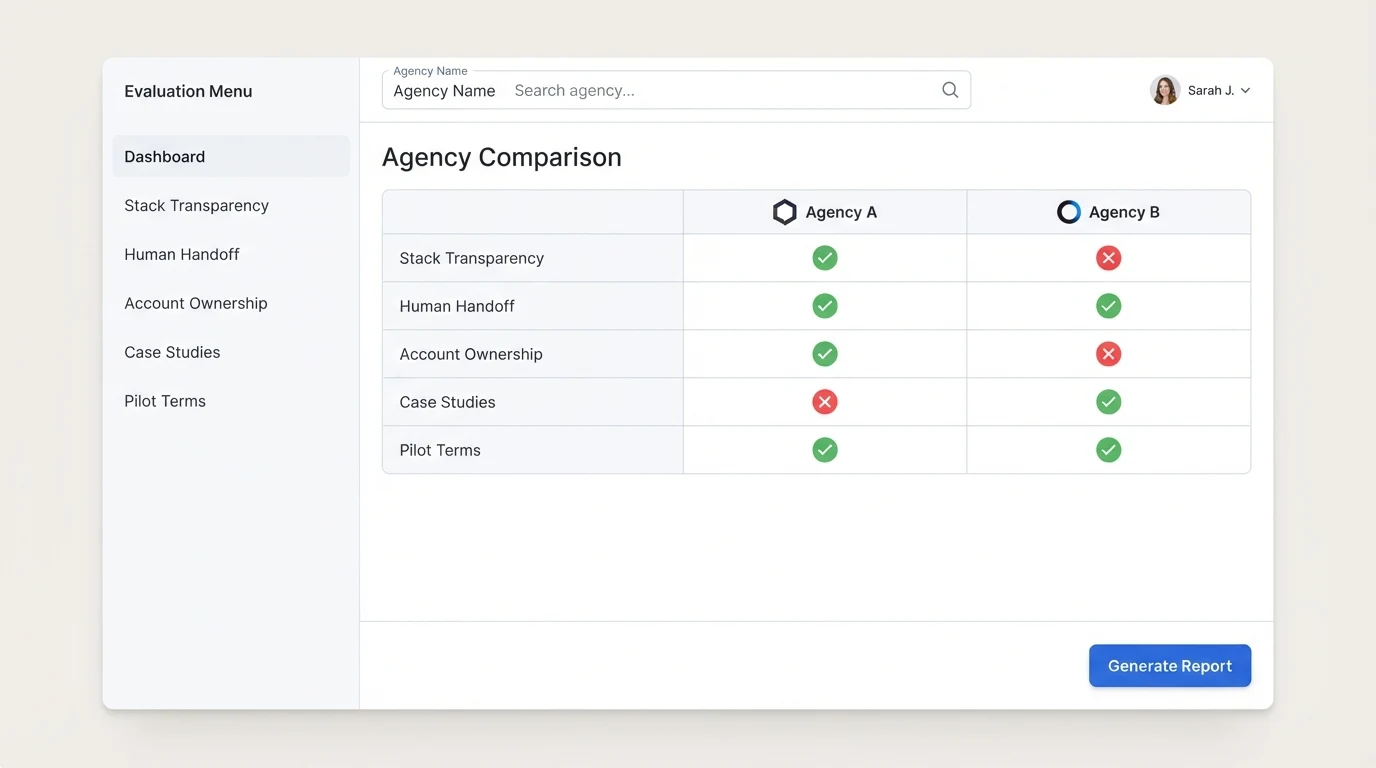
- Name every model and tool in your stack. You want specifics: GPT-5, Claude, Gemini, Runway, Veo, Midjourney, your own fine-tunes, the orchestration layer. Vague answers mean either a thin stack or a fear of being copied. Neither is your problem.
- Where does automation stop and a human take over? The honest answer names the human, their role, and the checkpoint. The dishonest answer says 'AI does the heavy lifting and our team polishes it'.
- Who owns the accounts, prompts, fine-tunes, and outputs? Ad accounts, analytics, CMS, custom GPTs, LoRAs, and generated assets should all be yours on day one and portable on the last day of the contract.
- Show me two case studies with spend, CPA, and ROAS in my vertical. Not impressions. Not asset counts. Money in, money or pipeline out, in a category close enough to yours to be useful.
- Break pricing into strategy, platform and API pass-through, and setup. You are not asking for a discount. You are asking to see whether the margin sits on the human work or on marked-up API tokens.
- What is the shortest contract you offer? Anything longer than a quarter for a first engagement is the agency managing its risk at your expense.
Score each answer out of two. Anyone under seven out of twelve is off the list. This sounds harsh, and it is, but the point of the filter is to protect the next three months of your calendar from discovery calls with agencies who were never going to be right. If you want a longer treatment of the hire-versus-freelance question that sits underneath all of this, see our piece on AI content agency vs freelancer.
How to read an AI case study without getting fooled
Case studies are where AI marketing agencies do their best magic tricks, so it pays to know the sleight of hand. There are four moves to watch for, and once you see them you cannot unsee them.
The first is impressions dressed as pipeline. A case study that leads with reach, views, or impressions and never converts that number into revenue, qualified leads, or CPA is telling you the campaign did not move money. If it had, the money number would be the headline.
The second is before-and-after cherry-picking. The 'before' window is a bad quarter, the 'after' window is peak season, and the uplift is mostly seasonality. Ask what the same period looked like the year before the engagement started. If they cannot tell you, the comparison is not real.
The third is the attribution window shuffle. A 28-day click and view-through window will always beat a 7-day click-only window on paper. If two case studies from the same agency use different windows, ask why, and always normalise to the window your own team reports on.
The fourth is the asset volume trap. 'We generated 400 assets in a week' is not a result, it is an input. The result is what those assets did in market. Volume as a headline usually means the outcomes were not strong enough to lead with. Our take on why volume alone does not justify a retainer sits in this piece on hiring an AI content agency.
Pricing models decoded
Four pricing models dominate the category in 2026, and each one hides a different thing. Understanding which model the agency prefers tells you a lot about how they think about their own risk versus yours.
| Model | How it works | What it hides | When to prefer it |
|---|---|---|---|
| Retainer | Fixed monthly fee for a defined scope | Utilisation. You may be paying for capacity you do not use, or subsidising other clients when things get busy | Stable, predictable programmes where scope will not swing month to month |
| Performance | Fee tied to ROAS, CPA, or revenue share | Attribution assumptions. The agency picks the metric and the window, both of which flatter their number | Direct response with clean tracking and a mature measurement stack on your side |
| Credit-based | You buy a pool of credits and burn them against deliverables | The exchange rate. A 'credit' can quietly inflate between quotes | Bursty creative work where volume genuinely varies week to week |
| Hybrid | Base retainer plus performance kicker or credit top-ups | Complexity. Invoices are hard to reconcile and disputes are frequent | Mature buyer-agency relationships where trust already exists |
Absolutely AI quotes per scope after a short brief review, which is the honest answer for creative work where the deliverable defines the effort. Whatever model your shortlist proposes, ask them to price the same brief three ways and watch what happens to the numbers. A confident agency will do it. If you want to see how retainers get structured in practice, our note on AI content retainer pricing walks through the mechanics.
The trial that de-risks the decision
Do not sign a long engagement off a pitch deck. Buy a pilot instead. A well-designed pilot is two to four weeks, has a defined deliverable, names the humans doing the work, and has a kill clause. It costs money, and it should, because free pilots are staffed by juniors and designed to close the sale rather than test the fit.
The pilot brief should specify one concrete output, for example a paid social campaign with fifteen creative variants and a two-week test budget, or a hero brand film with two rounds of revisions, or a GEO content sprint targeting ten priority queries. Write down the acceptance criteria before the pilot starts. If you do not know what good looks like at the end, you will accept whatever they hand you.
Name the humans in the contract. Not 'a senior strategist' but a person, with a LinkedIn URL, who will be on every call. Agencies bait-and-switch senior talent for junior delivery all the time, and naming names in the pilot document is the cheapest insurance against it. The same discipline applies to your AI content creation partner, your paid-media shop, and your AI film studio.
Red flags and green flags checklist
| Red flag | Green flag |
|---|---|
| Refuses to name models or tools | Publishes the stack and updates it when it changes |
| Case studies lead with asset counts and impressions | Case studies lead with revenue, pipeline, or CPA change in a comparable window |
| Wants twelve-month lock-in on a first engagement | Offers a paid pilot with a kill clause |
| Owns your ad accounts, CMS, or custom GPTs 'for efficiency' | Sets everything up in your tenancy on day one |
| Same senior in every pitch, different juniors on every call | Names the delivery team in the SOW |
| Vague on where human review sits in the pipeline | Draws you the human-in-the-loop diagram unprompted |
| Pricing shown as one blended number | Pricing broken into strategy, pass-through, and setup |
10 questions to send before you book the sales call
Copy this block into an email and send it to every agency on your shortlist before you agree to a call. The ones who answer in writing, quickly and specifically, are the ones worth ninety minutes of your calendar.
- Which archetype do you consider yourselves: AI-augmented traditional, AI-native creative, GEO specialist, paid-media automation, or in-house-agent builder?
- List every model, tool, and orchestration layer in your production stack today.
- Draw or describe where human review sits between input and delivered asset.
- Who will own our ad accounts, analytics, CMS access, custom GPTs, fine-tunes, and generated assets during and after the engagement?
- Share two case studies in our vertical with spend, CPA, ROAS, and the attribution window you used.
- What is the same-period-prior-year comparison for those two case studies?
- Break your proposed pricing into strategy, platform and API pass-through, and setup.
- What is the shortest first engagement you offer and what does a paid pilot look like?
- Name the specific humans who will lead strategy, creative, and delivery on our account.
- What would make you turn down our business?
Question ten is the sharpest one. An agency that cannot describe a client it would decline is an agency that will say yes to anything, which is the same as saying it has no point of view.
Frequently Asked Questions
How long should a first engagement with an AI marketing agency be?
A paid pilot of two to four weeks, followed by a quarterly rolling engagement once the pilot ships. Anything longer as a first commitment protects the agency's forecast, not your outcome.
Should I hire one full-stack AI agency or several specialists?
Depends on the archetypes you need. If you need brand film plus paid media plus GEO, one shop rarely does all three well. Two focused partners with clear swim lanes usually outperforms one generalist.
What is generative engine optimisation and do I need it?
GEO is optimising your content so it gets cited inside answers from ChatGPT, Perplexity, and Google's AI Overviews. If your buyers research in those surfaces, yes. If they still Google and click blue links, traditional SEO still matters more.
How do I check an agency's AI stack claims are real?
Ask for a live walkthrough of a real project in their tooling, not a slide about it. Screens shared, prompts visible, humans named. Anyone who cannot show you the machine is selling you a slideshow.
Who should own the prompts and fine-tunes an agency builds for us?
You should. Prompts, custom GPTs, LoRAs, fine-tuned checkpoints, and workflow definitions built on your brief and your brand data are your IP. Get this in writing before the SOW is signed.
What is a fair way to structure a performance-based fee?
Agree the metric, the attribution window, and the measurement source before the engagement starts. Cap the upside and floor the downside so neither side games the number. Review quarterly.
How many case studies should I ask to see?
Two in your vertical with real numbers beats ten glossy ones across random categories. If they cannot produce two, they have not done the work in your space yet, which is not disqualifying but changes the pricing conversation.
What is the single biggest mistake buyers make in this category?
Confusing output for outcome. Four hundred assets, twelve videos, a hundred blog posts. None of it matters if the revenue line does not move. Anchor every conversation to the outcome and the volume takes care of itself.
Closing thought
Choosing an AI marketing agency in 2026 is a diligence problem, not a taste problem. Diagnose the archetype, run the six-question filter, read the case studies critically, price the same brief three ways, and buy a pilot before you buy a year. If you want a partner who will answer every one of the ten questions above in writing before the first call, Absolutely AI is built for that conversation.