AI Video Production Agency: What to Expect Start to Finish
Hiring an AI video production agency for the first time is a different beast to booking a traditional shoot. There is no crew call, no location scout, no shoot day, but there is still a creative process with real craft behind it. This guide, written by the team at Absolutely AI, walks you through exactly what happens from first brief to final cut so you know what good looks like before you sign anything.

An AI video production agency creates commercial video using generative models like Veo, Runway, Sora and Kling instead of cameras, sets and crews. What makes a good one different from a tool subscription is the craft layer wrapped around the generation: concepting, scripting, storyboarding, model selection, iterative prompting, human QA and finishing. If you are a marketing lead, founder or brand manager evaluating your first AI video engagement, this piece from Absolutely AI is written for you.
What an AI video agency actually does
The scope is broader than most people expect. A capable agency runs the full creative arc, from a strategic brief through to a graded, sound-designed master file with usage rights transferred cleanly. That includes concepting and scripting, storyboarding and style frames, model selection for each shot, generation and iteration, colour grade, sound design, and versioning into every aspect ratio and duration your channels demand.
What separates an agency from a freelancer or an in-house prompter is the ability to hold brand consistency across a full campaign. A single hero spot is one problem; twelve cutdowns for paid social across three markets is another entirely, and it is where structured pre-production earns its keep. Our AI films practice is built around that distinction.
The end-to-end process, phase by phase
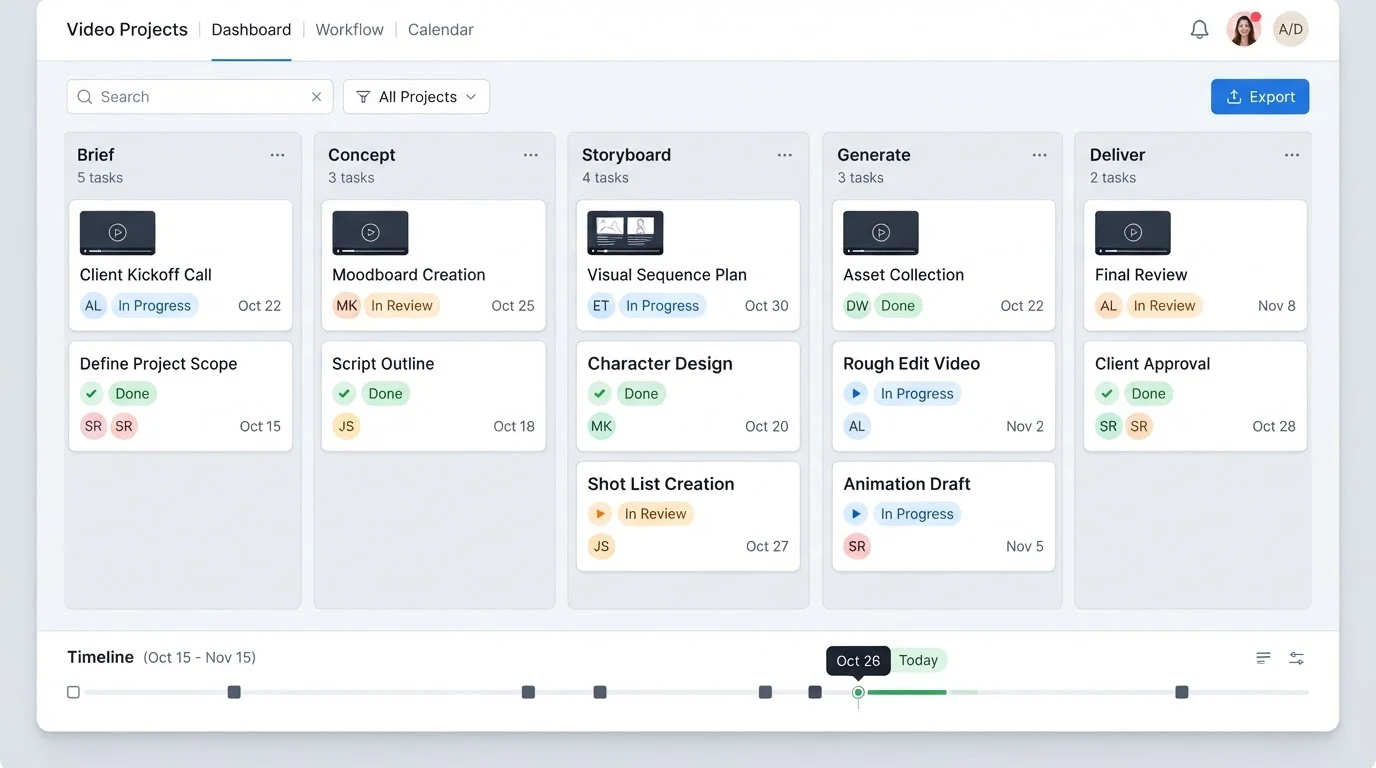
Every serious agency runs some version of five phases: brief and discovery, concept and script, storyboard and style frames, AI generation and iteration, and human QA and delivery. The days shift depending on scope, but the sequence should not. If a shop offers to skip storyboarding to save time, walk away.
| Phase | Day | What happens |
|---|---|---|
| Brief and discovery | Day 0 to 1 | Kickoff call, positioning aligned, references gathered, approvers named |
| Concept and script | Day 2 to 3 | Two or three creative routes presented, one chosen, script locked |
| Storyboard and style frames | Day 4 to 7 | Shot-by-shot boards, look development, model selection per shot |
| AI generation and iteration | Day 8 to 12 | Shots generated, reviewed, re-rolled, sequence assembled |
| Human QA and delivery | Day 13 to 16 | Grade, sound design, aspect ratio versioning, final QA, handover |
Storyboarding is the phase most first-time buyers underestimate. It is also where the money is saved, because a locked board means fewer expensive regenerations later. Our note on AI storyboards for brand videos covers why we treat this as non-negotiable.
Deliverables you should get
A single-spot engagement should hand back a hero cut, cutdowns at 15, 30 and 60 seconds where the concept supports it, and aspect ratio variants for 16:9, 9:16 and 1:1. You should also receive stills pulled from hero frames, source project files, and a clear usage rights statement covering paid media, organic and web.
- Hero master, graded and sound-designed
- Cutdowns at 15s, 30s and 60s
- Aspect variants: 16:9, 9:16, 1:1
- Hero stills for social and display
- Source project files and generated assets
- Written usage rights and licence terms
If the agency pushes back on transferring source files or rights, that is a commercial red flag rather than a technical one. You are paying for the work; you should own the outputs. A studio confident in its ongoing value does not need to hold your masters hostage, which is a principle we apply across every engagement inside our commercial work.
What you need to bring to the kickoff
The quality of the final cut is set in the first 60 minutes of the kickoff call. Come with your positioning written down, the single core message the film has to land, brand assets including logo, type and colour, three to five reference films with notes on what you like about each, hard constraints such as legal or claims restrictions, and the named list of people who can approve at each stage.
The approver list matters more than people think. Amends are the single biggest driver of schedule bloat in AI video, and unclear sign-off chains turn a two-week project into a six-week one. If you have not had the internal conversation about who signs off on script versus who signs off on final cut, have it before you brief. Our piece on AI pre-production for campaigns goes deeper on this.
Timeline: realistic versus hype
Honest numbers: a single spot, briefed cleanly, lands in three to five days if the brief is tight and one approver signs off. A full campaign with a hero, cutdowns, aspect variants and paid social iterations is two to three weeks. Anyone quoting 24-hour turnarounds is either doing a favour, cutting corners, or working on something you would not want to run as an ad.
Where schedules bloat is almost always amends. Two rounds of revisions on a locked storyboard is normal; five rounds because the script was never really approved is where projects fall apart. Locking each phase before moving on is the single biggest lever on delivery time, and it is why the studios that ship fast are the ones with the most structured pre-production, not the loosest.

How pricing works
Agencies price either per deliverable, on a project basis, or on a monthly retainer for brands producing continuous content. Per-deliverable pricing suits one-off launches; retainers suit performance marketing teams shipping weekly. Pricing at Absolutely AI is quoted per scope after a brief review, so you get a number tied to your actual deliverables rather than a menu.
AI production is meaningfully cheaper than traditional for equivalent output because you are not paying for crew, location, talent day rates or a shoot day. What you are paying for is craft: the script, the storyboard, the model selection, the iteration and the human QA. Cheap AI video is cheap because it skips those layers, and it shows. Our guide to AI video ad pre-production cost breaks down where the real money goes.
Quality control: how good agencies stop AI slop
Human QA is the difference between AI video that runs as a paid ad and AI video that gets clowned on LinkedIn. Generative models fail in predictable ways: hands with extra fingers, lip-sync drifting off phoneme by phoneme, continuity breaks between shots, faces morphing across a cut, and factual drift when the model invents product details.
- Hand and finger check on every shot with visible hands
- Lip-sync verified frame-by-frame against the voiceover
- Continuity check on wardrobe, setting and character across cuts
- Brand alignment against colour, type and tone guidelines
- Factual check on product claims, features and legal copy
- Motion coherence: no melting objects, physics-breaking movement
A serious agency runs this checklist before delivery, not after you flag issues. If shots come back with obvious failures on the first review, the QA layer is not there and you are paying for a prompt-and-hope workflow rather than a studio.
Red flags when choosing an agency
The most common warning signs are tool-first pitches that lead with which models they use rather than what they will make, no evidence of script craft in the portfolio, no written revisions policy, no clear rights transfer, and a portfolio of tech demos rather than brand work that actually shipped. Our comparison of an AI storyboard generator vs an agency spells out why the tool is not the offer.
Also worth watching: unwillingness to show you the storyboard before generation, resistance to naming the lead creative on your account, and portfolios where every piece looks identical because the studio has one preset it applies to every brief. Consistency of quality is good; sameness of aesthetic across unrelated clients is a tell.
Questions to ask on the first call
- Walk me through your process from brief to final delivery, phase by phase.
- Who is the lead creative on my account, and what is their background?
- How many revision rounds are included, and how are additional rounds priced?
- What is your QA process for hands, lip-sync and continuity?
- Which models do you use, and how do you decide per shot?
- What rights do I get on delivery, and are source files included?
- Show me a brand campaign, not a tech demo, that shipped in the last 90 days.
- What happens if a shot cannot be generated to brief after iteration?
- How do you handle brand consistency across a multi-asset campaign?
- What is a realistic timeline for my specific scope, not a generic one?
Frequently Asked Questions
How long does an AI video actually take?
A single spot with a tight brief and one approver lands in three to five working days. A full campaign with cutdowns and aspect variants runs two to three weeks. Amends are the biggest variable.
Can AI video match traditional production quality?
For a wide and growing range of briefs, yes. Character-driven dialogue with complex lip-sync and high-emotion performance is still the hardest ground, and honest agencies will tell you when a brief is a poor fit for generative video.
Who owns the final video?
You should. A standard engagement transfers full commercial rights to the final deliverables on payment, including paid media, organic and web usage. Confirm this in writing before you sign.
How many revisions are normal?
Two rounds on a locked storyboard is standard. More than that usually signals the script or board was never truly approved, which is a pre-production problem rather than a generation one.
Do I need to provide storyboards or scripts?
No. A full-service agency handles both. If you have existing scripts or boards you want to work from, they help, but they are not required.
What good looks like
A good AI video engagement feels like working with a traditional creative agency that happens to skip the shoot day. The brief is taken seriously, the script is written by someone who can write, the storyboard is locked before generation starts, and the final cut arrives on time with rights transferred and source files delivered. If you want to see how we run it, our AI video practice at Absolutely AI is the place to start.