AI Video Agency Australia: What They Do, Cost, and How to Pick One
Australian brands are rewriting their video budgets around AI. What used to take a six-week shoot and a six-figure spend can now land in days at a fraction of the traditional cost, without losing craft. This guide from Absolutely AI maps the local landscape, breaks down pricing bands, and gives marketers a clear framework for choosing an AI video partner in 2026.
An AI video agency Australia search in 2026 returns a very different landscape than it did even twelve months ago. Veo 3, Runway Gen-4, Kling, Luma Dream Machine, Flux and Sora have collapsed the gap between concept and finished frame, and a new class of studios has emerged to direct that output for brands. Absolutely AI sits inside this shift, and this guide is written to help marketers evaluate the category honestly rather than pitch a single studio.
What an AI video agency actually is in 2026
An AI video agency produces finished video content using generative models as the primary capture and animation layer, wrapped in traditional creative direction, editing, sound design and grade. The best operators are AI-native studios built around the model stack from day one, and they should not be confused with traditional production shops bolting AI onto a legacy workflow, or with DIY tool access where a marketer prompts Runway themselves.
The category splits roughly three ways. AI-native studios like the newer generation of Australian AI agencies treat models as cameras and lenses, with senior creative direction on every project. Traditional shops using AI tend to use it for pre-visualisation or VFX inserts inside a live shoot. DIY tools give in-house teams direct access to Runway or Veo for rough cuts, without the editorial layer.
Why Australian brands are moving to AI video
The commercial case is straightforward. AI video typically lands in days rather than weeks, opens creative territory that live production cannot reach, and produces unlimited variants for paid social without a re-shoot. Brands can render Mars, the 1700s, or a surreal product world without a location scout, and can spin up 9:16, 1:1 and 16:9 cuts of the same concept in parallel for Meta and TikTok.
The shift is national, not just Sydney and Melbourne. Brisbane, Perth, Adelaide and the Gold Coast all now have brands running AI-first campaigns, often because social ad creative demands a volume of variants that traditional shoots cannot economically supply. When the media plan calls for forty variants across three platforms, the maths of a traditional TVC stops working.
What AI video agencies in Australia produce
The output range is broader than most marketers expect. A modern studio will deliver social ads in vertical and square, brand films with cinematic pacing, product hero spots that would be impossible to shoot practically, explainer and training video, UGC-style creator ads with synthetic presenters, motion graphics, AI dubbing and lip-sync for multilingual markets, and generative VFX inserts into live footage. Explore how these formats come together in production-ready AI video services.
- Social ads: 9:16 and 1:1 cuts sized to Meta, TikTok and YouTube Shorts specs, often 6 to 30 seconds.
- Brand films: 60 to 120 second hero pieces with a directed narrative and original sound design.
- Product spots: hero shots of physical goods rendered in worlds a location shoot cannot access.
- Explainer and training: long-form internal or educational video, often with synthetic presenters.
- UGC-style ads: creator-look pieces with consistent synthetic talent across a campaign.
- Multilingual dubs: AI lip-sync into Mandarin, Vietnamese, Hindi and European languages.
- VFX inserts: generative elements composited into live-action footage.
The Australian AI video landscape
The market has consolidated around a small group of recurring players. The list below is written as a landscape map, not a ranking, and each studio has a different centre of gravity that will matter depending on the brief you are running. If you need help mapping your specific problem to the right kind of partner, an independent AI consulting conversation often clarifies scope faster than a round of pitches.
- Absolutely AI (Sydney): AI-native creative studio, cinematic brand films and social ad creative at scale.
- Apostle: traditional production heritage now integrating AI into commercial work.
- AI Labs Agency: broad AI services with a video practice.
- Locx: creator and social-first output.
- Pure Agency: integrated brand work with AI production.
- Filmito: AI-assisted corporate and explainer video.
- We Know Video: business-focused video production adopting AI.
- Ai Digital: digital and content services with an AI video arm.
- Nimbull: AI-adjacent digital agency work.
How pricing works locally
Pricing in the Australian AI video market falls into three engagement models, and understanding which one fits the brief is the fastest way to avoid a mismatch. The table below describes the shapes qualitatively, because reliable dollar figures depend on scope, model stack and delivery calendar. For a real number, brief a shortlist and compare quotes on identical scope.
| Model | Best for | Notes |
|---|---|---|
| Pilot or trial spot | First-time buyers testing the category | Single deliverable, tight scope, quoted per project. |
| Monthly retainer | Always-on social and campaign volume | Fixed monthly output across formats, quoted after a scoping call. |
| Per-deliverable | Defined campaigns with a fixed asset list | Priced per finished asset, revisions bounded in the SOW. |
Traditional TVC budgets remain in a different bracket entirely, which is the underlying reason CFOs are giving marketing teams permission to run AI-first pilots. Absolutely AI's own pricing is quoted per scope after a brief review, and every credible studio in the market should be willing to do the same rather than publish a rate card that ignores the shape of the work.
How to choose an AI video agency in Australia
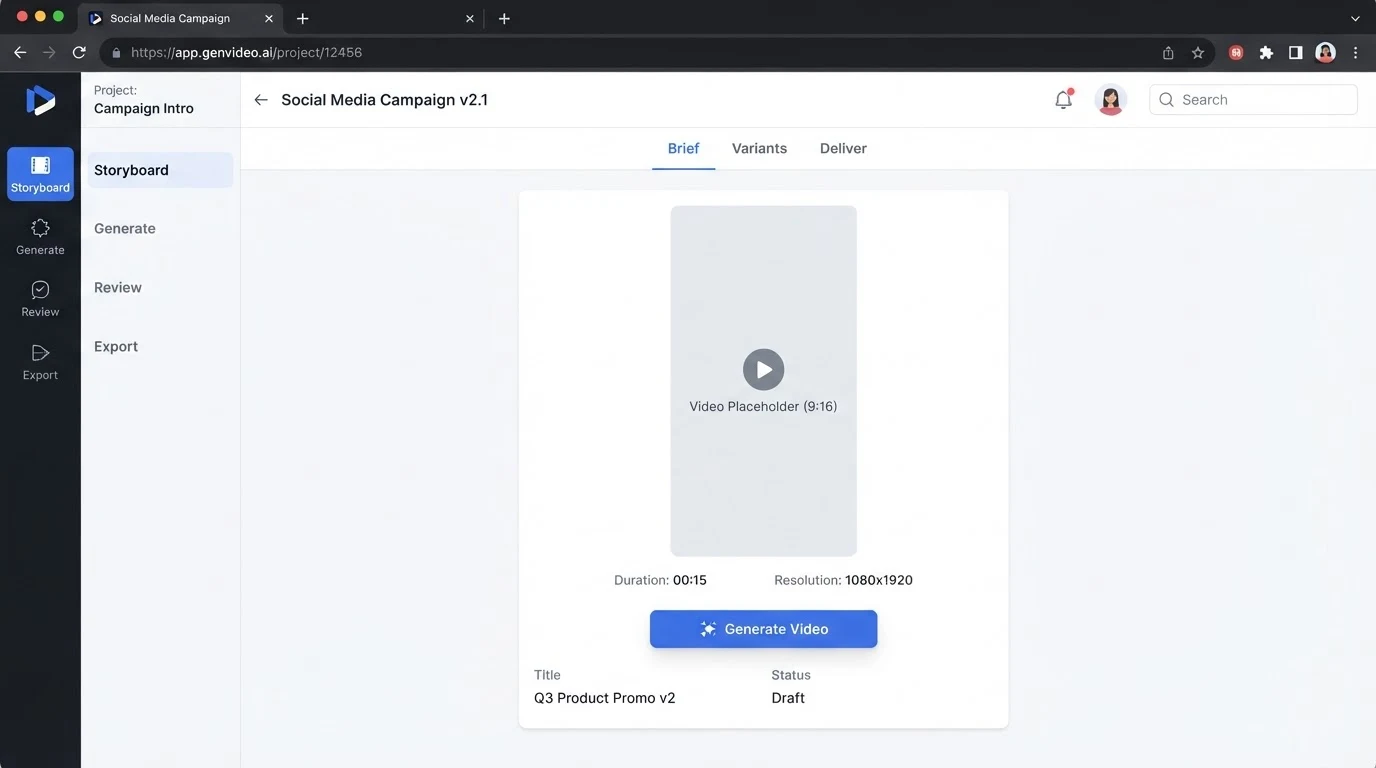
Use this eight-point checklist when you shortlist. It is designed to separate genuine creative studios from prompt-jockeys and to protect the brand from the compliance and quality issues that plague under-directed AI output. A useful companion read is our breakdown of AI storyboard generators versus an agency, which covers the same taste question at the pre-production stage.
- Creative direction: is there a senior director on the account, or just an operator running prompts?
- Model stack transparency: can they name which models they use and why?
- Revision policy: how many rounds, and what triggers a re-render versus a re-edit?
- Rights and licensing: who owns the finished cut and the underlying generations?
- Brand consistency: can they hold a look across a multi-asset campaign?
- Human editorial pass: is there real grade, sound design and pick-up work, or is the model output the final?
- Case studies: named clients, published work, real outcomes.
- ACMA and AANA awareness: do they understand Australian advertising codes as they apply to AI content?
Red flags to watch for
The failure modes in this category are consistent and easy to spot once you know what to look for. Pure text-to-video with no storyboarding almost always shows in the finished cut. Our note on AI pre-production for campaigns explains why the planning layer is where the quality actually gets locked in.
- No storyboarding or pre-visualisation before generation begins.
- No colour grade or sound design layer in the final deliverable.
- Hallucinated hands, warped logos or drifting product details in shipped work.
- Inconsistent characters or wardrobe across scenes in the same campaign.
- Hidden per-generation fees that inflate the invoice after sign-off.
- No named account director or clear point of contact.
DIY tools versus an agency
Direct access to Runway, Veo or Kling is genuinely useful for internal comps, mood pieces, sales tools and rough cuts that never leave the building. It stops being enough the moment the video needs to hold up on a paid media plan, carry brand equity, or run alongside a live-action library. At that point the missing layer is not the model, it is the direction, edit, grade and sound work that turns a generation into a finished asset.
A useful rule of thumb: if the video will be seen by fewer than a hundred people and does not need to match a brand system, DIY is fine. If it will run against a media buy, sit next to your existing brand film, or represent the company externally, the editorial layer of a studio starts to pay for itself very quickly. See how the equivalent tradeoff plays out for AI storyboards on brand videos.
Frequently Asked Questions
Is AI video legal for Australian ads?
Yes, subject to the same AANA Code of Ethics and ACMA rules that govern any advertising in Australia. The obligations sit with the advertiser, so brands should confirm their agency understands truth-in-advertising, testimonial and endorsement rules as they apply to synthetic talent and generated scenes.
Do you own the footage?
You should. A credible studio will assign ownership of the finished deliverable and clarify the licensing position on the underlying generations in the SOW. If a prospective partner cannot answer this cleanly, treat it as a red flag.
How long does a spot take?
Pilot spots typically ship in days rather than weeks. Full campaigns with multiple deliverables and revision rounds run on a matter of weeks, not months. Timelines depend on scope, revision cadence and how quickly the brand approves each stage.
Can you match our existing brand film?
Yes, and this is where creative direction matters most. Matching an existing brand look across AI-generated video requires deliberate art direction, reference libraries and a grade pass that reconciles the two sources.
Do you work outside Sydney and Melbourne?
Most AI-native studios work nationally by default because the production model is remote-first. Brisbane, Perth, Adelaide and Gold Coast brands can engage a Sydney or Melbourne studio on the same terms as a local team.
How many revision rounds are typical?
Two to three structured rounds is standard, with clear rules on what counts as a revision versus a change of scope. Confirm this in writing before signing.
Conclusion
The right AI video agency in Australia is the one that treats models as production tools inside a real creative process, not a shortcut around it. Ask for the storyboard, ask who is directing, ask what happens after the generation lands, and ask for the finished cuts of named campaigns. If you would like to talk through a specific brief, Absolutely AI is happy to scope it honestly.