AI Production Company: What They Actually Do
The term 'AI production company' gets thrown around a lot in 2026, but few marketers can tell you what actually happens inside one. This guide from Absolutely AI walks through the services, workflow, tools, pricing, and honest limitations of an AI production studio, so you can decide whether one belongs on your next campaign.
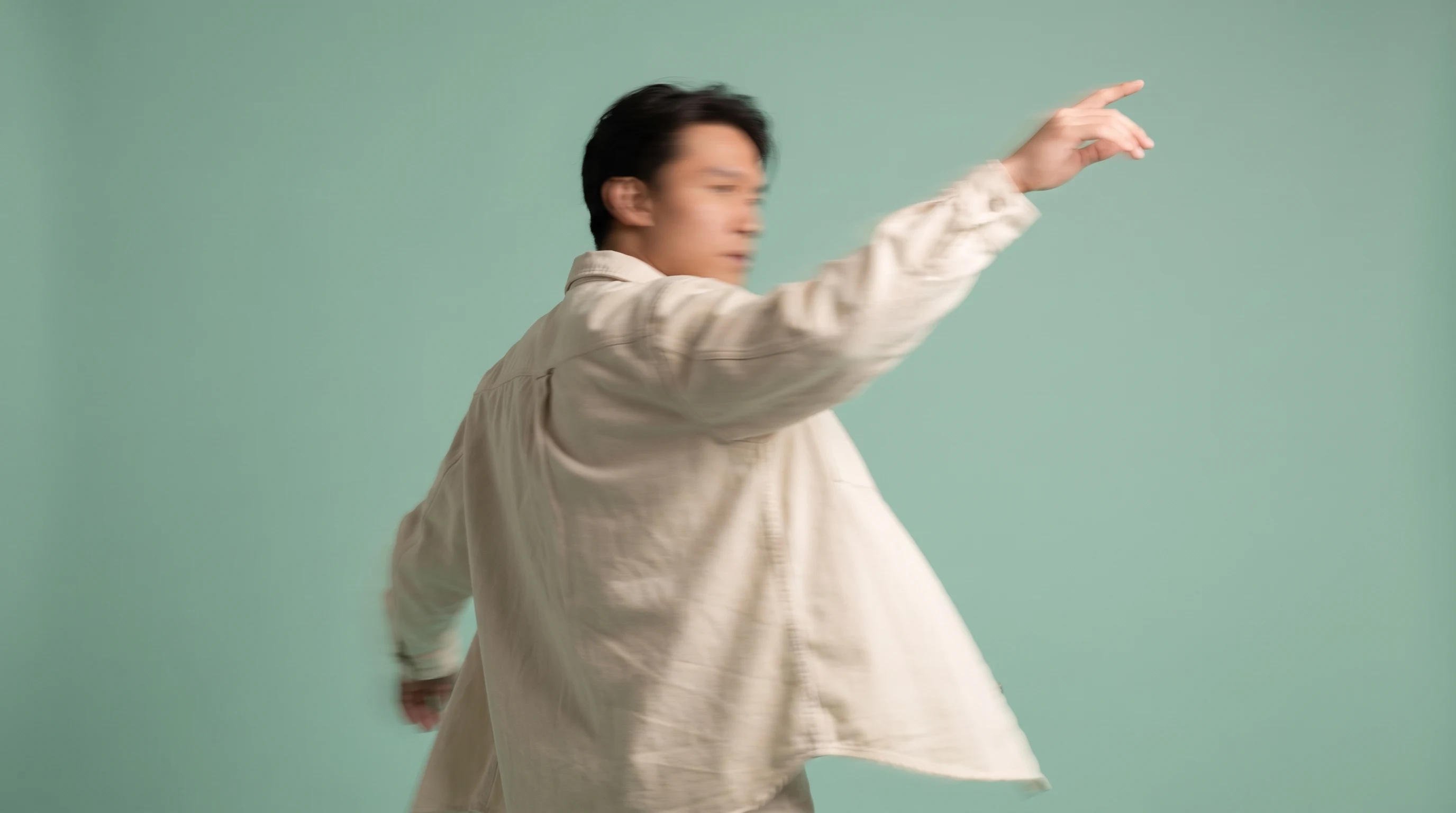
An AI production company is a studio that builds ads, films, and branded video by embedding generative AI models for image, video, voice, and music into every stage of a traditional production pipeline, rather than shooting on location or animating frame by frame. The team at Absolutely AI works this way every day, and the shorthand we use with clients is simple: creative direction on the front end, an AI pipeline in the middle, and human editors, colourists, and sound designers on the back end. It is not a SaaS tool and it is not a single freelancer with a Midjourney subscription.
This guide is written for marketers, founders, and brand leads who keep hearing the term and want to understand what actually happens between the brief and the delivered master. We will cover services, workflow, the tools in the stack, what gets delivered, how pricing works, when to choose an AI studio over a traditional one, and the limitations nobody likes to talk about.
What an AI production company actually is
An AI production company is a hybrid. It has the roles of a traditional production house, creative director, producer, art director, editor, colourist, sound designer, but it replaces the physical shoot day and the animation seat with a generative AI pipeline. Frames that would have been captured on a RED camera or built in Cinema 4D are generated using diffusion and video models, then treated in Resolve or Premiere like any other footage.
It is not a SaaS video tool. A SaaS tool sells you a self-serve interface and hopes you have the taste to drive it. It is also not a freelance prompt artist, who can make a stunning single image but rarely owns colour, sound, edit, and delivery specs. A real AI video studio owns the full creative and technical pipeline, and takes responsibility for the finished master.
The services they offer
Most AI production companies offer a mix of AI-native services (things that only exist because of generative models) and AI-augmented services (traditional craft made faster or cheaper with AI in the loop). A typical service menu looks like this:
- Concept development and scripting (AI-augmented): treatments, taglines, script drafts, moodboards.
- Storyboarding and pre-visualisation (AI-native): shot-by-shot boards generated in hours instead of weeks. See our note on AI pre-viz for commercials.
- AI image and video generation (AI-native): hero frames, motion clips, sequences.
- Voice and music (AI-native): generated VO, custom scores, sound design beds.
- Editing, grading, and VFX cleanup (AI-augmented): traditional post, plus AI rotoscoping, upscaling, and frame interpolation.
- Localisation and versioning at scale (AI-native): the same ad in twelve languages, six aspect ratios, and thirty product SKUs.
The versioning piece is where AI production really pulls away from traditional. Once a concept is locked, a social ad creative team can spin out dozens of variants for testing without a reshoot.
How the workflow runs, step by step
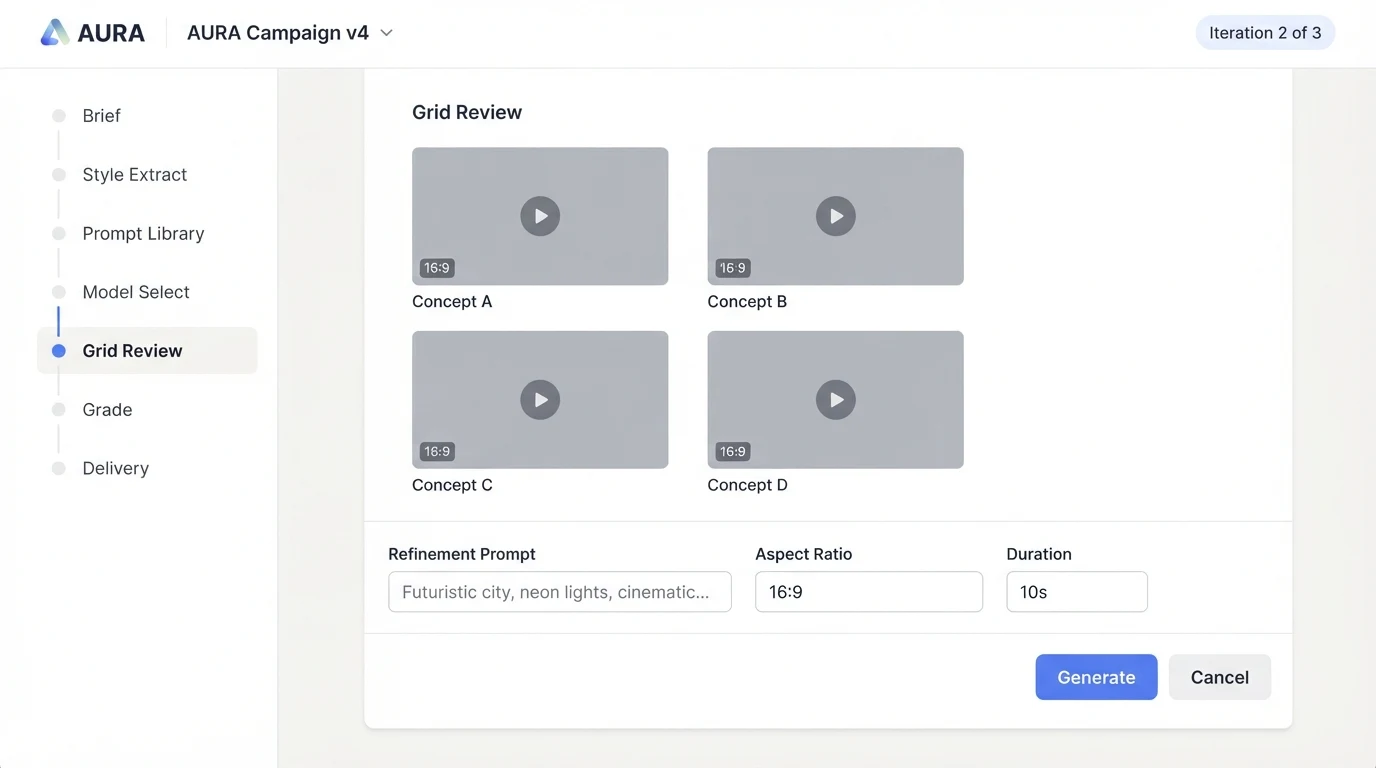
The workflow inside a good AI production company looks less like magic and more like a disciplined post-production pipeline with generation steps in place of a shoot. This is the sequence we use on most projects, roughly mirrored by other serious studios:
- Brief and discovery (day 1): brand, audience, deliverables, references, non-negotiables.
- Brand and style extraction (day 1 to 2): the creative team distils a visual system, palette, lensing, grade, and tone into a written style guide plus a reference image library.
- Concept and storyboard (day 2 to 4): three to five concept directions, each boarded as still frames. Client picks one. Read more in our piece on AI storyboards for brand videos.
- Model selection and prompt library (day 4): the team picks which model handles which shot. Veo 3 for realistic human motion, Runway Gen-3 for stylised camera moves, Kling for longer sustained clips, Sora for complex scenes, Midjourney or Flux for stills and plates.
- Generation and iteration (day 4 to 8): shots are generated in a grid or explorer UI, dozens of candidates per beat, curated down to selects.
- Human edit, grade, sound (day 8 to 12): the selects go into a traditional edit suite. Colourist grades, sound designer scores, editor cuts.
- Delivery and versioning (day 12 to 14): masters exported in every required aspect ratio, language, and duration.
The critical thing to notice is the human checkpoints. A generative model does not decide what a shot means, what the pacing is, or whether the grade sells the product. That is what the film team is paid to do.
The tools and models in their stack
A serious AI production company is model-agnostic. No single model is best at everything, and the frontier moves every quarter. In 2026 a typical stack looks like this, and a strong AI commercial team will be fluent in most of it:
| Layer | Common tools | What it does |
|---|---|---|
| Text to image | Midjourney, Flux, Ideogram | Stills, plates, storyboards, hero frames |
| Text and image to video | Google Veo 3, Runway Gen-3, OpenAI Sora, Kling, Luma | Motion clips, camera moves, sustained shots |
| Voice | ElevenLabs, PlayHT | VO, character voices, dubs |
| Music | Suno, Udio | Custom scores, stings, beds |
| Post and cleanup | Resolve, Premiere, Topaz, Runway rotoscope | Edit, grade, upscale, cleanup |
| Pipeline and orchestration | Custom prompt libraries, node-based tools, internal explorer UIs | Managing thousands of generations without losing track |
A studio that only uses one model, or refuses to name its stack, is a red flag. The value is in knowing which tool to reach for on which shot, not in loyalty to any single vendor.
What they deliver
The output list is broader than most people expect, because once a concept is generated it can be versioned cheaply. Common deliverables include TV commercials and OLV, paid social ads across every aspect ratio, product hero shots and campaign stills, explainer videos, music videos, pitch films, brand films, and increasingly episodic content for owned channels. A full-service AI marketing team will bundle these with the surrounding strategy and media plan.
How they price, and why speed matters
Pricing models fall into three shapes: per deliverable (a fixed fee for a defined asset), per concept (you pay for the creative direction and then scale versions), and monthly retainer (a fixed capacity for always-on content). At Absolutely AI, pricing is quoted per scope after a brief review, but the important structural point is the speed and versioning delta versus traditional production.
A traditional TVC of comparable finish typically runs six to ten weeks from brief to master, with a shoot day, crew, talent, location, and post. An AI production of the same concept typically runs two to three weeks, with the same creative craft on the front and back ends and generation replacing the shoot. The commercial upside is not just faster delivery, it is the ability to test twenty variants in market instead of one. Our breakdown of the pre-production cost side of AI video goes deeper on where the time and money actually shift.
When to hire one vs a traditional studio
AI production is not the right answer for every brief. This is a rough decision framework a good AI consulting team will walk you through honestly:
| Scenario | Best fit |
|---|---|
| Fast-turnaround social, high volume, tight budget | AI production company |
| Concept-driven brand film, stylised worlds, tight timeline | AI production company |
| Named celebrity talent as the hero of the ad | Traditional studio |
| Product must be shown with photoreal, verified accuracy (pharma, automotive interior) | Traditional or hybrid |
| Massive localisation across markets and SKUs | AI production company |
| Documentary or interview-led content | Traditional studio |
What to look for when choosing one
Not every studio calling itself an AI production company can actually deliver. When you are shortlisting, look at the reel first, then the stack, then the process. Specifically:
- Reel quality: does the work look like finished commercial output, or like tech demos?
- Model-agnostic stack: can they name the tools they use and why?
- Human creative direction: is there a named creative director, or just prompters?
- IP indemnity and rights: who owns the output, and what indemnity is offered against training-data claims?
- Revision policy: generative work has a different rhythm to a shoot. How many rounds are included, and at what stage?
- Case studies: named clients, briefs, and measurable outcomes.
A useful comparison read is our piece on AI storyboard generators vs a full agency, which unpacks the difference between a tool and a team on a smaller scope.
The limitations and risks
An honest answer to what an AI production company can do also requires an honest answer to what it cannot, and this is the section most competitor pages skip. The current model ceilings still show up in predictable places: hands and fine finger motion, readable on-screen text, character continuity across shots, and true photoreal likeness of real people. A good AI video team knows which shots to avoid, which to fix in post, and which to bounce back to a traditional workflow.
There are also rights and brand-safety considerations. Training data provenance, likeness rights for talent, music licensing, and IP indemnity are real buyer concerns. Ask any studio you are considering for their written position on each, and expect a clear answer rather than a shrug.
Frequently Asked Questions
Is an AI production company cheaper than a traditional studio?
Usually yes for equivalent finish, because there is no shoot day, but the more important delta is speed and versioning. You get the master faster and you get many more variants from the same concept.
Do they still use human editors and directors?
Yes. Every serious AI production company has human creative direction, editing, colour, and sound. Generation replaces the shoot, not the craft around it.
Which AI video model is best?
None, and any studio claiming a single winner is oversimplifying. Veo 3, Runway Gen-3, Sora, and Kling all have different strengths across realism, camera control, length, and prompt adherence. Model selection is a per-shot decision.
Can I use real actors in AI production?
Sometimes, through licensed likeness or hybrid workflows that composite real plates with generated environments. Unlicensed likeness of a real person is a hard no.
Who owns the finished work?
With a reputable studio, you do, on the same terms as a traditional commission. Read the contract, and ask specifically about IP indemnity.
How long does a typical project take?
A single-concept film with full craft usually lands in two to three weeks. Social ad batches and versioning can run in days once the master concept is approved.
What if the output has visible AI artefacts?
A good studio will not deliver work with obvious artefacts. Cleanup, rotoscoping, frame replacement, and traditional VFX all sit in the pipeline for exactly this reason.
Can they match our existing brand look?
Yes. Brand and style extraction is the first step of the workflow, and reference libraries are built specifically to constrain the models to your visual system.
Wrapping up
An AI production company is not a tool and not a shortcut. It is a studio structure built for a world where the shoot day is optional, versioning is nearly free, and the creative bar is set by the same craft roles that have always run production. If you are weighing one against a traditional studio for an upcoming campaign, the team at Absolutely AI can walk you through the tradeoffs on your specific brief and show you how the pipeline would run end to end.