How Much Does an AI Marketing Agency Cost? A Buyer's Guide
AI marketing agency pricing spans two orders of magnitude, from small productized retainers to enterprise custom builds, and most published ranges hide more than they explain. This guide from Absolutely AI breaks down the four pricing models you will actually encounter, what sits inside each tier qualitatively, the hidden line items nobody quotes upfront, and how to walk into a sales call already knowing what fair looks like.

Ask ten founders what they pay an AI marketing agency and the answers will sit across two orders of magnitude. Some are paying a modest monthly retainer for a productized content drop, others are paying multiples of that for a full-funnel team with custom agents wired into their CRM. Neither is wrong. The question is which shape of engagement fits the stage you are actually at, and that is where a modern AI-first agency tends to be evaluated poorly, because buyers compare headline numbers instead of what sits behind them.
This piece is written for the founder or marketing lead who is about to take a first sales call and wants to know, in advance, what fair looks like. We will describe pricing qualitatively, name the line items, and give you the questions that separate a serious operator from a reseller with a Midjourney seat. For anyone weighing a partner already, our companion piece on AI content agency vs freelancer covers the adjacent buy-or-hire call.
The Short Answer: AI Marketing Agency Pricing at a Glance
Before we go tier by tier, here is the shape of the market as it stands in 2026. The table below is qualitative, because published price ranges age badly and vary by region, scope, and how deeply the agency is embedded in your stack. Use it to orient, not to benchmark. Deeper commentary on retainer economics lives in our note on AI content retainer pricing.
| Option | Best for | What you get |
|---|---|---|
| DIY tools (Midjourney, ChatGPT, Runway) | Solo founders, pre-revenue | Raw model access, no strategy, no brand system |
| AI-first agency | Growth-stage brands | Senior creative direction, brand-trained models, output at pace |
| Hybrid agency | Established brands adding AI | Traditional service line with AI production woven in |
| Traditional agency | Enterprise, regulated sectors | Full team, slower cycles, deep account management |
| In-house team | Post product-market fit, high volume | Dedicated headcount, culture fit, fixed cost |
The right column of that table is what you are actually buying. The left column is a shorthand. If you want the long form on how modern studios compare to legacy production models, we wrote it up in AI content studio vs traditional studio.

The Four Pricing Models You Will Actually See
Every quote you receive will be a variation on one of four structures. Understanding which one you are being sold matters more than the number attached to it, because each model shifts risk and incentive in a different direction. For teams evaluating a full-service AI marketing partner, this is the first filter to apply.
Fixed monthly retainer
A defined scope for a defined monthly fee. Favours the buyer when volume is predictable and the deliverable list is tight. Favours the agency when scope creep is loose, because every extra ask compounds against a fixed margin. Ask for the deliverable count in writing.
Usage or credit-based
A base fee plus consumable credits that map to assets, minutes of video, or model tokens. This is becoming the dominant hybrid model in 2026 because it lets both sides scale gracefully. Favours the buyer for spiky campaigns. Watch for credit expiry and rollover terms.
Per-project
One-off scopes: a launch campaign, a custom agent, a 30-second commercial. Favours the buyer for defined outcomes with a clear finish line, and it is often the right shape for a first engagement before either party commits to a retainer.
Performance or revenue share
Fees tied to pipeline, revenue, or agreed KPIs. Rare, and usually reserved for paid media or ecommerce work where attribution is clean. Favours the buyer when the agency has genuine skin in the game, and punishes both parties when the attribution model is fuzzy.
What You Actually Get at Each Tier
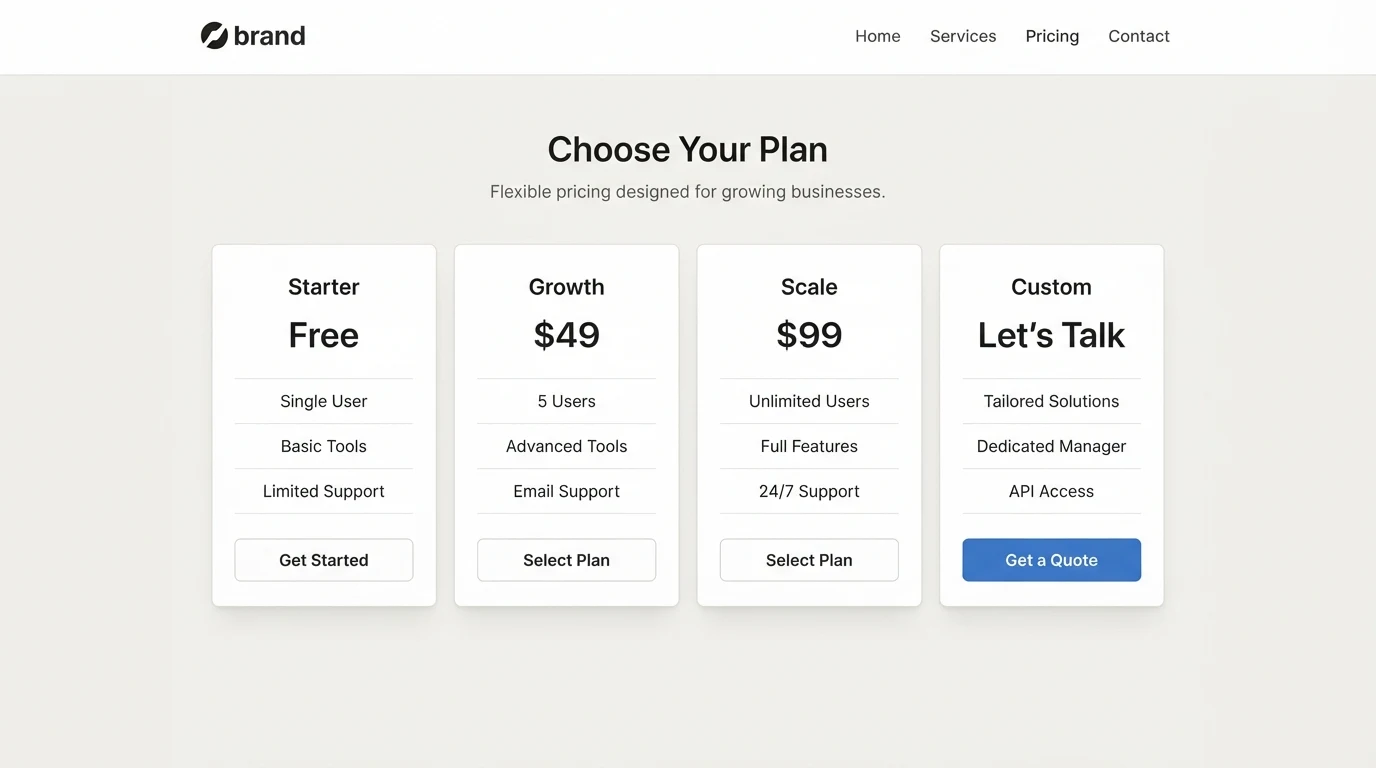
Rather than quoting numbers that will be stale by next quarter, here is what the shape of the deliverable typically looks like as budgets scale. This is the frame we use internally at Absolutely AI's content service when scoping new work.
Starter tier
Content generation, basic SEO articles, social scheduling, light brand guardrails. Usually productized, usually a fixed monthly retainer, usually a small pool of revisions. Good fit for a pre-Series-A brand that needs consistent output more than it needs strategy.
Growth tier
Paid media management, senior-directed creative production, reporting dashboards, a named strategist. This is the tier where an AI-first agency starts to feel materially different from a traditional one, because the same team can produce more variants for testing without a linear cost curve. Direct-to-consumer teams in this bracket should read our DTC-specific guide.
Scale tier
Full-funnel strategy, custom GPTs and internal agents, deep tool integrations, weekly reporting, and often an embedded team member. The retainer is really buying senior time and system design; the AI stack absorbs the production grunt work.
Custom builds
One-off engagements: a bespoke agent, a bank of hero commercials, a fine-tuned brand model. Scoped and quoted per project rather than by retainer. Worth doing when the artefact will outlast the campaign, for example a permanent brand system or an internal automation build.
AI Agency vs Traditional Agency vs In-House: A Worked Example
Take a SaaS company with a fixed monthly marketing budget in the mid five figures. Split across a traditional agency, that budget typically buys one senior lead, a junior, and enough production hours for a handful of polished assets per month. Split across an AI-first agency of similar quality, the same budget usually buys a comparable senior team plus meaningfully higher output volume, because the production layer is model-assisted.
In-house is a different comparison, because you are buying a person, not a service. The crossover point most founders want to know sits roughly where a full-time senior marketing manager, loaded with tools, benefits, and management overhead, costs more than the equivalent agency retainer plus the ceiling on what one person can produce alone. In-house wins on culture and institutional memory. Agencies win on range and speed. The honest answer is that most Series-A brands need both, phased.
Hidden Costs Nobody Quotes Upfront
The retainer number in the proposal is rarely the all-in number. Below are the line items that quietly show up on the second invoice, and any serious agency will name them proactively. Our comparison piece on Superside vs Absolutely AI walks through how productized platforms handle these differently.
- Tool stack pass-through. Midjourney, Runway, ElevenLabs, ChatGPT Team, HubSpot seats. Depending on the agency's model, this can be absorbed into the retainer or billed at cost. Ask which.
- Model API overages. Usage-based tiers can spike during launches. Confirm the cap and who eats the overage.
- Onboarding fees. A one-off charge to build brand training sets, prompt libraries, and internal style guides. Legitimate, but should be named.
- Revision caps. The proposal says "unlimited revisions." The MSA says "two rounds per asset." Read the MSA.
- Minimum term lock-ins. Twelve-month terms are common. Month-to-month exists but usually carries a premium.
How to Tell if an Agency's Price Is Fair
Fairness is not a number, it is a ratio. The four ratios that matter are deliverable count against retainer, senior hours against total hours, ownership of the assets and prompts produced, and reporting cadence. A quote that is silent on any of these is not yet a quote, it is a starting position. For a broader look at how to shortlist partners, see our roundup of the best AI content agencies in Australia.
Count the polished deliverables the agency commits to per month, then compare that against comparable quotes from two other shops. Bands that look suspiciously generous are almost always either template-driven or reliant on unnamed junior labour. Bands that look tight but include senior direction and IP ownership are usually the honest ones.
Red Flags and Questions to Ask Before You Sign
- Who owns the prompts, fine-tunes, and generated assets when the engagement ends? If the answer is not "you do," walk.
- How many senior hours are baked into the retainer? A retainer with meaningful senior time is very different from one staffed entirely by juniors under an AI wrapper.
- Which tools are pass-through and which are absorbed?
- What is the revision policy in the MSA, not the deck?
- What does off-boarding look like? Do you get the training data, the prompt library, and the model weights, or just the finished files?
- Can you speak to a client who left? A confident agency will introduce you.
These are the questions Jamie and the team at Absolutely AI expect to be asked, and they are the questions we ask on the other side of the table too. If a prospective partner cannot answer them cleanly, the price is almost beside the point. For a deeper walk-through of the hiring decision itself, our guide to hiring an AI content agency covers the process end to end.
Frequently Asked Questions
Is an AI agency cheaper than a freelancer?
Not always, and not for the same reasons. A freelancer sells hours, an AI agency sells a system. Freelancers win on small, defined jobs. Agencies win on ongoing volume, consistency, and strategic through-line.
Do AI agency results match traditional agency results?
For most creative and content categories in 2026, yes, and often at meaningfully higher volume. For deeply regulated categories, or work requiring on-location production, a hybrid model still wins.
Should I go month-to-month or annual?
Month-to-month for the first engagement, always. If the work is good, convert to annual at renewal in exchange for a rate concession or expanded scope. Never sign annual on a cold relationship.
Who owns the AI assets, prompts, and fine-tunes?
This should be spelled out in the MSA. The market norm in 2026 is that the client owns everything generated under the engagement, including the prompt library and any custom fine-tunes. Confirm it in writing.
When does an AI agency stop being cheaper than an in-house hire?
Roughly at the point where you need more than one full-time person's worth of consistent output and the work is narrow enough that a single hire can own it. Most brands hit this later than they expect, because agency range is genuinely harder to replicate than agency volume.
What is a fair onboarding fee?
Anything that reflects real work: brand system build, prompt library, model calibration, integration setup. Zero is a red flag, because it usually means that work is not being done.
What budget do most growth-stage brands land on?
Most Series-A to Series-B brands land in a mid five-figure monthly bracket all-in, spread across strategy, production, paid media management, and tool pass-through. The specific number matters less than the deliverable ratio behind it.
What is the cheapest way to test an agency before committing?
A paid pilot project with a defined outcome, a two to four week timeline, and a clear success metric. If the pilot lands, the retainer conversation is easy. If it does not, you have paid for a proof, not a contract.
The Honest Answer
The right price for an AI marketing agency is the one where the deliverable count, the senior-hour ratio, the IP terms, and the reporting cadence all add up to a system you would build in-house if you had the time. Anything less is expensive at any price. Anything more is worth paying for. If you want a scope reviewed against these criteria, Absolutely AI is happy to walk through the numbers with you, no pitch, quoted per scope after a short brief review.