What Results to Expect From an AI Marketing Agency
Most AI marketing agency pitches promise magic in 30 days and quiet automation forever. The honest version is more useful: predictable phases, channel-specific timelines, and a short list of things AI genuinely cannot shortcut. At Absolutely AI we work with brand teams who want to hold their agency (and themselves) accountable, so this is a buyer-side benchmark of what good actually looks like across the first year.

If you are evaluating an AI marketing agency, the single most valuable thing you can do before signing is calibrate your expectations to reality. The gap between what agencies promise in a pitch deck and what actually happens in your analytics on day 45 is where most engagements go sour. This guide walks through the timeline, the KPIs, and the honest failure modes so you can read a proposal, run a pilot, and know whether you are on track.
What an AI marketing agency actually does differently
The delta between an AI-native agency and a traditional one is not headcount reduction. It is compounding leverage. AI-assisted creative production means your team can test ten concepts in the time it used to take to shoot one. Automated campaign optimisation means bid, budget, and audience decisions happen hourly instead of weekly. Always-on data analysis surfaces anomalies before your Monday standup. The humans are still there, and they matter more, not less; they are just spending their hours on judgement rather than production.
The failure mode of the category is agencies that sell autopilot. A serious operator will tell you the AI handles velocity and the humans handle taste, brand voice, and strategic calls. If you want a longer read on where that line sits, our piece on AI content studios versus traditional studios unpacks the trade-offs.

The realistic results timeline
Every credible engagement moves through four phases. Anyone showing you a revenue graph in week two is either lying or selling you a project they already ran for someone else.
| Phase | What happens | What to expect |
|---|---|---|
| Days 0 to 30 | Brand calibration, data audit, tracking setup, workflow build, model stack agreed | No revenue lift. Baseline dashboards live. First creative concepts approved. |
| Days 31 to 60 | Paid media in market, first content published, feedback loops running | CPA improvements of 15 to 25 percent on paid. First keyword coverage. Early creative learnings. |
| Days 61 to 90 | Optimisation compounding, second content wave, attribution model tuned | 20 to 35 percent CPA reduction. Qualified lead lift. Ranking movement on mid-tail terms. |
| Months 4 to 6 | Organic momentum, lifecycle automation mature, creative library deep | Meaningful organic traffic. Generative-search citations appearing. Payback approaching. |
| Months 6 to 12 | Full compounding, brand-search lift, attribution model trusted | Payback achieved. Organic share of revenue climbing. Creative velocity stable. |
Notice that months one and two are about instrumentation, not miracles. If your agency skips the brand calibration phase to look busy on paid media, you will be re-doing month one during month four. Our note on the DTC engagement pattern covers this specifically for consumer brands.
Results by channel
The timeline above is a blend. Each channel has its own clock, and a good agency will report against them separately rather than smearing everything into one "marketing" number.
- Paid media. Two to four weeks for statistical signal on a properly structured account. Expect 15 to 35 percent CPA improvement inside 90 days if the baseline was healthy, more if it was neglected.
- SEO and content. Three to six months for meaningful organic traffic on money terms. Citations inside ChatGPT, Perplexity, and Google AI Overviews start appearing at month two if your content is quotable and structured well. See our thinking on how Australian AI content agencies stack up.
- Lifecycle and email automation. 30 to 45 days from kickoff to first automated flow generating incremental revenue. Fastest payback of any channel.
- Creative production. Immediate. Days, not weeks, from brief to first concepts. This is the most visible AI leverage and the easiest to audit in week one.
- Conversion rate optimisation. A 30-day audit typically pays back inside the first quarter through fixes on checkout, forms, and landing page hierarchy.
The KPIs that actually matter
Vanity metrics have never been worse than they are now, because AI makes it trivial to inflate impressions, clicks, and engagement rates while doing nothing for the business. Insist on outcome KPIs and treat everything else as diagnostic.
- Qualified leads and MQL volume
- Cost per lead (CPL) and cost per acquisition (CPA)
- Conversion rate at each funnel stage
- Keyword visibility on the ten to twenty terms that actually convert
- Revenue attributed to channel, using a model you can explain in one sentence
- Generative-search citation count and share of voice in AI answers
- Payback period, measured monthly against a documented baseline
Impressions, clicks, CTR, and engagement rate are diagnostics. They tell you whether a creative or a keyword is working; they do not tell you whether the engagement is working. If your monthly report leads with impressions, ask why.
Results you should not expect
Being explicit about the failure modes protects both sides of the engagement. A trustworthy agency will volunteer this list; if yours does not, print it out and ask them to sign it. For the deeper case on human oversight, our comparison of AI content agencies versus freelancers makes the same point from the production side.
- Overnight rankings. Google does not care that your content was written faster. Ranking still takes months, and the AI Overviews layer has if anything raised the bar on quality signals.
- Hands-off autopilot. Every good AI workflow has a human editorial layer. If nobody at the agency can name the person reviewing outputs before they go live, that is the answer.
- Raw AI content going live. Unedited model output ranks poorly, converts poorly, and damages brand trust. Speed comes from the workflow, not from skipping the edit.
- Replacing your brand voice. AI amplifies a voice; it does not invent one. If you have not done brand calibration properly in phase one, you will feel it in every asset for the rest of the year.
- Single-agency attribution for pipeline that had multi-touch help. If your agency is claiming credit for revenue that also touched your sales team, events, PR, and a referral, the number is fiction.
Red flags in month one
Most bad engagements are diagnosable inside the first 30 days if you know what to look for. Any of the following on their own is a yellow flag; two or more is a reason to have a hard conversation before month two starts.
- No documented measurement plan by day 14
- No named human editor or creative director on the account
- Refusal to name the model stack or workflow tools in use
- Guaranteed ranking or guaranteed lead-volume promises
- Vague reporting that leads with vanity metrics
- No baseline captured before work starts (you will never be able to prove impact)
- Creative approvals happening without your brand team in the loop
What a good 90-day report looks like
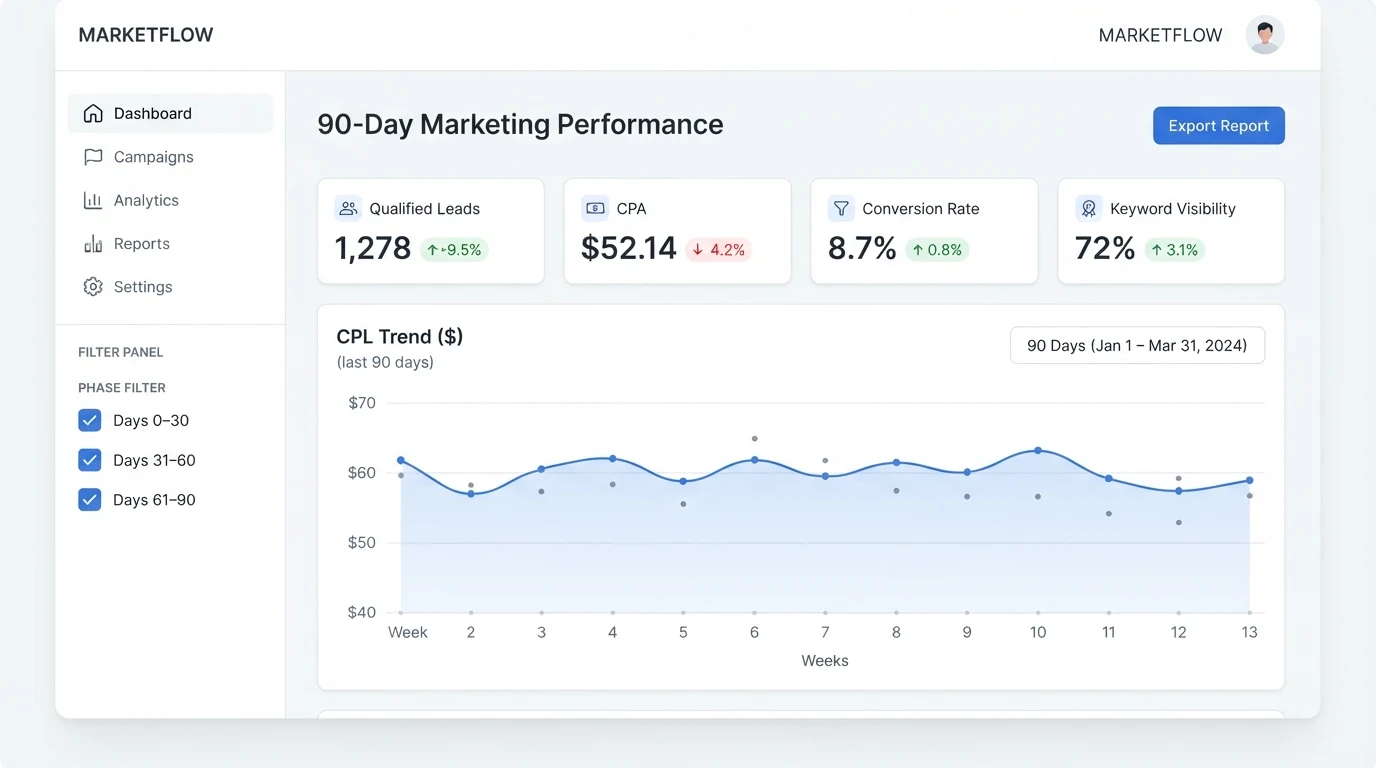
The 90-day review is the moment of truth. A serious report contains KPI performance against the baseline captured in week one, an updated view of the competitor and SERP landscape, an honest attribution snapshot, a revised roadmap for the next quarter, and a short list of things that did not work and why. It does not contain twelve pages of screenshots of ad creative or a spreadsheet of every keyword the site now ranks for. If you are considering an ongoing relationship after the pilot, our note on how AI content retainers are typically structured is a useful reference.
How to set the engagement up to win
Buyer-side hygiene is often the difference between a 15 percent CPA improvement and a 35 percent one. Four things matter more than the rest.
- Clean data in. Fix your tracking, event definitions, and CRM hygiene before kickoff. AI amplifies whatever signal you feed it, including bad signal.
- One owner on the client side. A single decision-maker who can approve creative, sign off strategy, and unblock access. Committees kill velocity.
- Weekly async review. A short Loom or written update from the agency, a written response from you within 48 hours. Meetings are for exceptions.
- Quarterly strategic reset. Every 90 days, step back from the dashboard and ask whether the plan still matches the business. Reallocate budget accordingly.
Frequently Asked Questions
How quickly should I see paid media results from an AI marketing agency?
Statistical signal on a properly structured account arrives inside two to four weeks. Meaningful CPA improvement of 15 to 35 percent typically lands by day 90, assuming a healthy baseline and adequate spend to reach significance.
When should I expect SEO and organic traffic to move?
Three to six months for meaningful traffic on commercial keywords. Generative-search citations in ChatGPT, Perplexity, and Google AI Overviews often appear sooner (month two onwards) if your content is well-structured and quotable.
Is AI-generated content bad for SEO?
Raw, unedited AI content is bad for SEO. AI content that has passed through a human editorial layer, is grounded in original research, and matches genuine search intent performs the same as any other well-made content.
What KPIs should I put in the contract?
Qualified leads, CPL, CPA, conversion rate, keyword visibility on money terms, revenue attributed to channel, and payback period. Do not contract on impressions, clicks, or engagement rate; those are diagnostics.
What does the first 30 days actually look like?
Brand calibration, data and tracking audit, workflow build, model stack agreement, baseline capture, and first creative concepts. No revenue lift, and any agency claiming one is either running work they already had or misattributing existing momentum.
How do I know if my AI marketing agency is any good?
They name their humans, they name their tools, they capture a baseline before starting, they lead reports with outcome KPIs, they volunteer what did not work, and they push back on your brief when it is wrong.
What is the realistic payback period?
Six to twelve months for most engagements, sooner for lifecycle and CRO work, longer for pure brand and organic plays. If the agency cannot articulate a payback thesis in the first month, treat that as a red flag.
Can generative-search citations really be measured?
Yes. Share of voice in ChatGPT, Perplexity, and Google AI Overviews can be tracked on a defined set of prompts and reviewed monthly. Expect this to become a standard reporting line in 2026.
Setting the benchmark
The plain-English version of everything above: instrumentation in month one, paid signal in month two, compounding in month three, organic momentum from month four, and payback inside the first year. Anyone promising faster is either fibbing or getting lucky with a baseline that was very broken. If you want to pressure-test a proposal against these benchmarks, or scope a pilot that runs against them from day one, Absolutely AI runs 30-day scoping engagements built around exactly this framework; a short call is the fastest way to see whether the numbers on the table match reality.