AI Ad Creative for DTC Brands: The 2026 Operating System
DTC creative is now the last real growth lever, and most brands are still treating AI ad generation like a novelty rather than a production line. This guide from Absolutely AI lays out a repeatable operating system: the stack, the archetypes, a two-week sprint template, the guardrails, and the benchmarks that separate a scaling AI creative program from an expensive experiment.

The average DTC brand is paying around $45 to acquire a customer, and Meta's own auction data suggests creative now drives roughly 56% of outcomes inside Advantage+ Sales Campaigns. Targeting is a black box. Bidding is automated. The only remaining lever that reliably moves CAC is the volume, diversity, and quality of the creative you feed the machine. That is the entire reason AI ad creative has stopped being a curiosity and started being an operating system.
Most brands miss the point. They generate a few glossy stills, post them, and conclude that AI creative does not work. The winners have built a weekly test engine: forty concepts in, twelve winners out, three scaled. This guide is the process, not the tool list.
Why creative is the #1 DTC growth lever in 2026
Advantage+ has quietly eaten manual targeting. Interest stacks, lookalikes, and custom audiences still exist, but the platform is optimising past them. What the algorithm cannot do on your behalf is invent a new hook, a new founder angle, or a new visual world. That job stays with you, and the brands that ship the most distinct concepts per week are the ones compressing CAC while everyone else watches fatigue curves collapse in three to five days.
The math is unforgiving. A single winning concept now has a useful life of roughly a week before frequency kills it. If your creative team ships four concepts a month, you are permanently in fatigue. If you ship forty, you are permanently in discovery. The gap between those two operating modes is not talent, it is workflow.
This is why the smartest growth leads have stopped asking "is AI creative good enough" and started asking "how do we industrialise it without losing the brand." The answer looks a lot like a production system rather than a prompt library.
What AI ad creative actually means today
The category is not one thing. It splits into four distinct layers, and confusing them is the fastest way to buy the wrong tool. Our commercial team maps every DTC engagement against this stack before writing a brief.
- Generative static. Midjourney v7, GPT Image, Ideogram. Best for hero product worlds, lifestyle scenes, and problem-agitation imagery. This is where most brands start.
- AI UGC and avatars. HeyGen, Arcads, Creatify. Synthetic presenters delivering scripts in a UGC register. The quality gap between these and real creators has closed dramatically in the last twelve months.
- Motion and video. Runway Gen-4, Sora, Kling. Product-in-motion, cinematic B-roll, transitions, and increasingly full 15-second spots. Still requires taste to avoid the plastic look.
- Full-stack workflow. AdCreative.ai, Pencil, Icon.me, Omneky. These try to own brief, generation, scoring, and iteration in one surface. Useful as scaffolding, dangerous as your entire creative department.
A mature DTC stack uses all four, orchestrated by a human editor-in-chief. The single biggest mistake we see is picking one full-stack tool and calling it a strategy, which usually leaves you with generic output that looks like every other brand using the same template.

The DTC creative stack that actually ships
Every functioning AI creative program we have built or audited runs on the same four-layer pipeline. Skip a layer and the whole thing degrades into noise. A properly instrumented pipeline is what turns raw generation into brand-consistent output at scale.
- Brief layer. A structured brief per concept: archetype, hook, product claim, audience state, visual reference, aspect ratio, disclosure requirement. Written by a human strategist, not a tool.
- Generation layer. The right tool for the archetype. UGC scripts go to Arcads. Product hero shots go to Midjourney plus a controlled edit pass. Motion goes to Runway or Kling. Never one tool for everything.
- Scoring layer. Motion, Foreplay, or a custom sheet pulling Meta API data. Every asset is tagged by archetype, hook, format, and creator. No tagging taxonomy, no learning.
- Iteration layer. Winners get five variants shipped within 48 hours. Losers get archived with a note on why. This is where most programs die, because nobody owns it.
Six ad archetypes AI produces best for DTC
Not every ad format benefits equally from AI production. These six are where the tools currently outperform traditional shoots on cost-per-concept without losing performance. They also map cleanly onto the archetypes surfaced in most winning ad libraries.
- Problem-agitation UGC. AI avatar delivers a pain-point monologue. Prompt pattern: specific persona, sensory pain description, product reveal at second seven, single CTA.
- Before and after. Split-frame or transition. Works especially well for skincare, home, and pet. AI generates both states from the same character reference to keep continuity.
- Founder story. Short, direct-to-camera origin. Real founder voiceover over AI-generated B-roll of the product world. Highest trust signal per dollar.
- Ingredient or feature callout. Macro product shots with animated labels. Runway plus a static overlay. Cheapest concept type to produce in volume.
- Comparison. Your product versus the category default. Works for supplements, coffee, apparel. Requires careful claim substantiation.
- Social proof compilation. Review carousel with AI-generated background scenes matching each testimonial's context. High relevance density.
A two-week AI creative sprint template
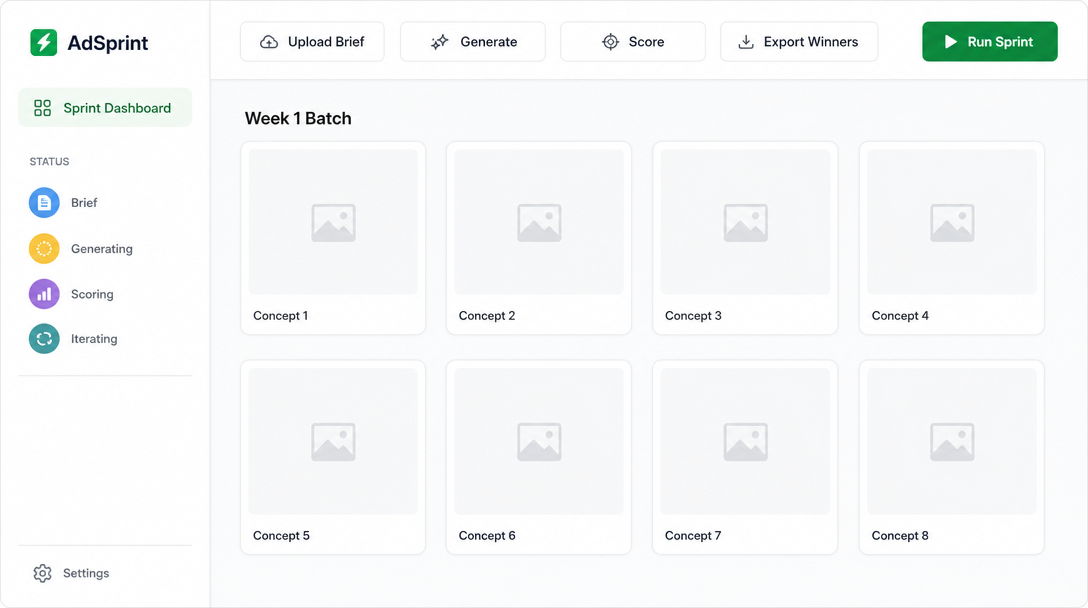
This is the cadence we run for DTC clients on retainer. Two weeks in, two weeks out, permanent overlap. Every sprint ships forty concepts and identifies twelve winners for scale. The full workflow sits inside our automation stack so nothing is done manually twice.
| Day | Owner | Deliverable | Gate |
|---|---|---|---|
| 1 | Strategist | 40 briefs across 6 archetypes | Every brief has hook, claim, disclosure |
| 2-3 | Producer | 40 first-pass generations | Brand ref applied, aspect correct |
| 4 | Editor-in-chief | QA pass: hands, anatomy, brand fit | No AI smell, no logo drift |
| 5 | Producer | Cut-downs, captions, thumbstop frame | Hook lands by second two |
| 6 | Growth | Launch with tagging taxonomy | Every asset tagged in Motion |
| 7-10 | Growth | Learn phase, minimum $200 per concept | Statistical significance on CPA |
| 11-12 | Producer | 5 variants per winning concept | Same hook, new execution |
| 13-14 | Full team | Sprint retro and next brief pack | Documented what won and why |
The non-negotiable role is editor-in-chief. Without a single human who owns brand fit and can reject a concept for taste reasons, the pipeline drifts toward generic within three sprints. This is the role most in-house teams try to skip and always regret. Our production leads sit in this seat by default.
Guardrails: brand consistency, anatomy, and disclosure
The failure modes are predictable. Every AI creative program hits the same four walls, and every one has a fix. Building these into the pipeline from day one is what separates an ongoing program from a pilot that quietly dies.
- Style references and character locking. Lock a style ref set per brand. For recurring characters, use consistent seed prompts or LoRA-style character references. Never let a generator freestyle the brand world.
- Hand and anatomy QA. Every asset gets a dedicated anatomy pass. Broken hands and warped eyes kill trust faster than any copy mistake. Fix in edit, not by regenerating.
- FTC and platform disclosure. AI-generated presenters that could be mistaken for real people need clear disclosure in the US, and Meta requires AI labelling on political and social content. Bake this into the brief template.
- Avoiding the AI smell. Symmetrical faces, glossy skin, floating hands, impossible lighting. The tell is usually over-polish. Add grain, imperfect framing, and real UGC-style vertical crops.
Benchmarks: what good looks like in 2026
Without benchmarks you cannot tell a winner from a mediocre asset. These are the numbers we hold DTC creative to on Meta, aggregated across roughly forty accounts in the $2m to $50m ARR range. Comparable benchmarks for vertical video tend to run slightly higher on thumbstop.
| Metric | Poor | Good | Great |
|---|---|---|---|
| Hook rate (3s / impressions) | <25% | 30-38% | >42% |
| Thumbstop ratio | <20% | 25-32% | >35% |
| Hold rate (15s) | <8% | 12-18% | >22% |
| CPA vs account average | +10% | -15% | -30% |
| iROAS lift on new concept | flat | +0.3 | +0.7 |
Common failure modes
Every failed AI creative program we have audited fails in one of three ways. Watch for these before they compound into a full pipeline collapse and eat the quarter's growth budget.
- Over-generation without tagging. Shipping 100 assets a week with no taxonomy means you learn nothing. You are just adding noise to the auction.
- No editor-in-chief. Committee QA produces generic output. One human owns brand fit or the pipeline drifts.
- Tool-first thinking. Buying AdCreative.ai and hoping it becomes a strategy. The tool is the layer, not the system.
Tool shortlist by budget tier
Match the stack to the stage. Overbuying tools is almost as expensive as overbuying media, and most brands underestimate how much of the value sits in the workflow around the tools rather than the tools themselves.
| Tier | Static | UGC / Avatar | Motion | Analytics |
|---|---|---|---|---|
| <$500/mo | Midjourney, Ideogram | Creatify starter | Runway standard | Meta native + sheet |
| $500-2k/mo | Midjourney + Photoshop generative | Arcads, HeyGen | Runway Pro, Kling | Motion or Foreplay |
| Agency-managed | Custom pipeline | Bespoke avatars + real UGC blend | Full production suite | Custom Meta API + BI |
Frequently Asked Questions
How many AI ad concepts should a DTC brand test per week?
For brands spending over $50k a month on Meta, twenty distinct concepts per week is the floor and forty is the target. Below that volume, you cannot outrun fatigue and you cannot generate enough signal to identify real winners with confidence.
Does AI creative actually outperform traditional UGC?
On CPA, AI UGC now matches or beats traditional creator UGC in roughly six out of ten head-to-head tests we run. The gap is closing fast. Traditional UGC still wins on very high-trust categories like health and finance, where a real named person materially lifts credibility.
What is the biggest hidden cost of an AI creative program?
Editing and QA. The generation itself is cheap. The human hours required to reject bad output, fix anatomy, apply brand refs, and tag assets is where budgets actually go. Plan for one full-time editor per twenty concepts a week.
Can I run this in-house or should I outsource?
In-house works if you already have a growth-side creative producer with taste. If you are hiring from scratch, an outside partner will get you to a working pipeline three to six months faster, and you can bring it in-house later once the system is documented.
How do I stop AI creative from looking generic?
Lock a style reference set, insist on a real founder voice or real customer language in every script, and give an editor-in-chief veto power. Generic output almost always traces back to a missing reference or a missing human filter.
What is the fastest way to start?
Pick one archetype, usually problem-agitation UGC, and run a two-week sprint against your current control ad. Ten concepts, real budget, real learnings. Do not try to build the full four-layer stack in month one.
How do I handle FTC and Meta disclosure for AI presenters?
Treat any synthetic person as requiring disclosure. Add a clear label in the caption or on-screen, and never imply a testimonial is from a real customer if it is not. Platform policy is tightening quarterly and the cost of getting this wrong is account-level, not ad-level.
What metric should I actually optimise for?
Hook rate for discovery, CPA for scale. Hook rate tells you whether the concept earns attention. CPA tells you whether it earns money. Optimising for anything in between usually means optimising for a vanity metric.
The takeaway
AI ad creative for DTC in 2026 is not a tool problem, it is a workflow problem. The brands winning right now have a repeatable weekly engine: structured briefs, the right generator per archetype, ruthless QA, tagged launches, and a human editor-in-chief who protects the brand. Everyone else is generating expensive noise. If you want a partner to build that engine with you, Absolutely AI runs this playbook end to end through our AI social content practice, from sprint zero to a fully instrumented creative operating system.