Brand Consistency in AI-Generated Imagery: The Agency Playbook
The failure isn't a bad prompt. It's the fourth deliverable in a six-asset campaign that no longer looks like the first three. Drift is what quietly breaks AI imagery for brands, and at Absolutely AI we treat consistency as a production-systems problem. This piece maps the four layers that keep a look locked across every deliverable.

The failure mode in AI brand imagery is rarely a single bad prompt. It shows up on the fourth asset of a six-piece campaign, the one where the lighting is subtly cooler, the product's proportions have shifted a fraction, and the mood has moved from confident to clinical. Nothing looks broken in isolation. In the grid, the drift is loud. Teams try to fix this with better prompts and hit a plateau inside a week. The real fix is architectural, and it borrows more from software engineering than from photography.
What follows is the four-layer system that keeps AI output on-brand across long-running work: a machine-readable Visual DNA, deliberate technique selection, a governed prompt library, and a human QA layer. Each layer catches a failure the prior one cannot. For the shoot-side mechanics that sit inside this frame, how AI lifestyle shoots work covers the production sequence in more depth.
Why AI Models Forget Your Brand Between Prompts
Diffusion models have no persistent memory of your brand. Every generation starts from noise, conditioned only by the prompt, the model weights, and whatever reference material you attach at inference time. The context window resets between calls, which means the brand book you carefully described yesterday is gone by morning. Prompt engineering compensates for a while, but only until the description becomes so long that later tokens lose weight and the model drifts toward its training distribution average.
This is why "just write better prompts" plateaus so quickly. Consistency has to live outside the prompt: in reference images the model can attend to, in weights fine-tuned on your assets, or in structured conditioning that anchors composition and colour. Prompts describe the intent. The consistency layer enforces it.
Style Consistency vs Subject Consistency: Two Problems, Two Toolchains
The clearest gap in most published guidance is treating these as the same problem. They are not. Style consistency means locking palette, lighting, grain, mood, and composition rhythm across a set. Subject consistency means the same face, the same product, the same hero object rendered accurately frame after frame. Different techniques solve each, and mixing them without a plan is the fastest route to a broken set.
Style is handled by reference conditioning: Midjourney's --sref, Flux style LoRAs, GPT Image 2's reference-image conditioning, Adobe Firefly's style matching. Subject is handled by identity conditioning: IP-Adapter for faces and products, ControlNet for pose and composition, character LoRAs or DreamBooth for fine-tuned personas. A campaign with a signature look and a recurring hero product needs both stacks running in parallel, not one stretched to cover both jobs.

Extracting a Machine-Readable Visual DNA
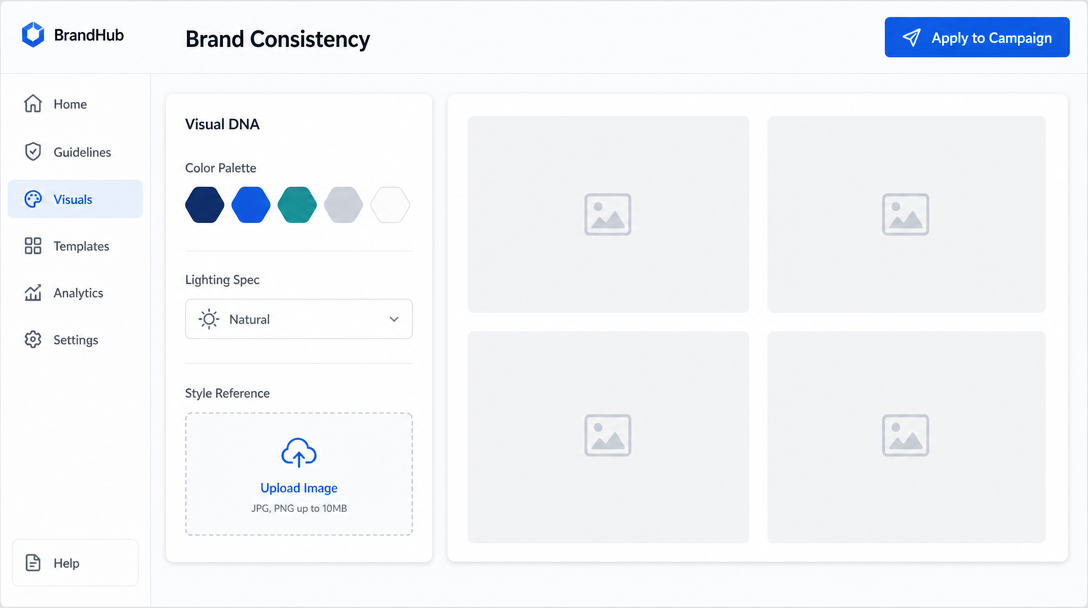
Most brand guides are written for humans. They talk about "warm, inviting light" and "confident negative space." Diffusion models need something more mechanical. The Visual DNA extraction step converts a PDF brand book into structured tokens the pipeline can paste anywhere: hex codes, colour temperature in Kelvin, key-to-fill ratios, aspect and composition preferences, mood vocabulary drawn from the actual asset library, and a curated reference set of eight to twelve exemplar images.
The output is a short token block you prepend to every prompt plus a reference bundle you can point --sref or IP-Adapter at. Done once per client, it becomes the source of truth every downstream prompt inherits from. Brand-building work at agency scale hinges on this artefact existing before generation starts, not being reverse-engineered from failed outputs later.
The Technique Stack, Ranked by Cost and Depth
No single technique wins. The right stack depends on deliverable volume, the shelf life of the look, and the client tier. The table below maps the common options across the trade-offs that matter in production.
| Technique | Setup cost | Speed per image | Consistency depth | Best for |
|---|---|---|---|---|
| Prompt templates + seed locking | Low | Fast | Shallow | Single-day social sets |
| Midjourney --sref | Low | Fast | Medium (style only) | Style-locked campaigns |
| GPT Image 2 reference conditioning | Low | Medium | Medium | Multi-asset editorial sets |
| IP-Adapter | Medium | Medium | High (subject) | Recurring product or face |
| ControlNet | Medium | Medium | High (composition) | Pose, layout, packaging structure |
| Flux + LoRA | High | Fast at inference | Very high (style or subject) | Long-running brand accounts |
| DreamBooth fine-tune | Very high | Fast at inference | Very high (subject) | Signature character or hero product |
| MCP-deployed brand context | High | Fast | Governance layer | Multi-team, multi-brand agencies |
The mistake is treating this as a ladder to climb. It is a menu to pick from. A one-off announcement asset can live entirely on a prompt template and a locked seed. A twelve-month always-on account with a recurring model usually needs a LoRA. Consulting engagements often start by auditing which layer a team is missing rather than adding another tool on top.
Prompt Library Governance for Teams
Every guide recommends a shared prompt library. Almost none explain how to actually run one. The libraries that hold up over time treat prompts as versioned artefacts: each master prompt has an owner, a version number, a linked brief, and a deprecation date. When the brief changes, the old prompt is archived rather than edited in place so historical assets remain reproducible on request.
Access control matters more than teams expect. Junior creatives get read access and a sandbox fork; senior operators get write access to the master; producers get sign-off on new versions. Integration with the project management tool closes the loop: every generated asset links back to the exact prompt version and reference bundle that produced it, so a client note six weeks later can be traced to a specific artefact and reworked without guesswork.
The Human QA Layer: How to Actually Measure On-Brandness
Measurement is the layer nobody explains. On-brandness is not a vibe check. It is a set of scores you can compute. Reference-image similarity scoring using CLIP or DINOv2 embeddings gives a numeric distance between each generated frame and the brand reference set. Anything below a threshold gets flagged automatically for regeneration or human review.
Visual regression catches drift over time: the same prompt run monthly against the current pipeline should produce visually equivalent output. When it stops doing so, something upstream changed. A human review rubric handles the qualitative side, scoring palette match, mood match, subject fidelity, composition rhythm, and brand-inappropriate artefacts each one to five before sign-off. Examples of AI lifestyle photography that clear this bar tend to show up on client feeds without further touching.
A Worked Example: Six Deliverables, One Look
A wellness client briefs a launch campaign: hero web banner, three social carousels, one paid-ad set in four aspect ratios, and a founder portrait sequence. Traditional shoot budget was not available on the timeline. The Visual DNA already existed from prior work, so the first hour goes into curating a twelve-image reference bundle drawn from previously approved output rather than starting from the brand book cold.
Round one generates the hero and the founder frames with GPT Image 2 reference conditioning plus a character LoRA for the founder's likeness. Round two extends the look into the social and paid sets, inheriting the same reference bundle and prompt template. QA runs CLIP similarity against the brand reference set, flags two frames below threshold, and both are regenerated with a tightened prompt. Sign-off takes an hour instead of a day because the rubric is explicit and everyone is scoring against the same axes.
When to Fine-Tune vs When to Reference-Condition
The decision comes down to volume and shelf life. Reference conditioning wins for anything under roughly one hundred deliverables or a campaign lifespan under three months. Setup is fast, iteration is cheap, and output quality is high enough for most editorial and social work. Fine-tuning wins when a recurring hero, product, or model will appear in hundreds of assets over a year or more, or when the brand look is distinctive enough that no combination of references reliably reproduces it.
Client tier plays in too. An enterprise account with monthly rebriefs justifies the LoRA training pipeline. A quarterly campaign for a growth-stage brand usually does not. When in doubt, start with reference conditioning and only escalate to fine-tuning after the second campaign proves the look has legs beyond a single launch cycle.
Common Failure Modes and Fixes
- Hand and anatomy drift: ControlNet pose conditioning on hero frames, targeted inpaint on the rest, and a rejection rule in QA that flags any frame with hands in the primary focal zone.
- Palette bleed: Style references outweighed by the model's training prior. Weight the --sref higher, add hex-code tokens explicitly to the prompt, and shorten the descriptive tail so style tokens carry more weight.
- Product-shape hallucination: Reference conditioning alone rarely holds detailed packaging. Layer IP-Adapter on the product plus ControlNet on its outline to lock the silhouette across every frame.
- Mood inversion under new lighting prompts: Lighting words tend to override style references. Move lighting descriptions into the reference bundle rather than the prompt, and keep the prompt itself neutral on light direction.
Frequently Asked Questions
How consistent can AI imagery realistically be across a campaign?
Consistent enough that a client cannot pick which frames were generated in which round. That level requires all four layers running together. Skip any one and drift shows up within a handful of assets.
Do we need to fine-tune a model to get on-brand output?
Usually not. Reference conditioning plus a strong Visual DNA covers most campaigns. Fine-tuning becomes worth the cost around the hundred-asset mark or when a recurring hero must render identically for a year or more.
Can Midjourney alone handle brand consistency?
For style-locked social work with no recurring subject, yes, using --sref and seed locking. For any campaign with a recurring face, product, or specific composition, combine Midjourney with a stack that handles subject and structure conditioning.
What does a Visual DNA actually contain?
Hex palette, lighting specification in Kelvin and key-to-fill ratio, composition and negative-space preferences, mood vocabulary drawn from approved assets, banned aesthetics, and a curated reference bundle of eight to twelve images. It fits on two pages and prepends to every prompt.
How do we measure whether output is on-brand?
CLIP or DINOv2 similarity scoring against the reference set for a numeric floor, plus a five-axis human rubric covering palette, mood, subject fidelity, composition, and artefacts. Both gates must pass before sign-off.
How should a prompt library be governed?
Version every master prompt, assign an owner, link it to a brief, and set a deprecation date. Archive rather than edit when the brief changes so historical assets remain reproducible on request.
What breaks first when a team scales AI imagery?
Prompt library discipline. Everyone starts forking and nobody merges back. The second failure is QA scoring, which teams drop under deadline pressure. Both need to be enforced structurally, not by goodwill.
Is reference conditioning ever enough on its own?
For short-run editorial work with no recurring hero, yes. For anything with a founder, an ambassador, or a hero product appearing repeatedly, add IP-Adapter or a LoRA to lock the subject identity.
Consistency Is a System, Not a Setting
Teams that treat AI brand imagery as a prompting problem plateau. Teams that treat it as a production system compound. The Visual DNA extraction, the technique stack, the governed prompt library, and the QA rubric are all doing the same job: moving brand knowledge out of any single generation and into the pipeline itself. That is how output stays on-brand at deliverable seven, and at deliverable seven hundred. Absolutely AI builds and operates this stack for brands running long-form creative programs where drift is not an option.