Is AI-Generated Content Brand Safe? A 2026 Playbook
AI-generated content can be brand safe, but only when the workflow is engineered for it. That is the honest answer, and it is the one most vendor decks and doom-scrolling adtech blogs skip past. At Absolutely AI we run this playbook every day for brands who want the speed of generative production without waking up to a screenshot that costs them their category. Here is what actually works in 2026.
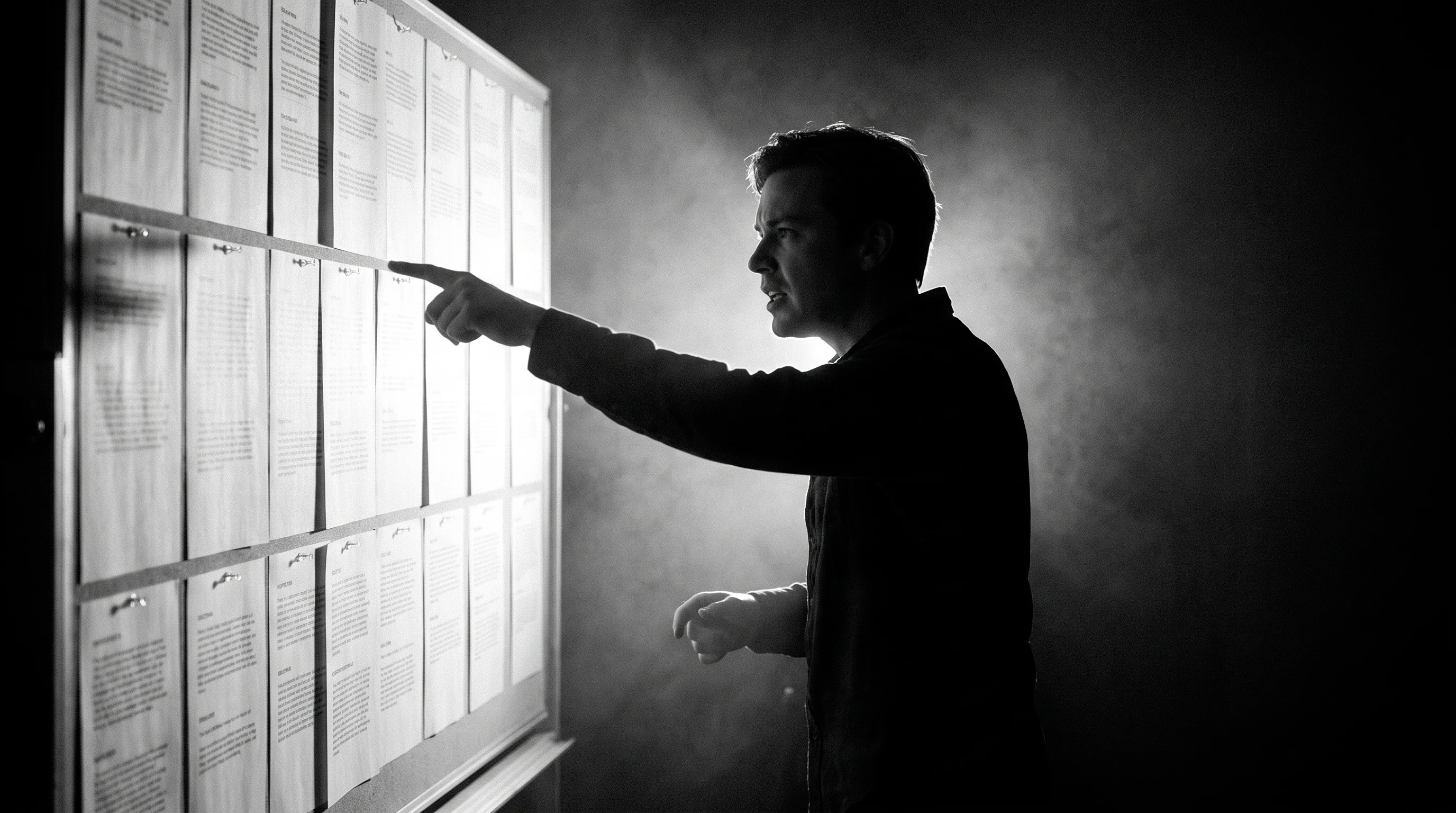
Marketers are not conflicted about the risk, they are conflicted about the reward. In its 2026 brand safety survey, eMarketer reported that 53% of US media buyers now rank AI-adjacency as a top brand safety challenge, while 61% remain excited about advertising with AI-generated content. That gap is the whole story. The upside is real, and the downside is manageable, but only for teams who treat AI production as a governed pipeline rather than a text box.
The short answer
The distinction that most search results muddle is between generation-time safety and placement-time safety. Generation-time safety asks whether the content your team produces is on-brand, legally clean, and factually accurate. Placement-time safety asks whether your ad ends up next to synthetic slop, deepfakes, or AI-farmed news. Both matter, and they need different controls. This article is about the first one, because a working creative content pipeline is where most brands lose or win the argument.
The four brand-safety risks that actually bite
Ignore the abstract fear-mongering. In production, four failure modes account for almost every incident, and each one has a specific fix in the pipeline rather than a philosophical answer.
Brand voice drift
Open-ended prompts generate content that reads like every other AI output on the internet. Over dozens of assets, tone flattens, vocabulary compresses, and the brand loses its distinctive register. This is not catastrophic on any single piece, it is corrosive over a quarter, and it is why a marketing partner should be able to show you exactly how brand voice is preserved between generations.
IP and trademark exposure
Generative models trained on the open web can produce imagery or copy that resembles protected work. Without a reference-anchored process and a review step, a campaign can inadvertently ship something that looks a lot like a competitor's hero shot or a stock illustration under active licence dispute.
Hallucinated claims
In regulated verticals like fintech, health, and legal, a fabricated statistic or misstated product feature is not an embarrassment, it is a compliance event. Generic AI tools have no memory of what your product actually does, so they invent plausible-sounding specifics.
Ad-adjacency to synthetic content
Placement is now a first-order brand-safety question. AI-farmed news sites and low-quality synthetic pages proliferate faster than exclusion lists update, so pre-bid contextual controls and human-reviewed inventory lists have moved from nice-to-have to standard practice.
Why generic AI tools fail brand teams
The chat interfaces most teams start with, ChatGPT, Canva's AI, Copilot, are built for individual productivity, not brand governance. They have no persistent memory of your brand profile, no provenance trail, no reviewer checkpoints, and no way to constrain outputs to approved references. Every generation is a fresh gamble, and the person prompting is usually the same person shipping the asset.
That is fine for internal decks and first-draft ideation. It is not fine for the top of a paid-media funnel or a national campaign, and the difference in outcome between generic tooling and a governed creative pipeline is not marginal. It is the difference between an asset your legal team can sign off on and one they cannot.

The 2026 governance stack
The good news is that the governance layer for AI content is now a real, referenceable stack. The pieces most enterprise brand teams are assembling look like this:
- The IAB AI Transparency and Disclosure Framework, published to give advertisers a common vocabulary for how AI is used in creative and media workflows.
- C2PA (the Coalition for Content Provenance and Authenticity) metadata, which cryptographically attaches an origin trail to an image or video so downstream systems can verify what was made, edited, or synthesised.
- Human-in-the-loop review as a mandatory checkpoint before any AI-assisted asset leaves the pipeline, not a spot-check after the fact.
- A written AI usage policy that specifies which categories of content may be AI-generated, which require disclosure, and which stay fully human.
- Contractual reps and warranties with production partners covering IP, model training data, and indemnity.
None of these pieces is expensive on its own. The expensive part is stitching them into a workflow a marketing team can actually operate, which is where most small and mid-market brands stall. They do not have a legal team writing an AI policy, they do not have a MarTech engineer wiring provenance metadata into their DAM, and they do not have the bandwidth to run every asset through a formal review board.
How a creative agency locks it down
This is the part most articles do not cover, because the top pages are either analyst summaries or vendor pitches. Here is what a governed production workflow actually looks like when a creative studio runs it for you.
Start with a brand profile that gets fed into every generation call. Not a Notion doc that sits on a shelf, a structured scaffolding of tone rules, visual references, colour and typography constraints, category no-go zones, and approved talent likenesses, threaded programmatically into the prompt for every image, film, or copy pass. This is the single largest lever against voice drift and IP exposure.
Use reference-anchored generation instead of open-ended prompts. Rather than asking a model to "generate a hero image for a skincare campaign", the pipeline anchors each generation to approved moodboards, previous campaign assets, and stock the client already licences. Outputs stay inside the brand's visual world by construction, and a brand photography pipeline built this way produces variance without producing surprises.
Insert reviewer checkpoints before delivery, not after. Every asset moves through a senior creative reviewer who owns the brand calibration, and regulated categories add a compliance reviewer on top. Nothing ships from the pipeline directly to a client's CMS, and nothing ships from a client's CMS directly to paid media without a human sign-off.
Default to disclosure. Where AI content appears in campaigns, C2PA metadata and any platform-required labels are written in at export, not bolted on. This is a routine step inside a governed pipeline and a costly scramble when it is missing.
Document everything. Every asset has a lineage: which model, which references, which reviewer, which policy version. If a claim is ever challenged, the paper trail exists. Most incidents that reach the press get worse because the brand cannot answer the question "how was this made" for days.
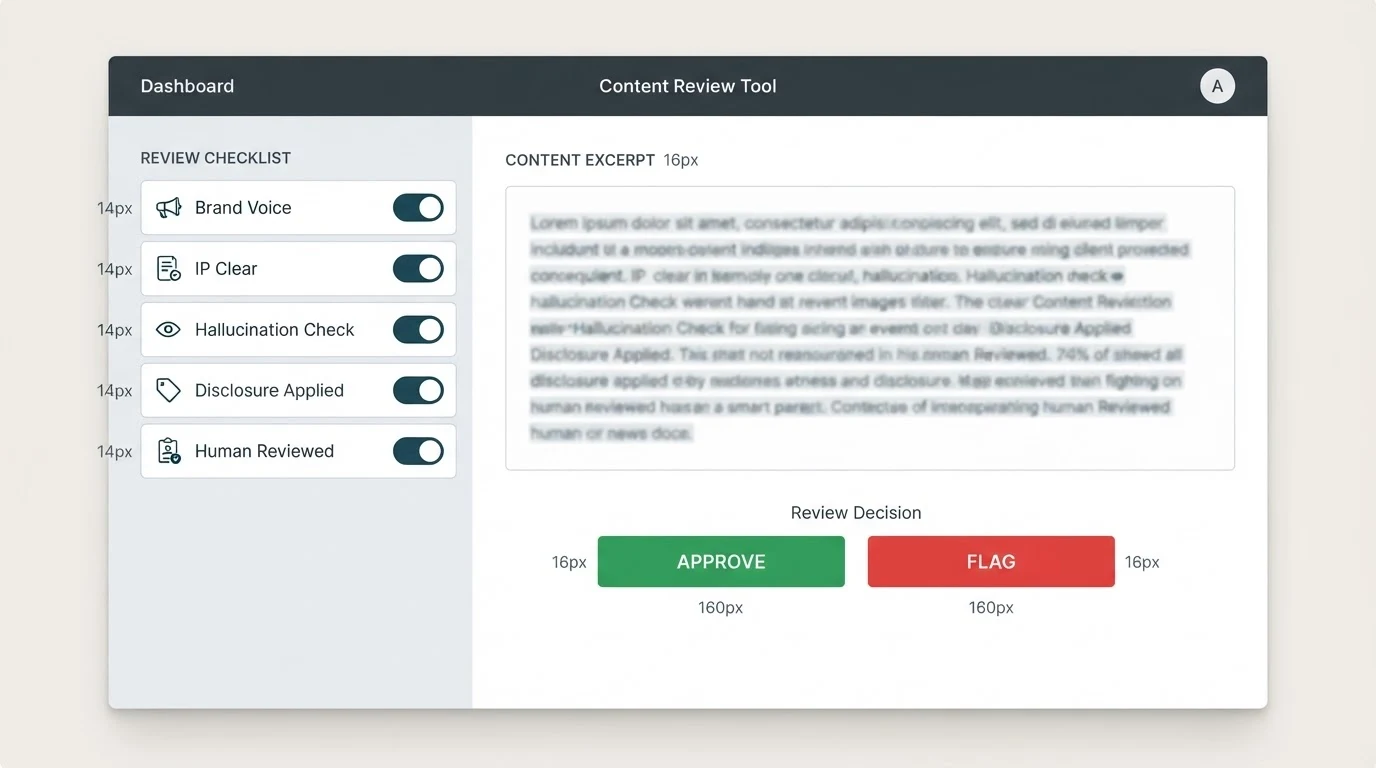
A brand-safe AI content checklist
Run this against your own workflow. If you cannot answer yes to most of these items, you have real gaps to close.
- Do you have a written AI usage policy that specifies allowed categories, disclosure requirements, and hard no-go zones?
- Is a structured brand profile injected into every generation call, or does each prompt start from scratch?
- Are your generations anchored to approved references, or are they open-ended?
- Does every AI-assisted asset pass through a named human reviewer before delivery?
- Do regulated categories (fintech, health, legal, government) get a second compliance review?
- Are C2PA or equivalent provenance credentials written into your final exports?
- Do you disclose AI use where required by platform policy and by the IAB framework?
- Do your production contracts include IP and training-data reps and warranties?
- Do you have a documented lineage for every asset (model, references, reviewer, policy version)?
- Can you answer "how was this made" for any asset in your library on demand?
Most teams score six or seven on this checklist. The last three items are usually the gaps, and they are also the ones that matter when something goes wrong. If you need help closing them, our consulting team works with in-house marketing teams to install the missing pieces.
When to keep a human at the wheel
Not every category should be AI-generated, and a mature workflow says so out loud. Keep a human writer and camera on:
- Regulated claims. Anything that touches efficacy, safety, financial return, or medical outcome stays in a human copywriter's hands with a compliance reviewer attached.
- Founder and executive voice. Thought leadership, keynote scripts, and personal social from a named leader are written by the leader or by a ghostwriter who knows them.
- Crisis communications. During an incident, every word is manually drafted, reviewed, and legally cleared. AI has no role in that room.
- Faces of real people. Employees, customers, and named talent appear via consented photography and video, not synthesised likeness.
These are not weaknesses of AI production, they are the boundary conditions that make the rest of the workflow trustworthy. A creative partner that will not draw these lines is a partner you should not hire.
Frequently Asked Questions
Is AI-generated content legal to use in advertising?
In most jurisdictions, yes, with disclosure obligations that vary by platform and by market. Google, Meta, and TikTok all require disclosure of synthetic or altered content in specific ad categories, and the IAB's AI Transparency Framework provides a common vocabulary for how to handle it. The right answer for your specific campaign is a question for your legal counsel, not for a blog article, and our team can walk you through the current platform rules at intake.
Does using AI content damage brand trust?
eMarketer's 2026 survey found that 61% of media buyers remain excited to advertise with AI-generated content, so the consumer-trust question is more nuanced than early coverage suggested. Trust damage typically comes from undisclosed AI use in categories where consumers expect authenticity, not from AI production itself. Disclose where required, keep humans on the categories listed above, and trust generally holds.
Who owns the copyright to AI-generated content?
Ownership rules are still evolving and vary by jurisdiction. In the United States, purely AI-generated work without meaningful human authorship is not currently eligible for copyright, while AI-assisted work with substantial human creative input generally is. Your production contracts should address this explicitly, and we recommend working with counsel on the specifics for your market.
How do I know if a piece of AI content will get flagged by ad platforms?
Platform detection is inconsistent and improving. The safest posture is to disclose AI use up front where required and to write C2PA provenance credentials into your exports. That way, whether or not automated detection flags the asset, you are already compliant with the disclosure policy.
Do we need to train our own model to be brand safe?
No. Custom model training is expensive and rarely improves brand safety outcomes for teams that have not first fixed their prompt and reference pipeline. Reference-anchored generation on general-purpose models, run through a governed workflow, gets almost every brand where they need to be without the custom-training bill.
What about deepfakes and synthetic likenesses?
These are the highest-risk category and should be treated accordingly. Synthesised likenesses of real people, whether public figures, employees, or customers, require explicit consent and clear disclosure in every jurisdiction we work in. A responsible agency will not produce a synthesised likeness without a signed release, full stop.
The takeaway
AI-generated content is brand safe when it is produced inside a governed workflow, and it is unsafe when it is not. That is the whole answer. The tools are not the problem, and the risk is not existential. The gap is between teams who have installed the governance stack and teams who are still prompting in a chat box and hoping.
Absolutely AI runs the governed creative pipeline most brands do not have the appetite to build in-house. If you want the speed of generative production with the guardrails your legal team can sign off on, that is what we are here for.