AI Content Creation for Brands: The 2026 Operator's Guide
AI content creation for brands has moved past the novelty phase. In 2026, the question isn't whether to use generative tools, it's how to embed them into a workflow that scales output without eroding brand voice or consumer trust. At Absolutely AI, we've built our practice around that exact tension: speed and volume on one side, taste and brand integrity on the other. Here's how the modern brand content pipeline actually works.

Two years ago, a brand marketer using AI meant someone with a ChatGPT tab open, drafting subject lines. Today it means an integrated pipeline: brand memory feeding structured briefs, generation engines producing copy, imagery, video and voice, and human creative directors reviewing everything before it hits a channel. The shift from ad-hoc prompting to workflow-embedded systems is the story of the last twelve months, and the brands winning are the ones treating AI content creation as an operating model, not a tool purchase.
What follows is a working guide for brand and marketing leaders evaluating how deep to go, how fast, and where the real risks sit. It's written from the perspective of an agency that ships this work daily, not a vendor pitching a platform.
What AI content creation for brands actually means in 2026
The phrase has quietly changed definition. In 2023, AI content creation meant using a tool like Jasper or Midjourney to produce a single asset faster. In 2026, it means an end-to-end system: a brand profile document that acts as persistent memory, a structured briefing layer, a generation engine combining large language models with image and video models, a human creative review stage, and a publish-and-measure loop that feeds performance data back into the brief templates.
The distinction matters because most of the frustration brands report with AI content, off-brand output, generic aesthetics, factual drift, comes from treating generation as the whole pipeline. It isn't. Generation is one stage of five, and the stages before and after it are where agency and in-house teams earn their keep.
The four content pillars AI now covers
Any serious brand content operation now spans four generative modalities. Treating them as one pipeline, rather than four disconnected tools, is what separates a working system from a novelty stack.
| Pillar | Primary models | Typical brand use | Human review load |
|---|---|---|---|
| Written | GPT-class LLMs, Claude, Jasper, Typeface | Blog, email, ad copy, product descriptions | Medium (fact and voice checks) |
| Visual | gpt-image, Midjourney, Adobe Firefly | Product, lifestyle, hero, social imagery | High (composition, brand fit) |
| Video and motion | Runway, Sora-class models, Kling | Social clips, product demos, ad cutdowns | High (motion coherence, pacing) |
| Audio and voice | ElevenLabs, Hedra avatars | Voiceover, presenter video, localised dubs | Medium (tone, pronunciation) |
Very few brands run all four pillars well internally. Most start with copy, add imagery within six months, and reach for video and film capabilities once the first two are working. The teams that skip pillars tend to fragment their brand voice across formats, which is expensive to fix later.

The modern AI content workflow
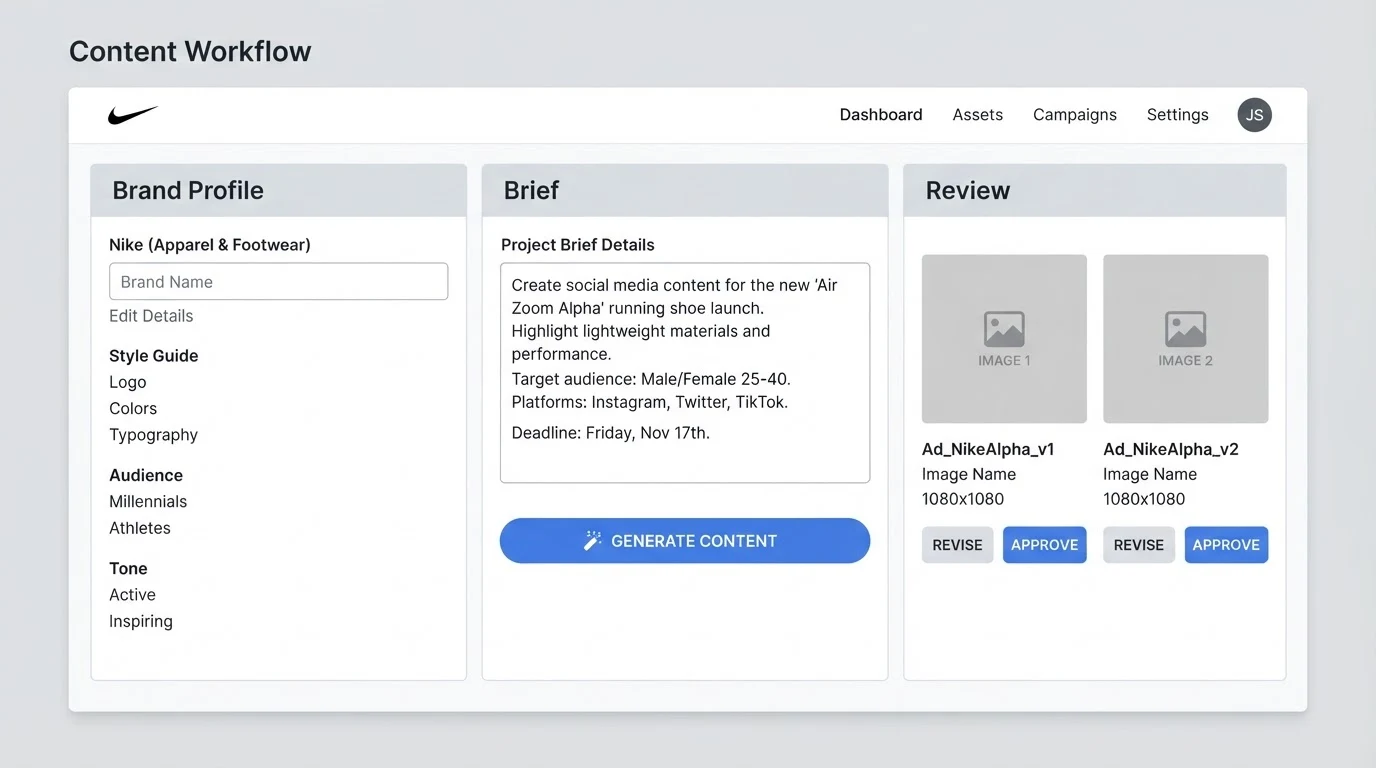
A reference architecture we've refined across dozens of brand engagements looks like this: brand profile document, structured brief, generation engine, human creative review, publish, measure, feed back. Each stage has an owner and a deliverable.
- Brand profile. A living document capturing tone, values, visual codes, banned words, competitor references, product truth. This is the system prompt that sits behind every generation. Update it monthly.
- Structured brief. Not a paragraph in a Slack message. A templated input covering deliverable type, aspect ratio, audience, message, mood references, and non-negotiables. Good briefs are 60% of output quality.
- Generation engine. The stack of models plus the orchestration layer that routes each brief to the right combination. This is where workflow automation earns its cost.
- Human creative review. A senior creative selects, edits, rejects. This stage is non-negotiable and it's where taste enters the pipeline.
- Publish and measure. Standard CMS or ad platform delivery, with performance data tagged back to the originating brief so the brand profile can learn.
The brief-driven approach is what makes concept exploration tractable at brand scale. Rather than generating one option and refining, a good pipeline produces four to eight concept directions per brief, then narrows through creative review. That's how you get concept rounds that used to take days down to hours without sacrificing the exploration phase.
How top brands are actually using it
Public case patterns from the last eighteen months tell a consistent story. Coca-Cola's Create Real Magic platform married generative imagery with tightly-controlled brand assets, giving consumers a sandbox without letting brand equity out of the building. Heinz ran an early campaign asking image models to draw ketchup, then used the outputs as proof of category ownership, turning an AI quirk into earned media.
VML and other network agencies have moved generative production in-house for repetitive social and ecommerce work, freeing traditional shoots for hero campaigns. Nike-style social teams are using generative video to cut dozens of format variations from a single shoot, which is closer to the sustainable use case for most brands than trying to replace principal photography wholesale.
The common thread: none of these brands replaced their creative direction with AI. They used AI to expand what a fixed creative team could produce, and kept the taste calls in human hands. Brands that inverted that ratio, letting AI drive direction while humans QA'd output, produced the flat, generic work the industry now calls AI slop.
Keeping brand voice and authenticity intact
Brand voice preservation is a systems problem, not a prompting problem. Three practices separate brands with recognisable AI-assisted output from brands whose content reads like everyone else's.
- Brand memory files. A persistent document, versioned, that the generation layer references on every request. Not a paragraph pasted into a prompt. A real document with sections on voice, banned phrases, competitor no-go zones, and canonical examples of on-brand work.
- Style guides as system prompts. The brand voice guide isn't a PDF for humans, it's an instruction set for the LLM. Rewriting it in imperative, model-friendly language is a one-week project that pays back forever.
- Human-in-the-loop review. Every asset that ships to a paid channel passes through a senior creative. Consumer research consistently shows around 75% of buyers want transparency about AI use, and that trust holds when a human is visibly accountable for what goes out.
DIY tools, AI-native agencies, and hybrid models
Deciding where to sit on this spectrum is the single biggest strategic question for a brand adopting AI content. The right answer depends on team size, output volume, and how taste-sensitive the category is.
| Model | Best fit | Strength | Weakness |
|---|---|---|---|
| DIY tool stack | Small teams, high-volume low-stakes output | Low fixed cost, full control | Taste ceiling, workflow burden on marketers |
| AI-native agency | Brands treating content as a growth lever | Senior creative direction, cross-format pipeline | Requires a real brief and clear brand inputs |
| Traditional agency plus AI | Heritage brands with existing partners | Continuity, established trust | Slower adoption, hybrid cost stack |
Teams under ten people producing high-volume ecommerce or social content usually get furthest fastest with a DIY stack plus quarterly agency support on hero work. Brands running multi-channel campaigns across format types tend to consolidate with an AI-native partner, because the coordination cost of running four generative pipelines in-house is higher than most marketers expect. Pricing for agency support is quoted per scope after a brief review, and a good agency comparison should focus on portfolio taste and workflow maturity, not headline rates.
Risks and guardrails
The risk register for brand AI content in 2026 has stabilised around five items. IP exposure from training data provenance, still evolving in courts. Disclosure obligations, tightening in the EU and increasingly expected by consumers. Hallucination in factual copy, which never fully goes away and demands editorial review. Aesthetic sameness, the AI slop problem, which is a taste and direction failure not a model failure. And over-automation of decisions that should remain human, particularly around cultural sensitivity and campaign concept.
Pragmatic guardrails: a disclosure policy in your brand guidelines, factual review for anything making a claim, a human sign-off gate before publish, and a quarterly audit of output for aesthetic drift. Brands that treat these as compliance overhead rather than quality infrastructure tend to underperform on both fronts.
A 30-day rollout plan
For a brand starting from close to zero, a realistic first month looks like this. It's the sequence we recommend when a new client engages for DTC content work.
- Days 1 to 5. Write the brand profile document. Voice, visual codes, banned words, competitor references, canonical on-brand examples.
- Days 6 to 10. Choose one pillar to pilot. Usually copy or product imagery. Set up the generation stack and the brief template.
- Days 11 to 20. Ship ten pieces of real work through the pipeline. Track review time, revision rate, and channel performance.
- Days 21 to 25. Add a second pillar. Refine the brief template based on what went wrong in weeks two and three.
- Days 26 to 30. Review with the wider marketing team. Decide whether to bring in agency support, expand internally, or hold at current scope.
Frequently Asked Questions
What's the difference between AI content creation and AI-generated content?
AI content creation is the workflow: brief, generate, review, publish. AI-generated content is just the middle step. The distinction matters because most quality problems come from treating generation as the whole process.
Will AI content hurt our SEO or brand trust?
Search engines and consumers penalise low-effort AI output, not AI-assisted work with editorial oversight. Google's guidance is explicit that quality and helpfulness matter more than authorship method. Brand trust holds when human accountability is visible.
Do we need to disclose AI use to customers?Increasingly yes, especially in the EU under the AI Act, and consumer expectation is running ahead of regulation. A short disclosure line on AI-assisted content is now standard practice for brands that take transparency seriously.How much creative work can realistically be AI-assisted?
For most brands, 60 to 80% of BAU social, ecommerce, and email content can run through an AI-assisted pipeline. Hero campaigns, brand films, and category-defining creative typically stay closer to traditional production with AI as a support tool.
What in-house skills do we need to build?
Brief writing, senior creative review, and prompt system maintenance. Not model training, not tool operation. The rare skill is a creative director who understands how to direct a generative pipeline the way they'd direct a photographer.
How do we avoid the AI slop aesthetic?
Custom brand references, strong art direction on every brief, and a human creative gatekeeper. Slop is what happens when models are asked to invent aesthetics rather than execute a defined one.
Can AI handle our video content or just copy and images?
All four pillars are production-ready in 2026, though video still demands the heaviest human review. Motion coherence, pacing, and brand-safe output remain the areas where a creative director's eye matters most.
How quickly can we see ROI?
Most brands see time-to-publish drop within the first month and cost-per-asset shift within the first quarter. Compounding returns from brand memory and workflow refinement typically show up in months four to six.
Where this goes next
The brands treating AI content creation as a permanent operating capability, not a temporary experiment, are the ones building durable advantage. The workflow is stabilising, the tools are converging, and the differentiator is moving from access to taste and process. If you're weighing how to structure your own pipeline, Absolutely AI works with brands on exactly this transition, from brand profile through to shipped campaign, with senior creative direction at every stage.