AI Advertising Disclosure Rules in Australia: 2026 Guide
Australia has no single AI Act, but AI-generated ads are already regulated through a growing stack of consumer, privacy, industry and broadcast rules. Two 2026 changes tighten the picture: mandatory synthetic-voice disclosure on commercial radio from 1 July, and automated decision-making transparency in the Privacy Act from 10 December. This is the Absolutely AI reference for marketers who need to know exactly what to label, and where.

If your campaign uses generative AI for imagery, voice, video, personalisation or targeting, at least one Australian instrument almost certainly applies. There is no standalone "AI Act" here yet, but the Australian Consumer Law, the AANA Code of Ethics, the Privacy Act and the new Commercial Radio Code of Practice already cover most of what agencies, in-house marketers and influencers put in market. This guide maps every trigger to the specific rule, updated for 2026, with copy-paste label wording at the end.
The short answer: when you must disclose AI in an Australian ad
The safest working rule is that disclosure is required whenever a reasonable consumer would be misled about who or what they are looking at, hearing, or being targeted by. In practice that means labelling AI use in these situations:
- A synthetic voice, cloned voice, or fully AI-generated "person" appears in the ad and could be mistaken for a real presenter, endorser or customer.
- An AI-generated face, avatar or virtual influencer is used in place of, or blended with, a real person.
- Prices, offers or product recommendations are personalised to the viewer by an automated system in a way that materially affects their decision.
- An influencer or creator uses an AI avatar, voice clone, or heavily AI-generated footage in commercial content.
- The ad makes a claim about AI capability, sustainability, or performance that cannot be substantiated (the ACCC's "AI-washing" concern).
Everything below explains which specific instrument bites in each case, and what a defensible disclosure actually looks like. For creative teams already producing AI-driven work at scale, this is the ground layer beneath our broader AI social ad creative practice.

The legal stack that already applies in 2026
The base layer is the Australian Consumer Law. Sections 18 and 29 of the ACL prohibit misleading or deceptive conduct and false representations about goods and services. According to the ACCC, penalties for corporations can reach up to A$50 million per contravention, or three times the benefit gained, or 30 percent of adjusted turnover during the breach period, whichever is greater. AI-generated content is not exempt from either section: a synthetic testimonial or a fabricated "before and after" is treated as a representation like any other.
Layered over the ACL is the ACCC's public guidance on "AI-washing", which warns businesses against overstating the role, sophistication or environmental credentials of AI in their products and marketing. The regulator has signalled that vague or unverifiable AI claims will be treated the same way as greenwashing has been in recent enforcement action.
The advertising industry adds its own layer through the AANA Code of Ethics. Section 2.7 requires that advertising must be clearly distinguishable as such to the relevant audience. Ad Standards, the industry's complaint body, applies this to influencer content, native ads, and increasingly to AI-generated creative that could be mistaken for user-generated posts or editorial. A finding against a brand does not carry a fine, but it forces removal and generates public case reports, which is a real reputational hit for anyone running AI UGC-style content.
The 10 December 2026 automated decision-making obligation
The Privacy Act 1988 changes commencing 10 December 2026 introduce a specific transparency duty for automated decision-making. Under the amended Australian Privacy Principles, APP entities must include in their privacy policy information about the kinds of decisions made by automated systems that significantly affect an individual, and the personal information used to make them. The OAIC has indicated a broad reading of what counts as "significant", which is likely to include automated targeting, dynamic pricing and AI-personalised offers where these materially change what a consumer sees or pays.
APP entities include most Australian businesses with turnover above A$3 million, plus health service providers and a range of other captured categories. Penalties under the Privacy Act for serious or repeated interference with privacy can reach A$2.5 million per breach for individuals and higher amounts for corporations, calculated on a formula similar to the ACL. Practically, if your ad stack uses AI to decide which creative variant, price or offer to serve which person, your public privacy policy needs a plain-English section explaining that by 10 December 2026.
The 1 July 2026 Commercial Radio Code
The Commercial Radio Code of Practice registered with ACMA introduces from 1 July 2026 a mandatory disclosure requirement for synthetic voices on regularly scheduled programs and in news content on commercial radio. In practical terms, if a station or an advertiser uses an AI-generated voice that sounds like a real person, a named presenter, or a generic "announcer" that listeners could mistake for a human, the use must be disclosed on-air. The code is administered by Commercial Radio and Audio and enforced through ACMA. Media buyers commissioning radio creative should add a synthetic-voice check to their trafficking sheet from that date.
AANA's live consultation on generative AI
The AANA has been publicly consulting on how the Code of Ethics should address generative AI, and further guidance is expected. The likely direction is a clearer requirement to disclose material AI generation in the creative itself (not just in a caption), tighter language around AI-generated depictions of real people, and explicit rules for AI avatars used as brand spokespeople. Brands that already build a disclosure habit into their process will not need to retrofit campaigns once the guidance lands.
Influencers, creators and AI avatars
The AANA Influencer Guide requires that commercial content be clearly identifiable, using labels such as #Ad or the platform's built-in paid partnership tools. Where AI is layered on top of that, the disclosure needs to cover both the commercial nature and the synthetic nature of the content. For an influencer using an AI voice clone of themselves, a caption reading "#Ad. Voice generated with AI" carries both hats. For a fully virtual influencer, the account bio and every commercial post should make the AI nature clear, not just the fine print.
The same logic extends to AI vertical video ad content produced for TikTok, Reels and Shorts, where the pace of the format tempts brands to skip labels. Ad Standards has been consistent that disclosure needs to be visible without the viewer pausing or expanding a caption.
Practical disclosure patterns that survive Ad Standards
Regulators and industry bodies have not mandated a single wording, but a small pattern language is emerging from Ad Standards case reports, the National AI Centre's "Be clear about AI use" guidance, and international precedent. The table below summarises defensible options for each surface.
| Surface | Trigger | Suggested disclosure |
|---|---|---|
| Static social image | AI-generated or heavily AI-edited visual | On-image label "Created with AI" plus caption line "Image generated with AI." |
| Vertical video | AI avatar, AI voice, or AI-generated B-roll | First-frame supertitle "AI-generated" plus caption line "Voice and visuals generated with AI." |
| Radio spot | Synthetic voice presenter or endorser | Spoken tag inside the read: "Voice generated by AI." |
| Influencer post | Commercial content plus AI avatar or clone | "#Ad. Created with AI." plus platform paid partnership label |
| Website or landing page | AI-personalised pricing, offers or copy | Privacy policy section on ADM plus on-page "Personalised for you" note |
Where the delivery format supports it, embedding C2PA content credentials in the file itself is increasingly treated as best practice by platforms that surface provenance signals. Credentials do not replace on-screen disclosure, but they help downstream distributors and journalists verify the source, which matters when the same asset is reused across earned media and AI Instagram carousel ads.
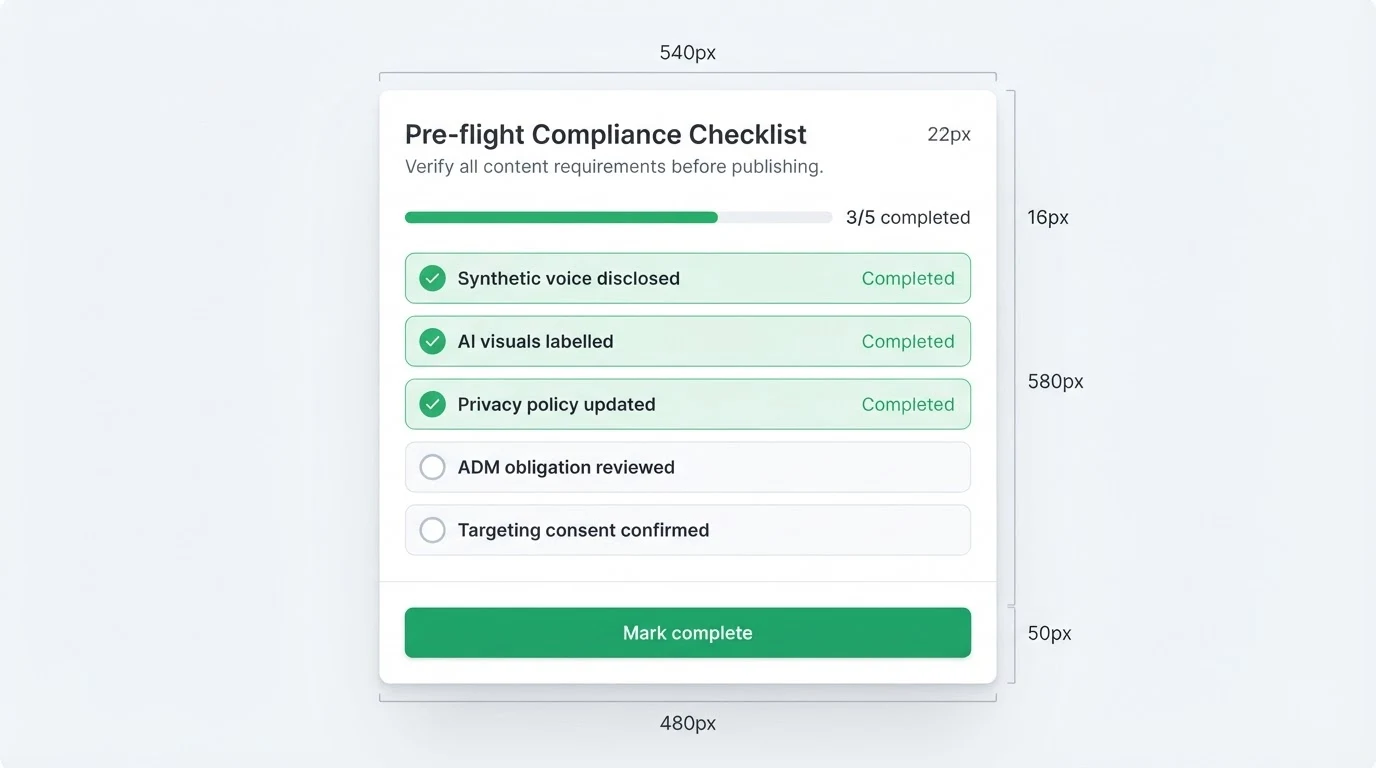
Pre-flight checklist for AI-assisted campaigns
- Identify every AI touch in the pipeline: image generation, voice synthesis, video generation, copywriting, targeting and personalisation.
- For each touch, decide whether it is material to how a consumer perceives the ad. Material equals disclose.
- Draft the on-creative label using the pattern language above, and add it before the asset is trafficked, not as a post-launch patch.
- Update the client's privacy policy with an ADM section if the campaign uses automated personalisation, in time for the 10 December 2026 commencement.
- Retain records of prompts, base models, training data provenance where available, and human review steps. These are what defends a claim if a complaint lands.
- Run a synthetic-voice check on any radio creative from 1 July 2026 and disclose in-read where required.
- Confirm influencer contracts require both #Ad and AI disclosure where relevant, and hold approval rights over the final captioned post.
Penalties and enforcement pathways
The four main enforcement lanes run in parallel. The ACCC investigates ACL breaches and can seek court penalties on the scale noted above. The OAIC investigates Privacy Act breaches, including inadequate ADM disclosure once the December 2026 changes commence. ACMA administers the Commercial Radio Code and can require corrective action for breaches. Ad Standards adjudicates AANA Code complaints and publishes case reports that stay on the public record. Beyond the direct penalties, the brand-safety cost of a public finding, particularly for anyone doing regulated-adjacent work like health, finance, alcohol or gambling, is usually larger than the fine itself.
Frequently Asked Questions
Does an AI-written headline need a disclosure label?
No, provided the claim in the headline is accurate and substantiated. AI-assisted copywriting sits in the same category as any other copywriting under the ACL and the AANA Code. The disclosure trigger is not the tool, it is whether the audience is misled about the source, the endorser, or the truth of the claim.
What about AI-generated stock images with no people in them?
A generic AI-generated background or texture with no depiction of real people, products, or performance claims is generally low risk and rarely triggers a specific disclosure obligation. Best practice is still to label the asset internally and, where the brand's guidelines require it, to note AI generation in the caption for transparency.
Do internal AI tools used by staff need to be disclosed to consumers?
Not directly. Consumer-facing disclosure is triggered when AI shapes what the consumer sees, hears, or is offered. Purely internal use, such as an AI research assistant for a strategist, is a workplace and privacy matter rather than an advertising disclosure one.
Is "Created with AI" enough on its own?
For a fully AI-generated image or video, yes, it is the current baseline. For a synthetic voice or an AI avatar of a real person, be more specific: "Voice generated with AI" or "AI-generated likeness of [name] used with permission." For automated personalisation, the specific ADM entry in the privacy policy is the load-bearing disclosure.
Do these rules apply to overseas brands advertising into Australia?
Yes. The ACL applies to conduct in trade or commerce in Australia regardless of where the entity is based, and the Privacy Act has extraterritorial reach for entities with an Australian link. Overseas brands running paid social into Australian audiences should assume the same disclosure obligations as local advertisers.
How often is this likely to change?
The ADM commencement in December 2026 and the Commercial Radio Code in July 2026 are the fixed dates. Beyond that, expect updated AANA guidance on generative AI, ongoing ACCC action on AI-washing, and platform-level rules that may go further than the law requires.
Australian AI advertising rules are still forming, but the disclosure obligations that already exist are enforceable now. The brands that will look best in 2027 are the ones building disclosure and provenance into their creative process this year, not retrofitting it after a complaint. Absolutely AI works with brands on exactly this: production, labelling and workflow for AI-generated campaigns that stay on the right side of the ACL, the AANA Code and the new 2026 privacy and broadcast rules. If you want a review of how your current campaigns map to these instruments, that is where our AI social content practice starts.